

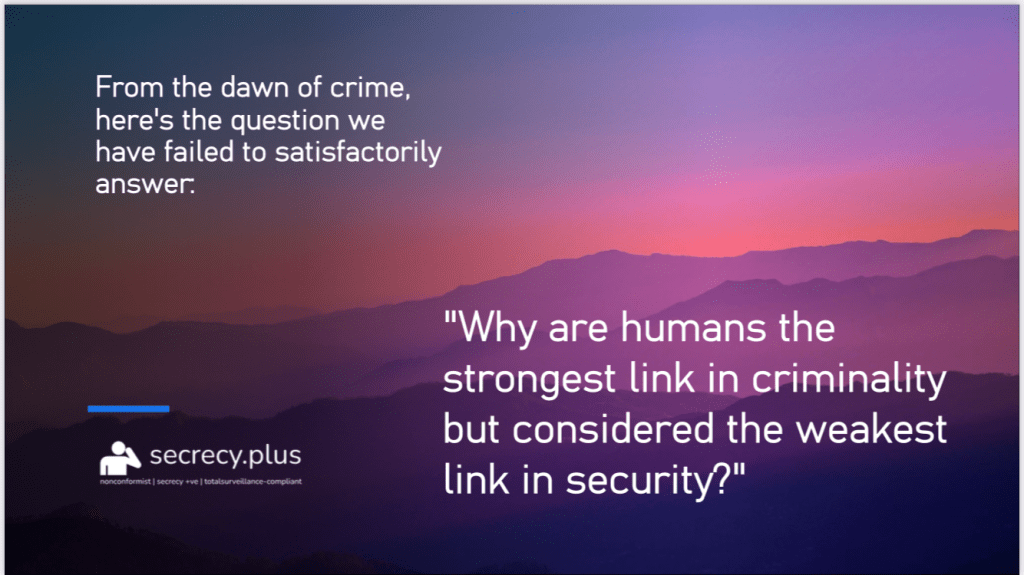
i once wrote the below:


i think i upset a lot of people. i remember a more than hour-long conversation with faceless executives from a big us tech corporation i really value and would love one day to work with.
i say “faceless” neutrally, mind: they had no faces, just circles with initials; and were never introduced to me. six or seven plus the person who organised the video-chat. during lockdown, it was.
i asked them the above question: there was silence for around ten seconds. in the event, no one replied at all. the fear was palpable. the fear that someone would say something which someone else would report back, and forever mark a person’s career, without recourse to explanation.
or so i thought. on reflection, maybe i had gone too far. maybe it was wrong for me to suggest their machines weren’t up to the job of beating creatively criminal terrorists. maybe it was wrong for me to suggest we could do more to creatively crimefight: to make human beings capable of being as nonconformist to the good as the putins et al of recent years have manifestly been longitudinally to the extreme ill.


here’s the thing: maybe i wasn’t wrong but maybe i wasn’t enough right.
obviously, if the exercise was delivered to its full extent, whatever your answer the assembled would inevitably agree that both machines and hollywood scriptwriters (or their analogous: the skillsets of, at least) would be the best solution. but even here problems would exist — and i would go so far as to suggest, actually, real roadblocks.
people who operate by rules and regulations — conformists we all need that make the world function with justice and fairness — don’t find it easy to value the contribution of nonconformists who, more often than not, make their own hugely competent rules. and, then again, of course, vice versa. conformists don’t always float the boats of nonconformists as much as they should.
so to allude to the fact that we need to be as good as the supremely creative criminality out there in our own forging of a singular combination of intuitive arationality with the best machines we can manufacture is NOT the solution.
no.
the solution lies in ensuring the cultures of nonconformism and conformism may come together to facilitate this outcome of creative crimefighting and national security … this … just this … has to be the solution.
if we minimally know our philosophy, a thesis — being that crimefighting and national security need ever more traditional ai to deliver a fearsome capacity to pattern-recognise nonconformist evil out of existence, alongside people who press the operational buttons on the back of such insights — will get, from me, its antithesis: that is … we need just as much, if not more, what we might term the “human good” to battle the “human bad”.
and maybe the machines, too. alongside and in fabulous cahoots.
yes. and maybe, of course, the machines.
but what if we change the process? what if a synthesis? as all good philosophy?
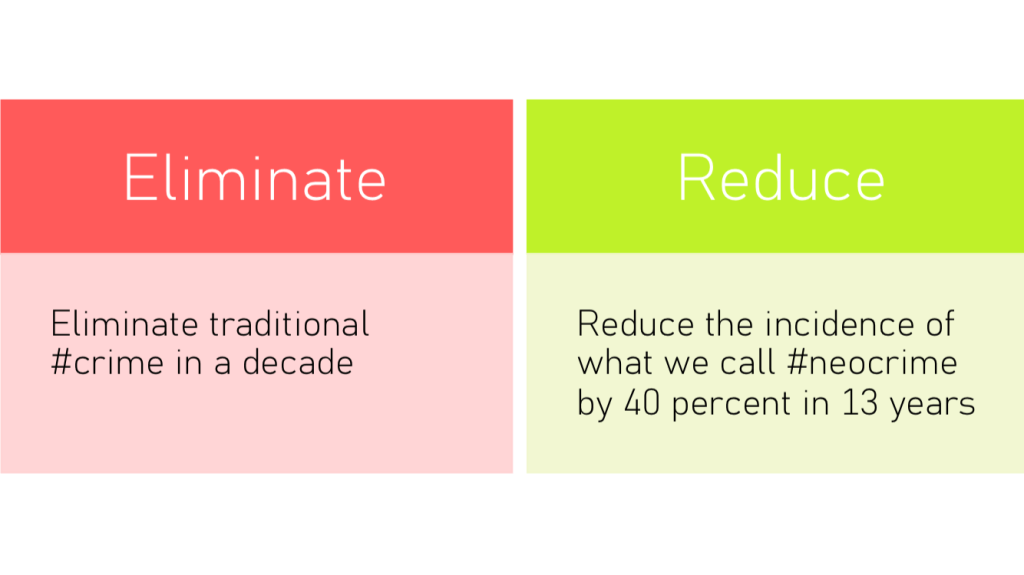
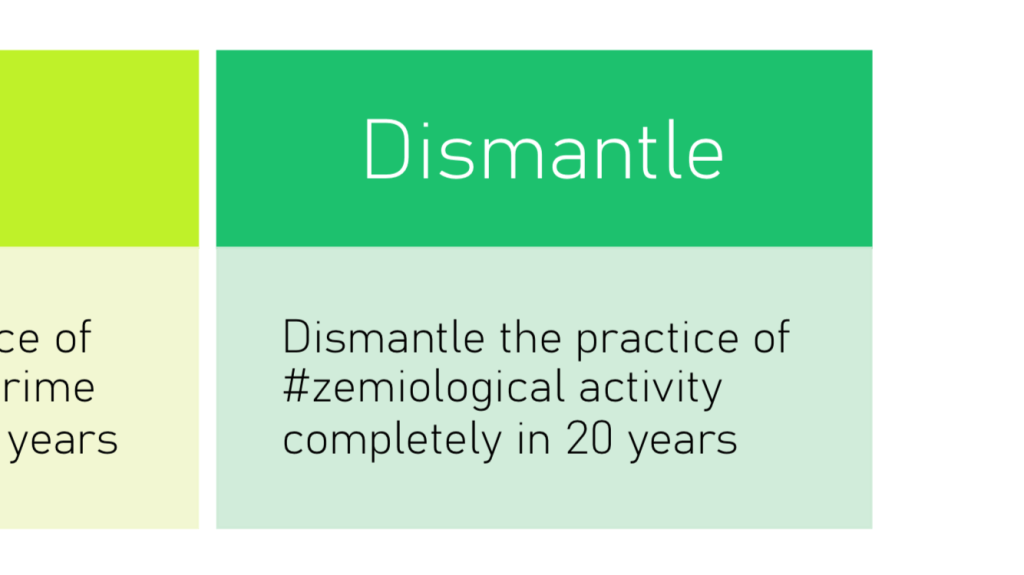
1. to find the nonconformist what and how — the next 9/11 before it arises — we use hollywood and analogous creativity to imagineer such events.
2. and to find the who and when of such newly uncovered neocrimes, we apply the obviously terrifyingly useful pattern-recognition capabilities of the ever more traditional ai. so that their adepts, their supporters, their proponents … and those conformists who more generally are comfortable with such approaches … well … simply be comfortable with this new paradigm i propose.
in this scenario, the suits and the flowery shirts work in consonance but never simultaneously. and so we square the circle of respect amongst the two parties, which long-term would always be difficult to sustainably engineer and forge permanently.
wdyt?





 mil's page