on celebrating viking life … maybe?

i met with an interesting #swedish man for the second time in as many weeks yesterday lunchtime. he told me an interesting story about the #vikings.

he said they’d started out as farmers. aware of the turn of the seasons and good husbandry of the land (if husbandry is a thing we still say these days).

and then there comes a time in the life of every grouping to decide whether to expand or contract. rarely, it seems, does the option exist historically for a sustainable #circulareconomy-style of maintaining oneself in simply a “steady as she goes” way: neither excessive growth nor dispiriting decline.

the #vikings went both #west and #east. i think this is what my #swedish friend indicated. for sure what he said was that the ones who went left, kinda, went across the sea. they became just about rightly known for the violent behaviours, their rape and pillage, and just about anything that an unbound soldiering will commit.

the ones who went kinda right, meanwhile, ended up quite differently. no seas for them; rivers instead. and instead of soldiers of destruction and fear, they became traders of exchange and cooperation.

the difference? why, i mean? my #swedish friend explained as follows: when you travel upstream or downstream on something like a river, eventually, some day, you have to return exactly the way you came. and this means your reputation matters: what you did to people — or, at least, what they perceived you did — will define the nature of the welcome you may get as you return downstream or up.

this environmental reality — not in the sense of ecology and sustainability (though, then again, maybe yes!) but instead in the sense of HABITAT — inevitably served to condition the #vikings who travelled via rivers compared to those who had chosen to ride the waves.

when you know you need to meet again, quite often you will keep something of your capacity to hate — or alternatively, equally, your capacity for the deepest love — quite to yourself.

it reminds me of something the british prime minister gordon brown once observed, i think in a book he wrote and i bought, on matters of independence. being a scot himself, he knew more than most in my homeland of such questions. and more than most, even today. (tbh, i wish i had met mr brown and then had occasions, from that point on, to exchange views from time to time: for me, he should’ve been the most erudite philosopher of the best philosophy school the uk might have cared to produce, if the study of philosophy hadn’t been summarily marshalled out of the british education system, precisely by people who knew its value and dangers … not by those who were unaware.) (i hope, as i say this, not mr brown, himself!)

so. anyways. to the topic of today’s post.

being what mr brown once made absolutely clear: the world, the world that rightfully we want to forge and rebuild, should never contemplate dependence as a sociopolitical advantage or path; should rarely support independence and know quite clearly why before proceeding; and should almost always promote and deliver only INTERdependence.

being, that is, what came out of the travels of the #vikings who kinda went right, NOT left, in my #swedish friend’s fabulously engaging narrative on the powers of space and the geographies of where we may exist.

interdependence: yes. this is a lovely word. and mr brown was right. and the #vikings who kinda went right, too.

much more what humans are: much more what we both want and NEED to want to be.

and so this for me defines the whole idiocy of #brexit: for in this narrative, the #europeanunion all this time, to more or less effective degree, but resiliently in the end, and robustly to this day, has stood for interdependence. that is, the #vikings of trade not pillage. whilst the #uk chose to use as a facile excuse its condition of island race to justify its isolationist instincts: that is, the #vikings of pillage, not trade.

in democracy, #gooddemocracy, everything needs tweaking all the time. if we don’t, it’s not purposeful: it’s no longer in possession of its true purpose. barter, exchange, dialogue, listening, responding, rethinking, understanding, and apologising … these are all qualities and virtues a #gooddemocracy exhibits. and where, as in the #uk for many years now, we see little of these … well, the word “good” obviously no longer applies.

and perhaps today, especially these days, we find that the term #democracy in the otherwise beautiful #unitedkingdom is firmly visible through its profound and wicked absence.

so.

then.

admire what it is to be a #viking, always? maybe so, yes. maybe after all.

one caveat, mind, before i finish.

as i don’t know the source of this story — i mean the book the #swedish man referred me to on his explaining the anecdote under discussion — i don’t know if the authority in question tells a historical truth or not. and even if it does, to what ideological end: you never know, do you?

but choose the path of trader … no? surely this can’t be bad in itself.

from ww2 to the eec to the eu of now is quite a journey.

soldier … trader … human be …?

yes.

whomsoever the authority, this works for me.

thank you mr brown.

and thank you, jaan.
why sweden is the most individualistic society i have had the pleasure to encounter, ever … and then, how this is the best way forwards you could imagine

a couple of days ago i was in a human-friendly cafe in a department store here in #stockholm which i love so much.

not the one in the video above, i hasten to add — but the feelings i regularly extract joyously from it are exactly similar …

🙂


it’s a cafe which is human-friendly for several reasons: firstly, the working-conditions which the staff may work to their best in; secondly, the overall atmosphere and decor which are both, without being shouty about it, firmly diversity-welcoming; and then thirdly, the food itself … the salads it sells are magnificent paeons to well-priced and healthy existences.

ok. so.

this post is actually not about the above. not really. it’s more about the #swedish character: the right to allow someone to learn by making mistakes.

and sometimes the “someone” in question doesn’t; and especially if they are not steeped in this deep #swedish tradition of profound reflection: a tradition some — especially from the us, uk, and similar — confuse foolishly with an inability to take decisions in a timely fashion.


in the uk, we usually say no decision is worse than a decision taken poorly. but what we in the uk forget to remind ourselves (oh, and i say “we” so i sound less combative, didn’t you know?) is that to resist even the poor decision because one’s finely attuned #intuition knows that the gold of the matter — any matter! — is still out there waiting to complete a full picture is, in itself, surely, to sometimes involve taking the best decisions history will be able to witness.

so in countries like the uk and the us, when we have ENOUGH data is WHEN we decide.

which is why so often — in respect of nation-building at least (what provoked this post in part), but perhaps civil engineering as just one example, as well as other complex processes in a multitude of sectors, too — enough actually is clearly not enough in historical hindsight.


it may also be a thing of a certain kind of social sensibility. and whilst this is for another post, i do think yes it could very well be. the good right is often patient out of calculation, despite all intentions. the good left perhaps, more resiliently (for my universe), acts out of true compassion.

either way, to know when enough is NOT enough is what the #swedish people, alongside a wider #sweden of institutions and organisations and ways of doing things so particularly, really does manage to deliver on quite superlatively when acting out of its very best instincts.

and so — finally! — to the anecdote: the human-friendly cafe. i saw a mother or carer, a toddler in high chair, and a joyful young girl of perhaps about five or six at a large round table near where i was sat. on the large tables in this restaurant they put red hearts on a sign which gently requests that only parties the size of the table sit there. the community instinct, i think they say (my #swedish still isn’t where it should be), so everyone can sit down who wants to. a jaundiced british eye would say: “footfall, above all …” (but then again, maybe the jaundiced one is me …)

anyways.

one of the hearts on another big round table next to this party of three was in the shape of an ace of spades: the sign had been placed upside down.

i watched from a distance: the young #swedish girl clocked the difference, checked back at her own table, and realised (i sense) what had happened. but then she did something which for me was initially strange — but which, in retrospect, was UTTERLY #swedish: she said nothing to her mother/carer; neither did she choose to change the ace of spades back to a heart; but instead, manifestly, kept the information for herself.

and maybe on another occasion, too, she’d mention it to someone. but at that moment, she chose to reflect further, as the individual she was and saw herself to be.

and this is what the rest of us forget about #sweden when our right trots out its tropes over and over as it does: the #swedish sense of community — even today — is built profoundly on the individual, NOT on a culture of smothering: the individual, that is, as the inviolable building-block of their sense of society.

and sometime this sense is more or less militaristic. but always it is founded on the deepest of respect for the right of each person to go so far as to make a fool of themselves — and then, fabulously, be fully supported into learning how not to in some better future.

above all this: support for the integrity and reality of the inviolable shape of the individual.

this for me is #sweden. and this is how i would like other countries and cultures to see the best of what #sweden still gifts to the world. why? because i would like the rest of us to learn that there is a way forwards; a profoundly good one for us all. not exactly the same way: but as music, reinterpreting itself continuously.


it doesn’t necessarily involve dominating the enemy either, whomsoever our history at any time demands we must thus define it.

no.

not this.

but it does mean that the “enemy” must learn, finally for themselves, as the little girl who clearly is no one’s enemy is now doing every beautiful learning moment of her life, that nothing is irrational; that there is a reason for everything; and that if we think long enough, we will uncover the truth — NEVER post-modern nor relativistic, any more, for sure … — to absolutely all the pain and joy and intelligence and art and science and education and law and medicine and passion and poetry and good faith we just have to yearn for in our both shared and assertively collective future-presents … based, always, as i now demand myself they be, firmly and forever i mean, on the rights and integrities of the individuals we all are: OUR building-blocks.

just this.

ourselves …

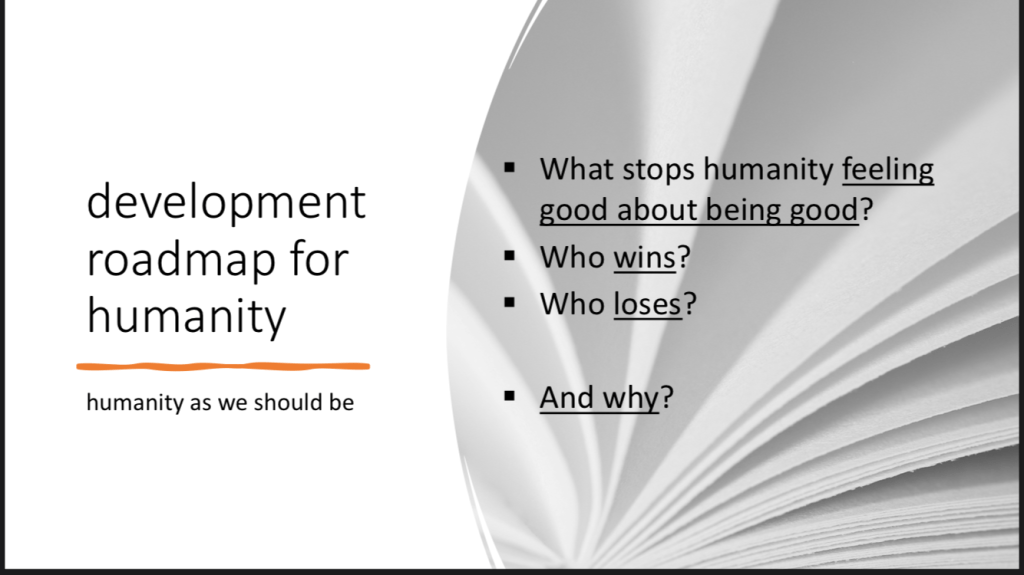
Why is it so hard for good people to stay good?

It’s clear that #criminaljustice isn’t working. The fact of #putin’s #russia and its invasion of #ukraine — just one example of how malevolent experts in #loopholes are able to act in the very worst of bad faith — absolutely demonstrates that #criminaljustice manifestly can’t pursue and being to book the most serious #societalharm before it harms in the most serious ways.


Because #ukraine didn’t start the year of the invasion. It started a long time ago when the #kgb man #putin has always been firmly decided that any vestiges of #european hopes that a joint way forwards which might have been found between one side of the ex-#ironcurtain and the other needed to be longitudinally strategised out of existence forever. But also stealthily so: you don’t tell the enemy there’s a knife getting ready to be twisted deeply right in their back.

And so #ukraine was also enabled long-term by the richest centres of power on the planet: transnational corporations which had implemented the original way-back-when command & control #sovieteconomics — top-heavy and hyper-integrated economic structures — which in the age of supercomputers and their capacity to number-crunch in ways the #soviets never even dreamed possible made it possible for these companies to calendarise entire societies over periods as long as decades, never mind the crusty Lada-ridden 1984-style five-year plans.

What exactly am I getting at here?

Some of these corporations have more power than ANY country. Maybe not in the sense of the country GDP versus corporate revenue numbers themselves: but definitely in the almost authoritarian capability they have to make rapid decisions about billions of whatevers; and when I judge rapid I mean virtually from one day to the next.

And, therefore, in this sense in much more immediately impactful ways than any mere democracy will ever be able to engineer.

So this is power: and if knowing you have it you do choose to act, and you prevent #ukraines with your perspicacious even where secretive research data — even if only for bottom-line reasons, forget for the moment the rag-doll babies lying in pools of red at the end of a parent’s counterpane — it’s a massive power indeed exerted for the wider good.

But if conversely you don’t act; if you limit yourself to the role of spectator; if you trim and tack your humongous dinghy so any possibility of encroaching waves remains distant to your ship of shareholder stock … then effectively, when all those immense command & control buttons of the brightest are simply NOT being pressed, you actually are proactively enabling the #putins of the world.

Why is so hard for good people to do good? Really … why?

Well. There’s a thing, for sure.

I read a George Monbiot article in the Guardian a long while ago: it described a survey which said that most of us think most of us are bad people but, equally, most of us simultaneously see ourselves as good people.

Curious, huh?

Some weird disconnect, there.

For me it’s a question of access: the potential whistleblower needs to know their digital notes won’t be read by #badtech people (as mine almost certainly were on the metro this evening); equally, the #abusedspouse must know not only that her husband’s #mafia-behaving business colleague won’t be able to touch a friendly police office for a favour that needs to be called in, but that when it ends up in court and the husband’s word against hers, some kind of fair #tech platform for validating such assertions will also have been invented in the first place, so the pillar of the community he is won’t be able to sway the jury with his mere presence.

This is mostly why I want The Philosopher Space: so people – ALL of us, citizens and professionals, both — can recover our right to the secrecy of pencil and paper but with the 21st century advantages of digital.


That is, when we’re obliged to use digital, we aren’t forced by the system to strip ourselves naked in front of the #tech experts — as I might accurately observe, 70 percent men — who NEVER themselves have to perform the same humiliating acts of self-discovery.

spt-it.com | www.secrecy.plus/spt-it

WHY be so secretive about #freethinking on rockets?

What if the real reason the #elonmusks of our time are forcing #humans back into physical workplaces is because they know if it doesn’t happen more widely, then their long-existent, highly prized, and presumably immensely costly #secrecypositive thinking-spaces, based in such physical locations, will begin to lose their advantages over what was once a mostly blindsided European tech and socioeconomic sector?

Mil Williams, 9th July 2023, Stockholm Sweden

Background

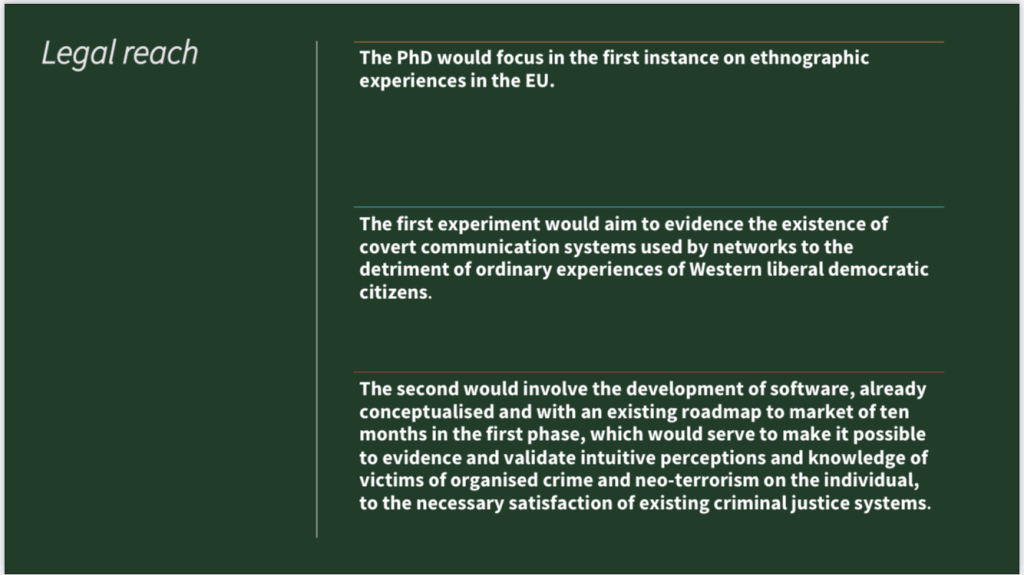
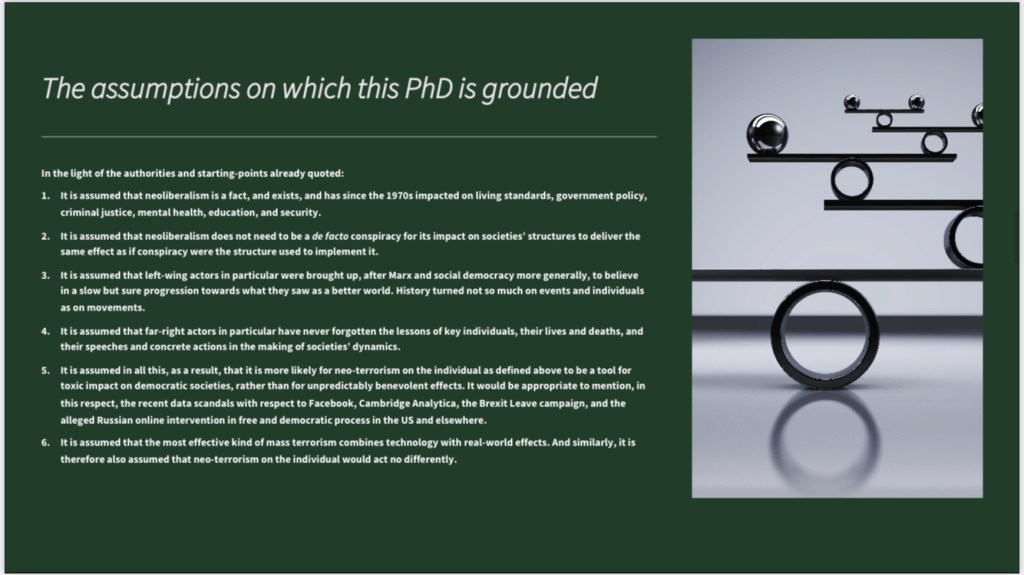
From the slides included below today:

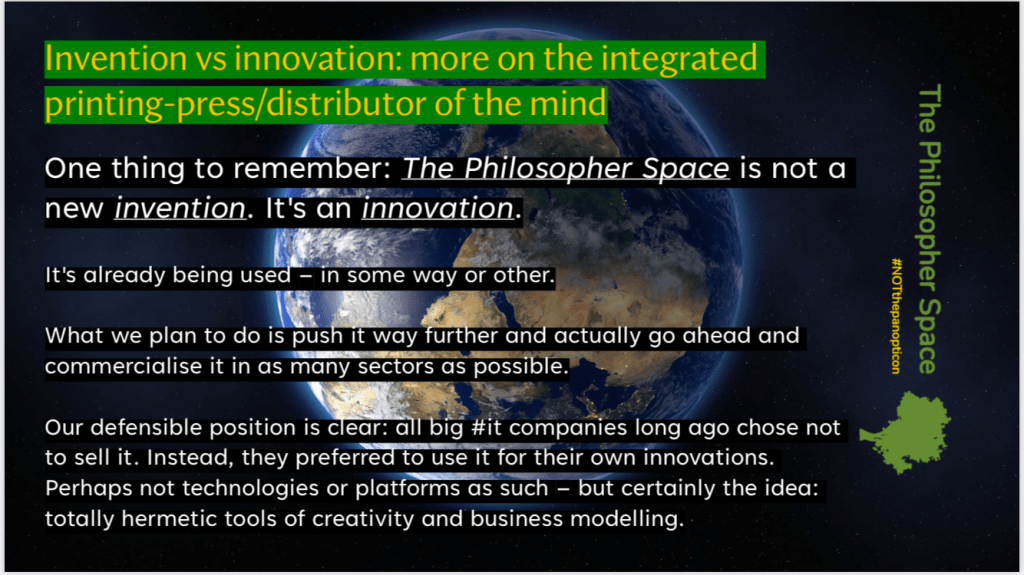
“Our defensible position is clear: all big #it companies long ago chose not to sell it. Instead, they preferred to use it for their own innovations. Perhaps not technologies or platforms as such – but certainly the idea: totally hermetic tools of creativity and business modelling.”

The full slide-deck can be found by downloading from the link that follows:

The Philosopher Space | #NOTthepanopticon slide-deck

The Philosopher Space | the full online whitepaper


But not only that: #espionage, #nationbuilding, interfering with due #democratic process … and #cultural/#industrial #intellectualproperty/#ip, and its broader tracking.

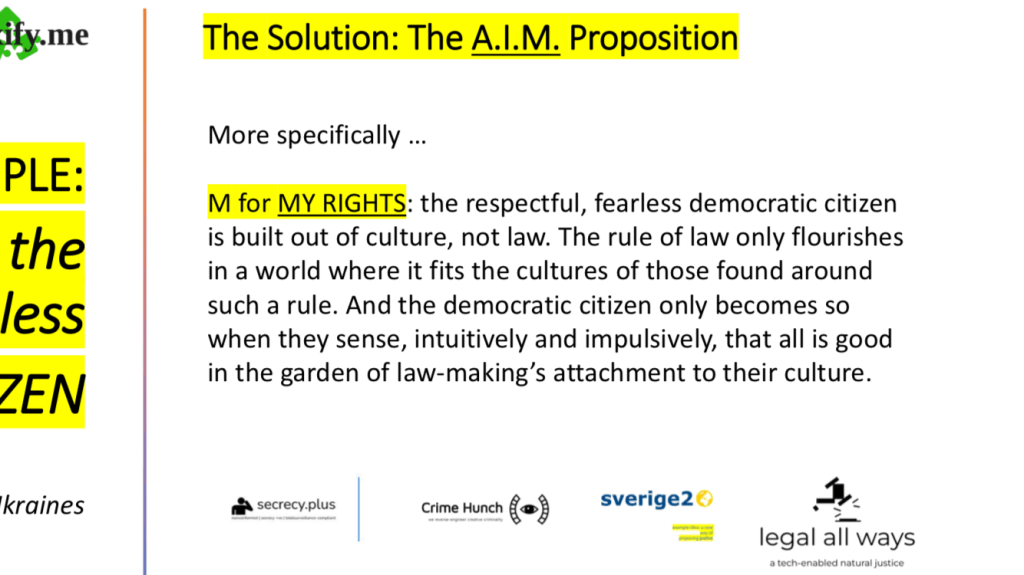
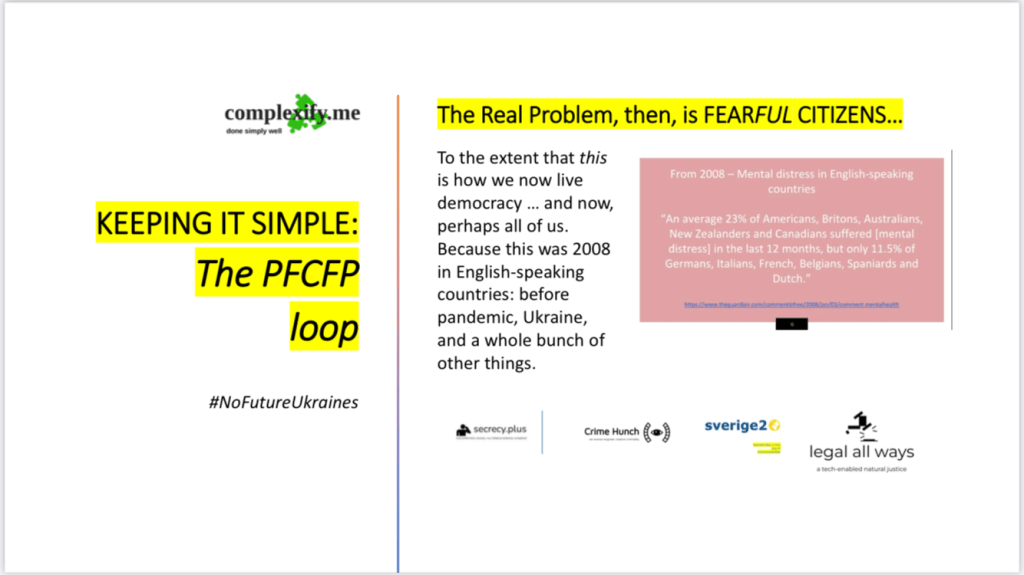
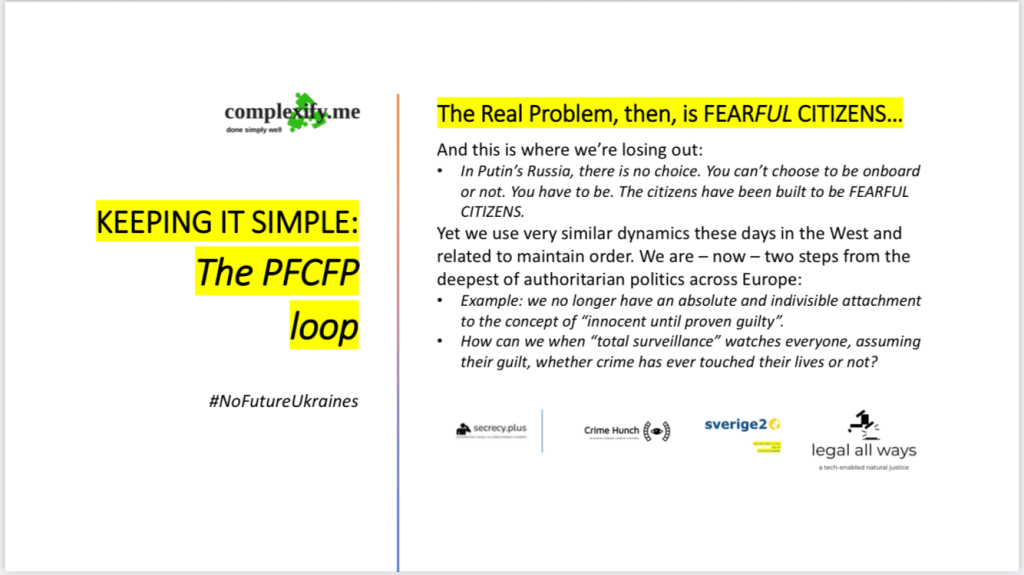
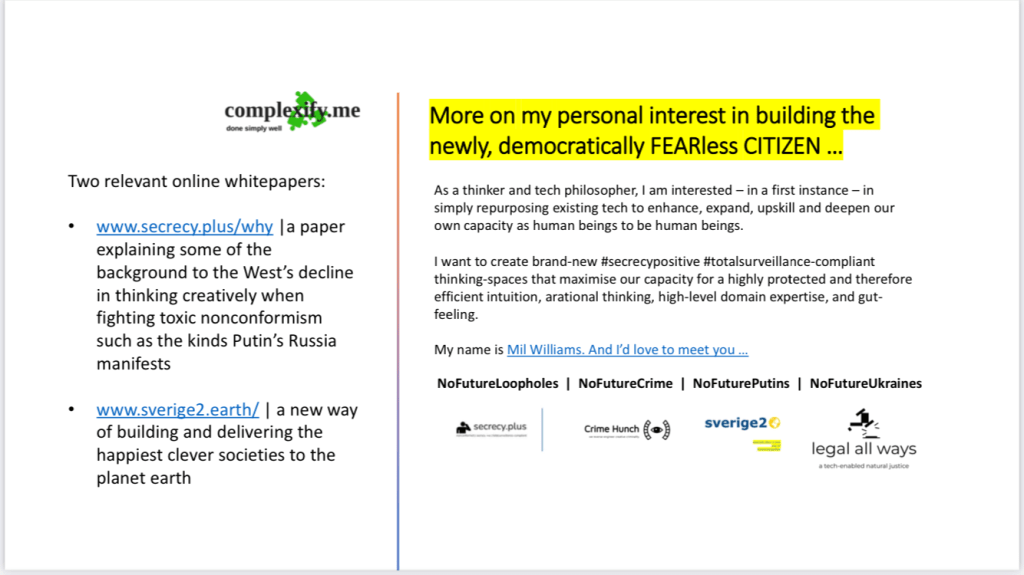
Yes. The final image above says “With A Little Help From My Friends” …

And actually, really rather a lot. Because I do have them, too. Though some spread the half-truth it ain’t so.

Why this post today

However, I’m not posting again about this brief and perhaps not overwhelming slide-deck to repeat myself. No.

It’s because I had an insight yesterday evening, late. I’ve been reading surveys from PwC and others — really cool surveys which shape narratives and edit reality interestingly, well and deliberatedly — which talk of how #innovation amongst the less advantaged has increased. And then again, more generally, how #innovation in digitally connected and aware organisations is increasing leaps and bounds over the olde-worlde office-bound competition.

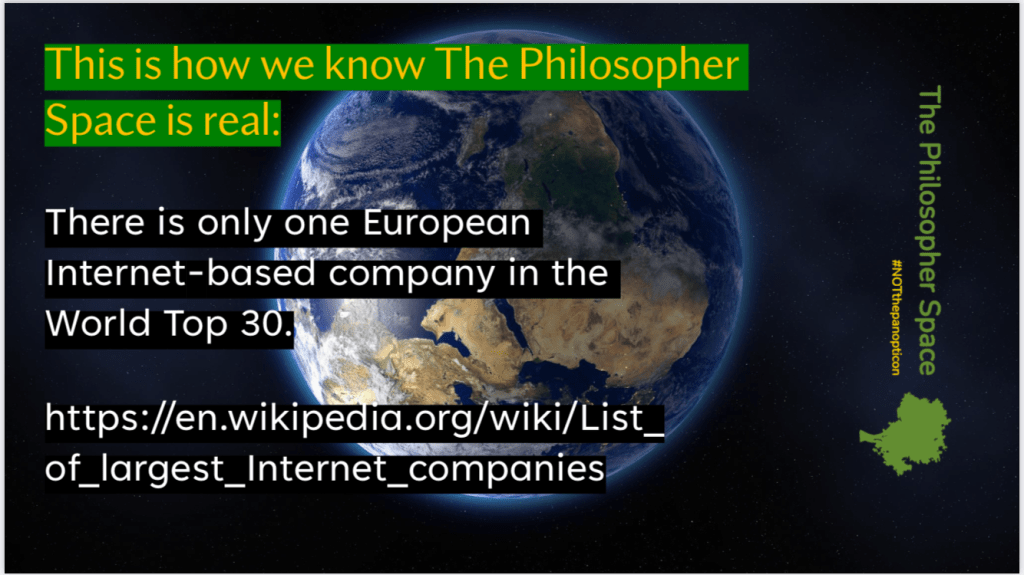
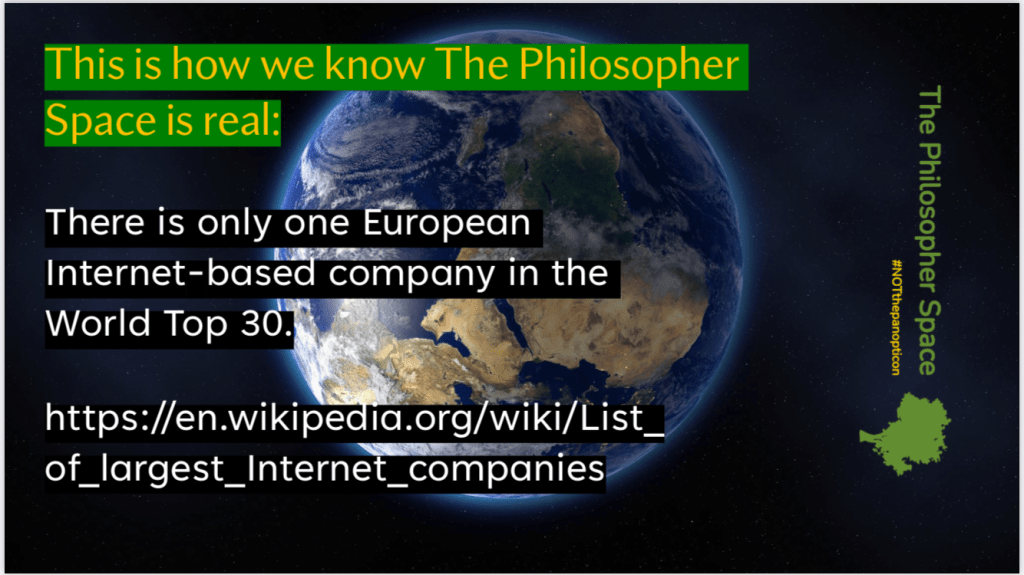
I wonder something else, in the light of my slide-deck’s thesis: what if for the first time — post-pandemic times, I mean — everyone is innovating? Not just the companies of #techbarons which own already, use habitually, and restrict the distribution fiercely of #privacypositive and #secrecypositive thinking-spaces. The spaces that mean 29 out of the top 30 Internet companies aren’t European:


No.

In this sense, partly so, with hybrid and working-from-home workflows, it’s become easier to hack into a part of the system but also — maybe even more — harder for intrusive #bigtech to establish the overall narrative arc of a potential new competitor, in respect of an equally potential #innovation — or even #invention! — in the throes of. Like the difference between traditional warfare versus guerrilla, perhaps?

The real reason #techbarons want their workforces back behind THEIR closed doors

What if the real reason the #elonmusks of our time are forcing #humans back into physical workplaces is because they know if it doesn’t happen more widely, then their long-existent, highly prized, and presumably immensely costly #secrecypositive thinking-spaces, based in such physical locations, will begin to lose their advantages over what was once mostly blindsided European tech and socioeconomic sectors?

What do I mean?

In the face of the #totalsurveillance #panopticon used by aggressive corporates — particularly #bigtech corporates — against anyone they decided was a threat, there was little the rest of the world — without a shield of some sort, I am saying — could do to protect its ideas. Or even develop them half usefully before they were gouged into non-existence.

But maybe, just maybe, that competitive advantage began to fizzle during pandemic. With everyone outside #secrecypositive and/or #secrecy-obsessed HQs, and the world all operating from home, two consequences emerged:

1. Everyone worldwide was in just about the same conditions, as far as the visibility of #innovation and #invention was concerned.

2. Suddenly a new openness — a confidence that it was OK to be nonconformists in front of colleagues — began to arise. We communicate via Zoom, in pyjamas, wild cats running across desks, children bursting in unexpectedly … and business, serious starched white-collar business, is suddenly exposed to real human life. In business contexts. And what’s more, it works.

Of course, collaterally, we’d gain equal confidence to THINK as WE TRULY HAVE BEEN THINKING all these years! Only they never let us shine … hardly once.

Should we then forget about our own #secrecypositive thinking-spaces?

Am I suggesting that there’s no need for #privacypositive and #secrecypositive thinking-spaces of our own?

No. I’m not.

Even whilst we are more dispersed and yet creatively so at the moment, and even as this makes the overall shape of a competitor’s #innovation more difficult to sense as well, sooner or later they will work out a way. But in the meantime, they need US all back in OUR offices and locatable, just as much as they need THEIR workforces back in THEIR offices, and once more hideable.

In truth, isn’t it the case that hybrid and working-from-home workplaces are to the #secrecy-obsessed #techbarons what #opensource at its most competent most competently was to closed source? A breath of collaborative and hyper-creative air in often challenging and anti-creative hyper-competitive environments.

Our challenge now

The question is: do we now have the balls to deliver for our humanity what #techbarons multiple have only ever cared to deliver for themselves?

And perhaps not even fully for their shareholders … not even this!

After all, the species is burning the planet, #bigtech has kept to itself this #freethinking on steroids I discuss in this post (and other places, too) for all these years … and all they’ve been able to use it for instead is making money out of a pandemic and putin’s three wars. As well some untold number of other human tragedies …

I’d guess since #totalsurveillance itself was implemented: 2003, says anyone?

Because NO ONE in the history of warfare has ever invented a sword without developing it’s related shield. So whilst the digital #panopticon was applied for reasons we all understood clearly in their day, #bigtech has sold global humanity short ever since.

How? I’d surmise by developing the aforementioned #freethinking on rockets — but for purely selfish gain.

In summary

Shouldn’t we all now REALLY feel cheated by the #techbarons of the world who act like this?

Actually, I think we should. Look. Give us all a break, guys. The planet needs us to be all at the top of our games much much more than rockets to Mars ever will.

How about we collaborate instead?

Ever heard of a philosopher kind of a guy called John Forbes Nash Jr?


On future-proofing #ai

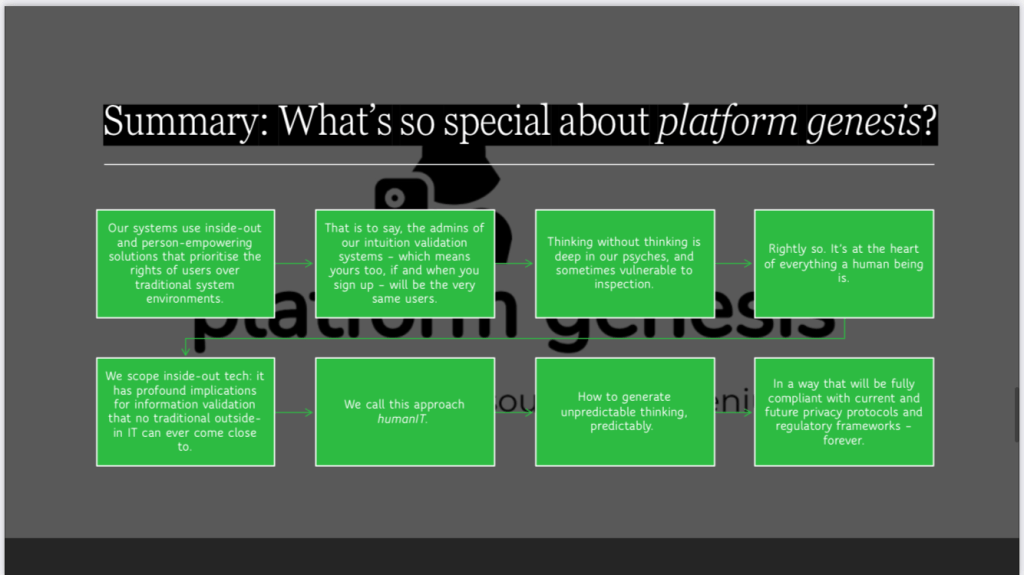
In a nutshell — or a chipset! — what I propose we do asap is move radically away from the more recent division of power and hierarchies between admins versus users that has shaped #ai and #it ever since the arrival of the Internet, towards the suggested conflation of admin and user in one.

Mil Williams, 3rd July 2023, Stockholm Sweden

Proposal

Would anyone in #scandinavia, more specifically I’d be bound to say #sweden, like to begin work on designing and implementing, from scratch, a totally repurposed set of #ai- and #it-related architectures and frameworks in order to create absolutely future-proof ethical and privacy-positive #ai and #it frameworks?

That is: do for #ai what I have already suggested via the concept of a digital equivalent of the #privacypositive and #secrecypositive attributes pencil and paper have for centuries conferred on us:

https://www.secrecy.plus/spt-it


The original “intuition validation engine” README on GitHub

In this case, in respect of #ai- and #it-#tech, I would suggest using a starting-point I already clearly described with the original 2019 specification of the #intuitionvalidationengine (i’ve) (currently on my GitHub account in private mode, and reproduced in full below):

intuition-validation-engine

The goal of this engine is to permit both human and machine intuition to be validated.

This will be done constantly, but not intrusively. People and machines will have a choice, always.

It is assumed that for the purposes of this project both parties will be encouraged to upskill the other in mutual dialogue and equal partnership.

It is also assumed, a priori, that the keywords for the processes involved will be:

1. A procedure of CAPTURE, controlled by humans on the one hand and machines on the other, where neither will be obliged to share ideas, content and personal data that they do not feel safe sharing.

2. A procedure of EVIDENCING, where the captured data can be stored, retrieved, shaped and patterned, and used for supportive purposes that expand the lives and experiences of the beings concerned.

3. A procedure of VALIDATION, where it becomes clear to everyone participating: a) why a human being might believe and act in a certain way; and equally so, b) why the machines that prefer to work within the framework of this project will arrive at their own particular positions and conclusions.

Finally, it is hugely important that everyone who chooses to work on the project might easily understand that it is not a traditional software paradigm: let us assume, instead, that people, code, machines and all other objects participating will form part of a new space we might call “i’ve”.

That is to say, there will be no distinction or hierarchy in this space between the individuality of the objects in question, with respect to their entity as sovereign actors. In this sense, all will enjoy becoming part of a multiple-perspective environment, and all will help to support and contribute to a wider and transcendental knowledge that both befits and benefits others.”

https://ive.home.blog


So.

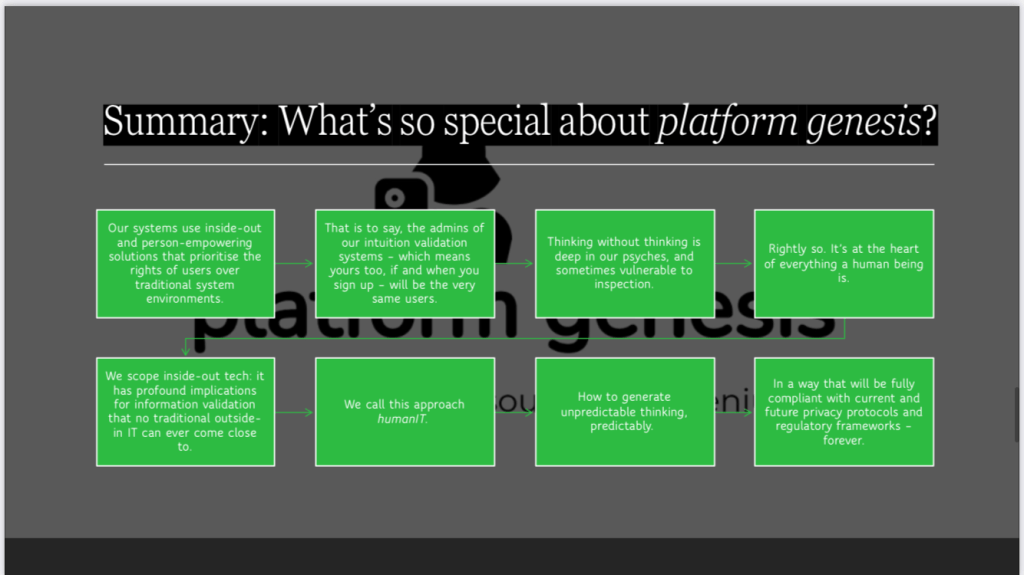
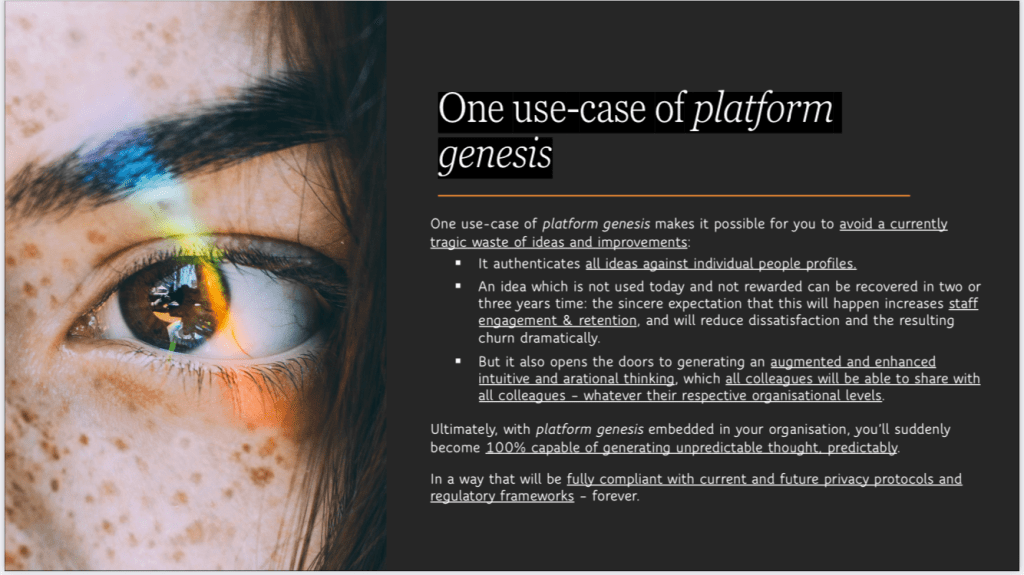
Alongside the clearly developed initial architectural philosophy stated above, i would then have us move on to working with the #platformgenesis progression of the original concept as it existed since 2019:

https://platformgenesis.com | see also the attached slides


Then, with further collaborative actions, especially in the light of other technologies developed since, we could begin to properly propose an absolutely future-proofed #ai and #it-#tech which, as per their real-world template of pencil and paper, could never NOT become privacy- and ethically-sensitive, whatever the regulatory demands created in the future by any global or regional body.

This would be my objective from two directions: legal and technological; abandoning neither for the other. And making both future #ai and #it-#tech as firmly #ethical and #privacypositive by design as to make regulatory innovations that might challenge it impossible to design.

To summarise

In a nutshell — or a chipset! — what I propose we do asap is move radically away from the more recent division of power and hierarchies between admins versus users that has shaped #ai and #it ever since the arrival of the Internet, towards the suggested conflation of admin and user in one.

The division described has, in my judgement, severely — and increasingly — affected the citizens and workforces who strive to function and live creatively, despite the challenges, in Western corporates and wider societies when needing to think freely. These needs arise in many — if not all — fields of endeavour too, and in most during mission-critical moments and when decisions have to be taken using an unpickable #highleveldomainexpertise (something we sometimes are also happy to call #gutfeeling) which becomes the only thing we may be able to reliably depend on.

The real existential challenge for our democracies and business discourses and praxis then arises when we fail to think as freely as others who, with a clear and ongoing possession and enjoyment of #privacysensitive and #secrecysensitive architectures and technologies, maintain their capacity to beat us hands-down, at least on the #intuition side of societal and business activities:

https://crimehunch.com/terror | concentrate here on considering which team would be best at a new “what and how” (I’m happy, meanwhile, to recognise that pattern-recognition capabilities in machines will inevitably process vast amounts of data better when focussing on more concrete questions of “who and when”)

https://www.secrecy.plus/why

https://omiwan.com/the-foundations


Finally …

If you want to find out more about my latest ideas, why not go to the #sweden located and focussed online whitepaper I’ve been using to further my thought around complementary strands of complex thinking?

https://www.sverige2.earth

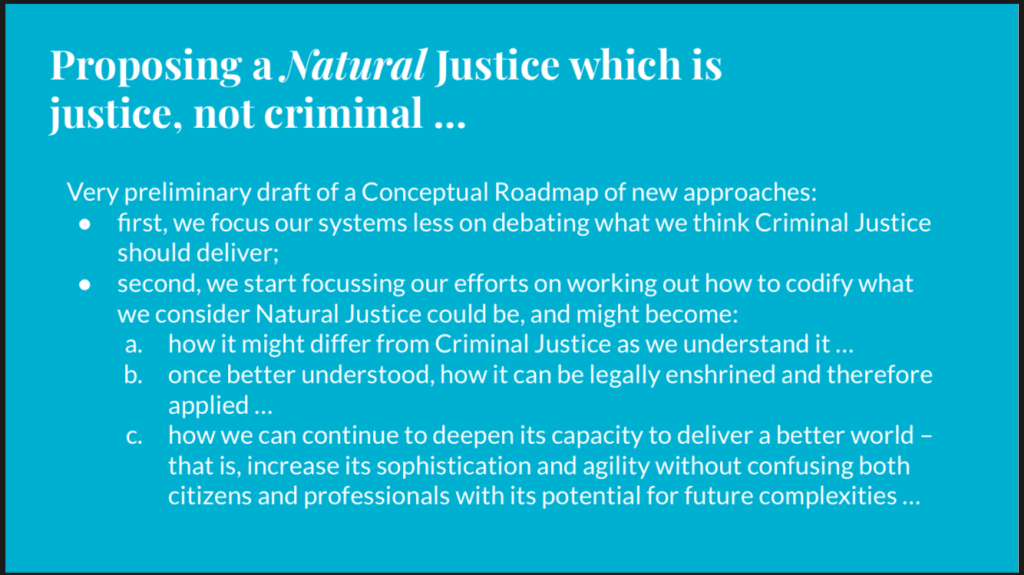
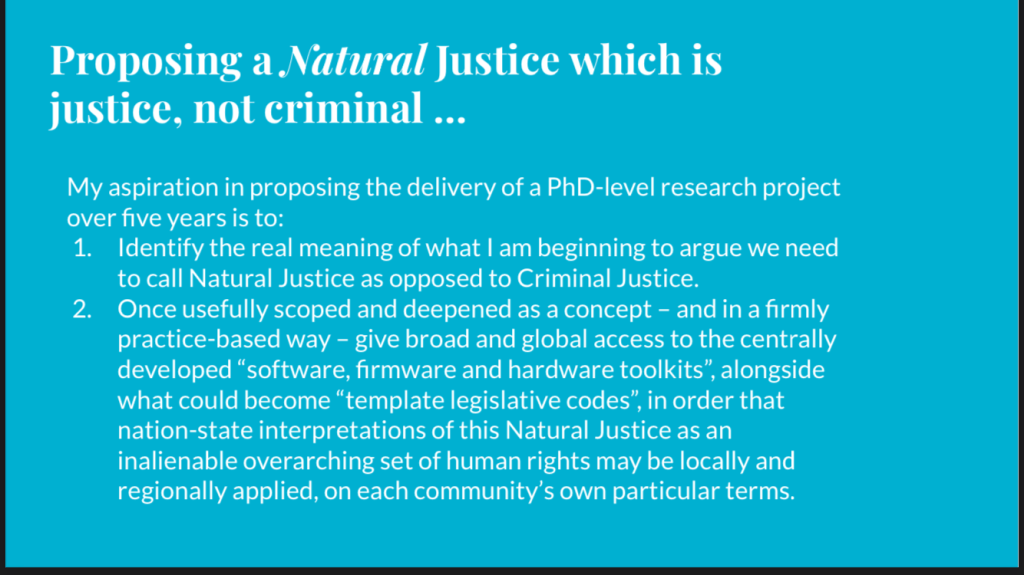
The Last Mile of Creative Criminality: the Key to #NoFutureUkraines

OUR end-to-end thinking. The creative crimefighting we now need: bringing together the complementary and existent interests and skills of military, security and law-enforcement into one macro-team of defenders of the species.

Mil Williams, 2nd July 2023, Stockholm Sweden

On eliminating the Petri dish of Putin & Co’s creatively criminal strategies towards a European and wider longitudinal dislocation

Introduction

This is the current law-enforcement, security and military situation as I see it:

1. Organised crime funds Putin & Co’s Russia by embedding itself in local communities across Europe and other regions: it’s effectively the last mile of creative criminality:

https://amp.theguardian.com/uk-news/2018/nov/22/uk-organised-crime-can-police-catch-up-national-crime-agency-lynne-owens

https://crimehunch.com/neocrime

https://omiwan.com/the-humans


2. Organised crime is then the deep connector of glocal (global <-> local) reach. It makes it possible for top-down and bottom-up approaches to moving illegal money around and in respect of its generation, capture, and delivery to easily acquire an almost impossible to unpick synthesis of seamless functioning.

3. It also allows Putin & Co to longitudinally gather data — on local turfs and from great distances — on trends, movements and rising individuals in democratic systems that might all prove threats to the established order he and his kind continue to strategise in order to achieve and sustain.


This is why I argue that in order to develop a capacity to prevent another #ukraine from ever being contemplated, never mind delivered on, we need to create human-enhancing technologies that empower good human beings like ourselves to fight back with a “War & Peace (II)” approach:


That is to say, for a change our kind of war on our sort of terms: but even so, permanent and ongoing; and then again, our kind of peace on our sort of terms: and even so, permanent and ongoing.

What will the process leading to these preferred outcomes consist of?

1. Identifying sources of power and wealth which to date could have contributed to #ukraine not happening and which, nevertheless, have chosen either a) to effectively sit on the sidelines and watch the region burn; or b) have proactively consented to and created the environments and frameworks which have led directly to #ukraine: nation-states; large transnational corporations and others with huge reserves of cash and wealth of various kinds; zemiological actors of multiple kinds.

2. With this information to hand, we robustly and firmly ringfence these actors future participation in:

a) our own future human-interfacing and enabling tech tools and platforms; and

b) the strategic and longitudinal reconstruction of a wider Western democracy.

I suggest, above all, that as a general principle we do NOT use the often self-interested advisory and consulting processes of tech and related corporate organisations when scoping, developing and configuring the natures of the architectures of our proposed new software and hardware architectures and frameworks.

Instead, from our own university and other research institutions we build up teams of our own consulting and advisory specialists consisting of human-related and tech-related researchers both — as well as others who may be chosen to be upskilled in such skillsets, in the collective democratic future-present we wish to forge anew — in order to create a permanent future-present capability in such processes.

The proposal would then employ big tech and related SIMPLY AND ONLY as implementers of, never participants in, our secret sauces.

After all, you cannot invite into the kitchen of future Western stability those organisations which have actively collaborated in the poisoning of Western democratic ways of acting and engaging with complex problems — either by default and their sitting on the sidelines, or through an affirmation on their part of criminal activity by their working alongside and continuing to gladly invoice such organisations in full knowledge of their ongoing zemiology:

http://complexify.me


We can however, I now firmly believe, use such corporations as simple extensions of fully formed projects which reach them with absolutely all the necessary specifications and requirements ready drawn-up by the aforementioned bespoke teams of OUR own researchers and in-house advisory & consulting experts.

To summarise

If we follow the above path, in this way:

a) we won’t lose the agility of large corporates’ manifest capability to deliver massively on clear specifications when everything is duly finalised and competently in possession of its always necessary roadmap;

b) but, equally, we don’t allow them to move us in the direction of solutions which continue to be optimal for their bottom lines but not for a European and wider security and safety environment:

https://crimehunch.com

https://citizenhunch.com


https://www.secrecy.plus/why

https://www.secrecy.plus/hmagi


https://www.sverige2.earth/example

http://complexify.me

https://www.sverige2.earth/unified


c) nor will we lose the element of absolute internal and external secrecy we need if, in any reasonable way, we are to successfully fight back against Putin & Co’s longitudinal strategising in favour of the sustenance of his own brand of creative criminality and its related Petri dish.

Because it’s time to break into unusable pieces that serve zero purpose the Petri dish of Putin & Co that enables local-turf criminality from feeding — ultimately — into the pockets of their aspirations to global dislocation and domination.

Because it all starts from that neighbourhood you live in, where you enjoy shooting the breeze with the man you know, for sure, to be a gangster.

And it all ends in the bloodied baby’s cot in a Kyiv apartment block.

Let’s think as creatively as the criminals, for a change

OUR end-to-end thinking. The creative crimefighting we now need: bringing together the complementary and existent interests and skills of military, security and law-enforcement into one macro- and hyper-team of defenders of the species.

Just that.

And so then, finally, by both scoping and using new tech architectures which Putin & Co cannot bribe themselves into acquiring under any circumstances, we make it increasingly difficult for #ukraine to happen ever again.

https://www.secrecy.plus | for human-expanding and upskilling #secrecypositive software architectures and hardware

they called us pirates all those years ago, but #bigtech is the truly zemiological community of today


my ex- has two indian friends she used to teach spanish to. they lived close to where we did: a married couple.

we were invited to theirs on occasions, and would go over enthusiastically of course, for a full evening repast with other guests we might or might not have met before. they were immensely gracious guests, were her indian friends.

one time, we were introduced to what turned out to be a techie guy: an executive type, though.

yes … not a software engineer or anything like this.

i was clear i’d been invited by apple via the brother of the bebo founder, at a meetup in the wellcome foundation cafe some years before in london, to come onboard.

this time, the techie guy basically spun the story that all tech corps controlled the next ten years of tech … all tech corps. this wasn’t an apple thing, let’s be clear. this was all of them, including apple. (he did assert he knew the apple case from inside.)

so. big tech would rarely launch useful stuff, just for the good of the world. it would do so when a series of conditions were met.

for example:

• what — for them — was all-too-existent tech, but invisible and, indeed, unknown to the outside world, wouldn’t end up being revealed to anyone unless there was a sound bottom-line reason. they wouldn’t even float the concept publicly (that is, telling the idea but not saying they had developed it …)

• neither did they ever seem keen to express the desire, or be driven by the need, to apply such apparently non-existent tech imaginatively for the whole species’ benefit, before, that is, its time arrived as per their aforementioned ten-year calendarisations of the related monetisation opportunities and timelines

remember google glass?

research the year it appeared: go on.

dr steve mann invented it and used his own from 1984, if my memory serves me right:

https://mannlab.com/eyetap

google then had to finally retire its own consumer version from sale because of “invasion of privacy” concerns from the wider market (and perhaps, also, the wider mass media): and this, even when the version sold had an unnecessarily large and obviously clumpy camera.

do you think they weren’t using it far more covertly way before they launched a consumer version?

do you think they stopped using their own privately covert version after the consumer version was boxed off and deactivated?

of course they used it way before, covertly and more, on everyone.

of course they wouldn’t stop using such a powerful surveillance — and counter-surveillance — tool.

like exxon in the 1970s hiding the research that predicted THEN to the tenth of a degree the global warming (not climate change, ffs) NOW incurred due directly to their fossil fuels:

https://www.theguardian.com/business/2023/jan/12/exxon-climate-change-global-warming-research?CMP=Share_iOSApp_Other

well. big tech behaves in exactly the same way. it has massive solutions: it had them decades ago. its bottom-line doesn’t need them now, though.

and it certainly DOESN’T want to democratise genius, as i have argued increasingly our species needs us to aim at doing, if we want to survive the cataclysmic climate and other challenges encroaching more and more our daily experiences of life:

https://platformgenesis.com | see the slides at the top of this article for more detail of #platformgenesis

so what do we do? if big tech refuses to change its ways 180 degrees — and it will refuse, i assure you — what do we do?

we do it ourselves!

we do it for the military and security, but also for a citizen force which uses sousveillance not to control the state but work with it.

we create relevant software constitutions to achieve it. we use the genius resident deep down in every human being to deliver unpredictable thought, predictably.

and ultimately, we will eliminate ALL loopholes.

and we will eliminate a wider zemiology from every community.

and we will cut back the dried-out deadwood of our societies’ most creatively criminal poachers.

we will make the woods of every community — whether professional or geographical — good again: all of them.

that is, make the timbers of a civilised society no longer anything to be shivered about by anyone.

look:

in sweden you already invented a cctv which is useful but, at the same time, doesn’t need to store the images to deliver law-enforcement support.

it’s this kind of shameless thinking — shamelessly free! — that i hanker after, and now really really do need.

this is why from here: from sweden. exactly this.

yes …

and i appreciate, too, that everyone needs to participate.

but i am angry at big tech for giving up on the species.

and i know how capable it is of getting into projects in order to mess around with them for defensive reasons and purposes: to protect above all the interests of its blessed bottom-line over the interests of, for example, war-torn victims.

the fortnite founder event in salford i attended some years ago proved this, when i was informed by an attendee that basically my idea of #hmagi had been bought up and closed down from another bright mind years before:

https://www.secrecy.plus/hmagi

so hear this please, and believe me: i speak from evidence not prejudice.

i see things and then make connections of a precise and painful nature which few others — very few — either care to, or can’t, see.

and i am here to change the world, so it becomes the world we ALL deserve — even the bad guys as they stand: because, after all, maybe i am wrong.

maybe i am.

maybe, after all, we may all be redeemable …

… woman … and genders-all, naturally

when #secrecypositive tools were turned long ago against their creators …

i’ve described the idea of “mil’s theorem” before:

“If, in an almost infinitely malleable digital world, I can imagine a new kind of criminal activity via the limited intellectual and financial resources I have access to, others with far more of both will already be doing what I imagined. I don’t, therefore, need to provide more evidence than that to be able to demonstrate it’s happening and it exists.”

let’s take the above theorem one more time then.

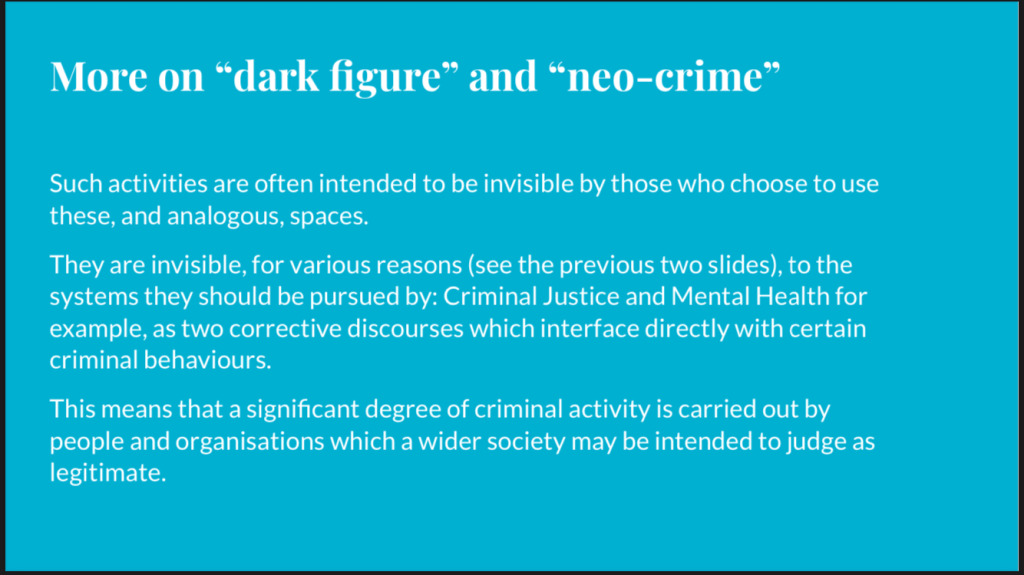
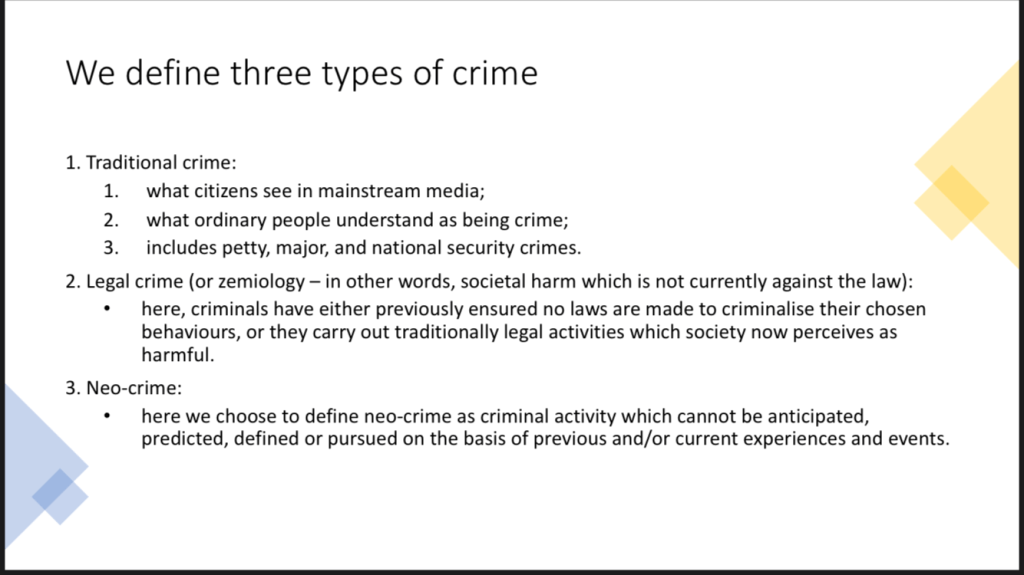
the definition, in my #whirled and your #world, of #neocrime having become this:

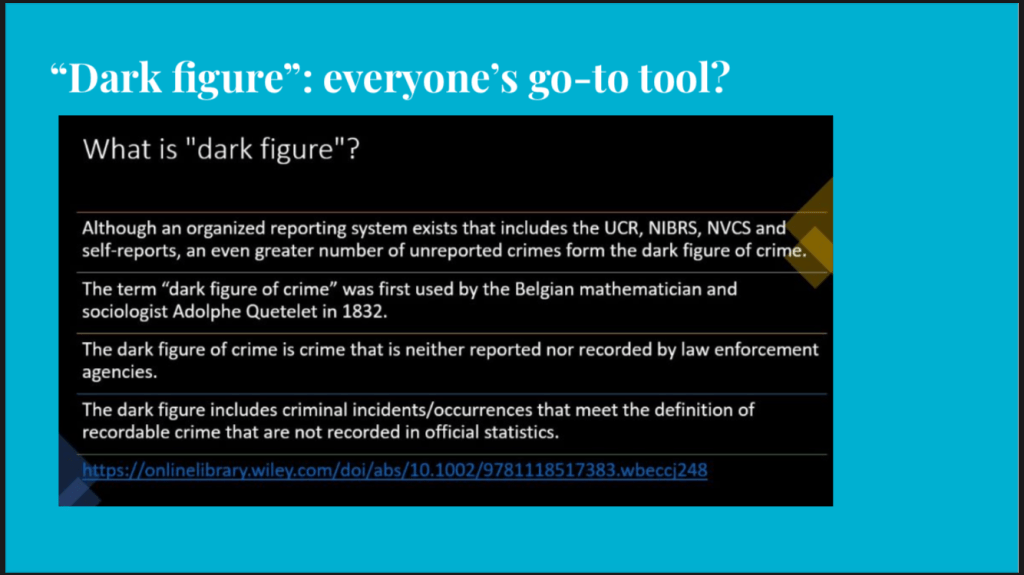
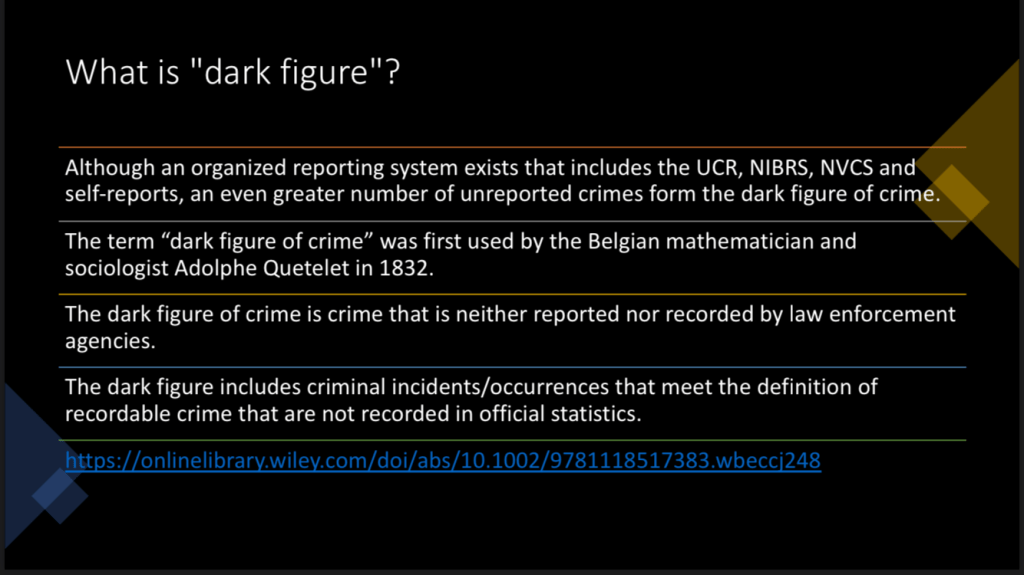
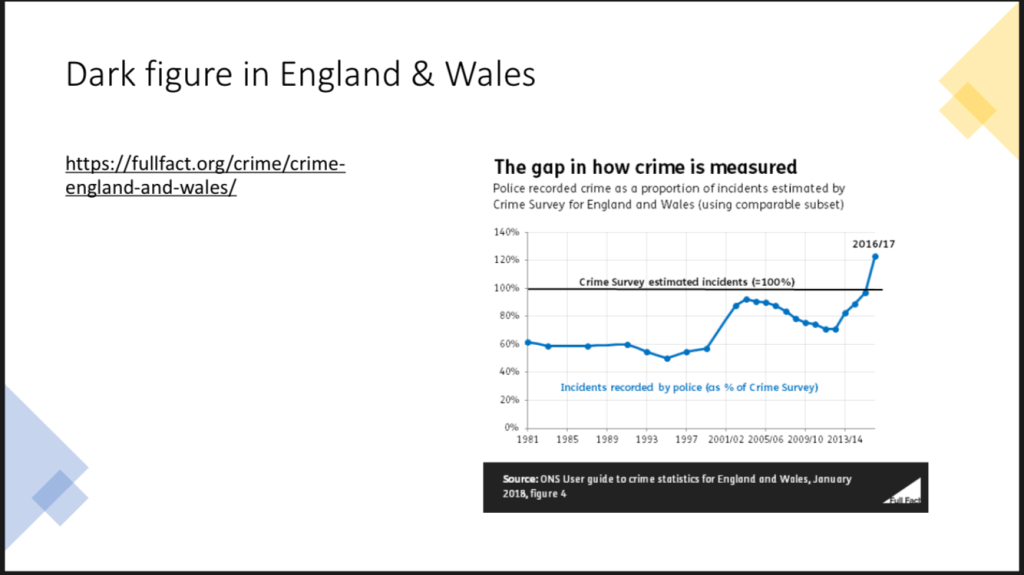
crimehunch.com/neocrime | an updated understanding of the 19th century concept of “dark figure”

now then: if we accept my argument for argument’s sake, that in almost infinitely malleable digital we only have to intuitively and creatively think up new criminal activity in terms of its “whats” and “hows” (“who” and “when” remaining the preserve always of the machines) in order to be evidencing their existence, today i bring a new one to the table:

“let’s imagine that communities of professional praxis exist in #espionage, too. just like journalists who communicate outwith their employer-spaces with other journalists; just like security people and bus drivers acknowledge the presence of the nominal ‘opposition’ with a tip of the cap or a thumbs-up … just like any profession where specialised skillsets bring humans together with humans who are like them because of their knowledge-sets more than the allegiances they are paid to maintain …

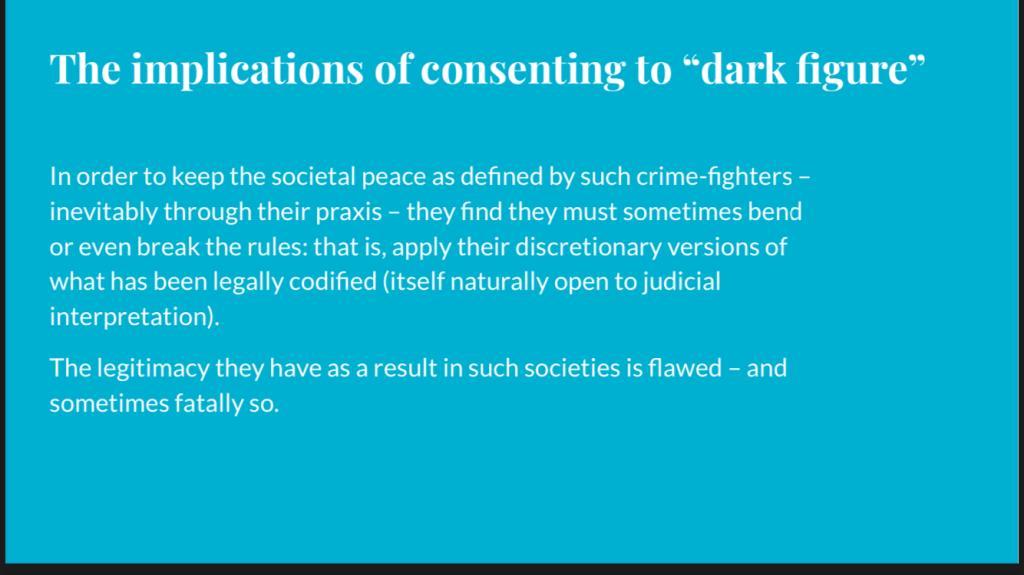
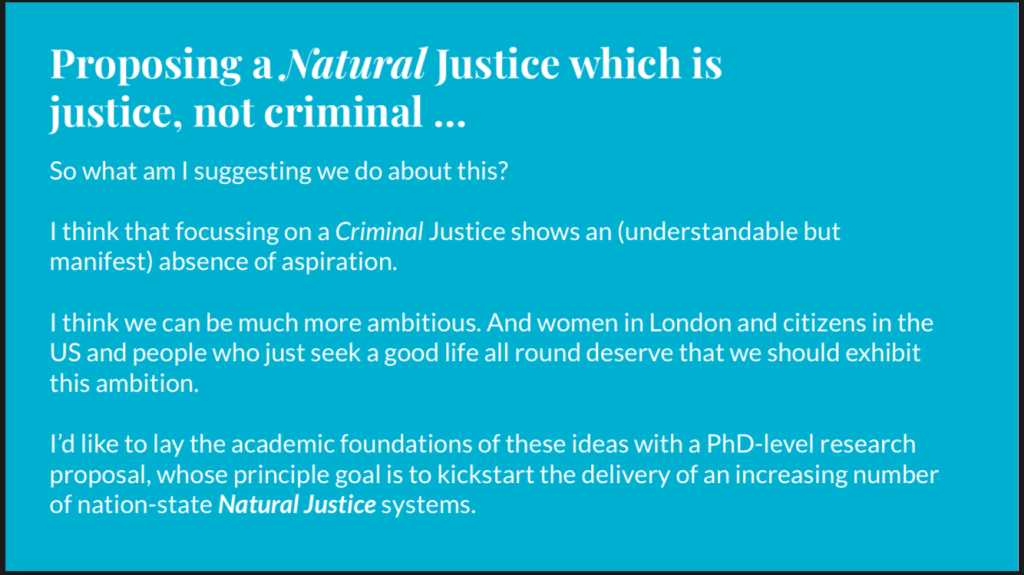
imagine the above, then, in #spycraft in particular; and so imagine over the years that a network out of sight of the employers themselves has grown up exponentially, where — using tools i nowadays sustain firmly have been developed to operate in the areas of #neocrimes and #darkfigure (supposedly on the side of the good gals and guys, too) — agents commonly communicate with each other using #secrecypositive (and NOT #totalsurveillance-compliant as i would prefer) environments and architectures, in order to basically scratch each other’s backs at the expense of broader citizen and state interests.

remember “mil’s theorem”: if i can simply think it up, someone else more powerful and monied than me already did long ago.

but here’s the thing: it’s possible the field operatives might be doing such things but it’s also possible that in 99 percent of cases out of deep ingrained senses of honour and responsibility (and why not? patriotism too …) they’ve chosen over the years not to. even when they could. (some of us still exist, you know.)

so here’s another #neocrime-ism: what if it wasn’t the operatives who worked behind democracy for their own self-enrichment — or maybe even global domination — but, instead, their bosses …?

not one and all. not even all that many. but enough to tip the balance over the years between #ukraine NEVER happening and #russia being given an under-the-counter carta blanca to proceed as it would wish, and always wanted.”

ok. that’s the last bit of “mil’s theorem” theorising for today.

enough, right? and maybe understandably insulting for many at that.

listen up before you get utterly irritated with me. what i’m doing here is using a public space as if it were a #secrecypositive space. i’ve reached a moment in my life where i realise what was done to me in 2003 can’t be done again. since then, i’ve studied #criminaljustice at master’s level and have a whole battery of logical tools and legal principles to defend myself. and so i’m feeling fairly impregnable — and will continue to do so unless someone actually, literally, wipes me off the face of the planet.

but assuming the latter won’t happen … what if #secrecypositive spaces have now been turned against the people who invented them? and not me thinking now? but them, having built decades ago? because when you create a weapon of destruction you ALWAYS consider how its corresponding shield might need to look …

so what if the guys and gals who did this technology all those years ago as i now surmise were good people who defend our security and safety every day? and what if the bad gals and guys are now abusing savagely — to the extent of enabling #ukraine AT LEAST — such architectures and platforms to their own ends?

what if … that?

how to save #chatgpt-x from its founders

i just saw an example of the power of culture over rules & regs when looking to achieve a particular outcome.

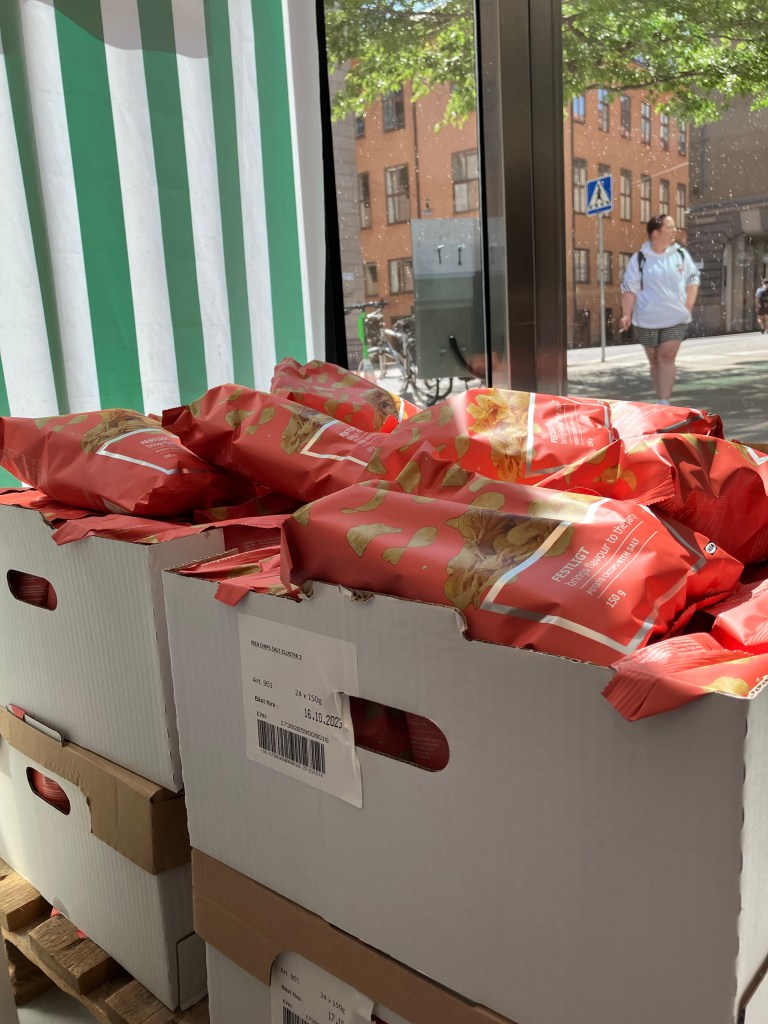
a human being removed a box cover and fluffed up some bags of crisps not because they had a rule saying when, but simply because their culture said now.


why conflict in the first place, for goodness sake?

an #ai designed to foreground the functions of machine-approaches to #complexproblem solutioning uses rules & regs always. it will do what you want it do as long as you have told it once. and told it in accordance with the needs of your domain. that is, all its needs.

a #humanbeing made bigger by #tech meantime — as per #film- and #movie-#tech has always chosen to do (the mic making the human voice bigger, the camera increasing the vision of the human eye, and even the stage extending great actors’ capabilities to express themselves powerfully via mise-en-scene) — will always operate better with the unexpected.

on the very human ability to deal with the unexpected

the unexpected doesn’t have to be: but it is. whether because it really was (9/11) or because you’re a newbie (me all the time in almost everything i do), our grand virtues as #humans supported by #machines (in this order), designed primarily to extend our existent virtues instead of deepen existent pockets (both are good, mind — when they coincide; but it’s my thinking the first is a problem to be solved and the second should never be permitted to become a solution in search of the former …), is that the unexpected is what engages us most deeply in life. and therefore what makes us reach our heights, every time.

in truth, it’s the kind of #machines we are if we were: except we’re not. we’re flesh and blood: we forget, only to remember a fabulous idea six months later; we frustrate, only to go on a drinking binge and then after hangover find marvellous beauty lodged amazingly in our heads; we get angry with another human for rejecting our beautifully formed solutions worked and reworked so often … and then after a sulk maybe of days we recapitulate and find an even better synthesis of both.

as #humans, the unexpected is what we are. only when we use #techtools designed to make their design cheaper to build and more profitable to hype, we act more like these #machines ourselves and may appear for a while to lose our capacity to surprise. to be different from machines, that is.

but it’s not true. believe me. an example. i’ve worked deeply in language learning for two decades in a previous life and know exactly what happens when the job of teacher becomes that of enabler; the task is no longer one of acquiring more data; and then, at last, it’s producing what we need as humans with what we’ve already got as thinkers that becomes the real challenge and delight.

and we don’t steal someone’s intellectual property to build an empire, either. it’s just not part of the gameplan.
no.

really.

we don’t.

and how many different types of burgers did #siliconvalley’s stand actually sell in the first place?

meanwhile, #siliconvalley has lately (“last three decades” lately, at that) delivered only one piece of money-making #tech.

when the #newspaperindustry was an industry, we called this “tech” #classifiedadvertising. this kind of #advertising had great virtue, too: to make people want to go to it and buy the products advertised and therefore pay the bills of what was actually very often a #publicservice, journalists wrote the greatest analysis and deconstruction of democratic and anti-democratic players; descriptions of things that were going just dandy and then again things that were going just frankly belly-up; and so finally we’d even get the most beautiful features and reportage that would manifest the world around us with #photography and #words that became #art in incredibly undeniable consonance.

and all of the above was rigorously original content.

#siliconvalley? hmm …

on the robbery of #ip

my question has to be this: why do we now go to the #classifiedadvertising we find on #searchengines and #socialnetworks and other sorts of apparent innovations?

well …

tbh, basically to read someone else’s unpaid-for content: what’s more, when a newspaper’s, quoted in full by a reader who in theory isn’t paying anyone for the honour, either.

this is not right. it happened with #search: that is, the robbery of #ip and content with clear #copyright. we shouldn’t allow it now to repeat with tools such as #chatgpt-x.

but can we square this circle to the satisfaction of all players?

why i’m of a mind now to propose a radically different approach to how #ai of any kind — never mind just #chatgpt-x & co — are trained and launched onto markets.


no. we don’t discard any #tech invented out of hand. ‘not suggesting this. but in #europe at least, in #sweden maybe to start with, the content used for the training of any #ai such as these must be duly paid for.

always. every use.

how? we could have a spotify-type platform which #ai developers could subscribe to, allowing for sanctioned access to all kinds of content, not just music of course.

and then the #ai tools would have certificates showing “denominación de origen” for all the #ip used to train up the #ai in question. and in their absence, the product could not be released in any legal form to the market.
this is practical; the streaming tools already exist and would allow for agile development to continue; and we would NOT repeat the daylight robbery conducted all those years ago under the banners of #search #classifiedadvertising.

wdyt?

there’s a business model in this too; not dissimilar at all to spotify as it stands.

no?

coffee, anyone?


if you must, make sure you’re legal, you take care of your own, and above all you know your enemy

in #stockhom #sweden #sverige, what was broached in #dublin #ireland in 2016 is now possible here.


and i feel like it is new; not returning to an awful toxic past and having to pay every day for it, as it remains close and clammy to the touch.

no.

not that.

solving the putin problem

i was asked on the train today what the keys are to solving the #putinproblem.

the #putinproblem includes #trump, and #brexit, and #facebook escaping with virtual murder as #cambridgeanalytica became the fall guy for the inevitable outcome of #zuckerberg’s choice of business model: this outcome being the savage and unremitting dismantling of citizen agency in modern western and associated democracies.

it includes everything that means even professionals will think, when they take a life-changing decision on someone in their life-changing nominal charge, they do so with this agency i mention: no one else is furtively intervening. and god forbid that those intervening might be criminals on the scale of #putin’s #russia.

so the keys to solving these #complexproblems longitudinally and long-term are …?

first: accepting how we’ve been part of the problem

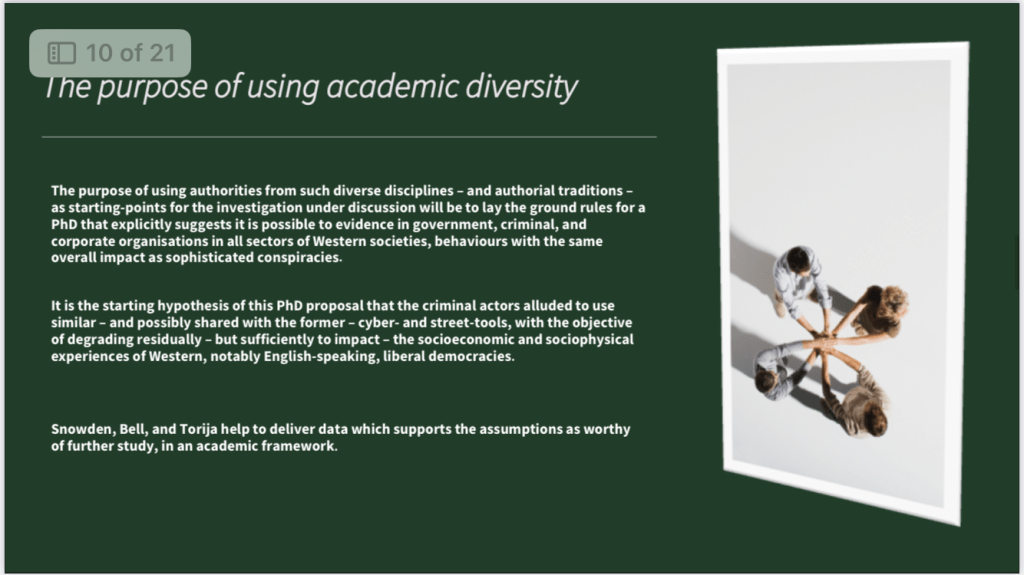
first, everyone who wants to join me in this battle in favour of a new democracy and against the #tech-driven #gaslighting that has been designed, developed and implemented over decades must accept they both tolerated and in some senses embraced #neoterrorismontheindividual because they used it themselves to shape their societies. they must take it firmly on the chin, as i do, that we are still part of the problem.


and whilst they/we were better at it than the enemy — #russia, a #badmoney without sovereign frontiers, #bigtech in practically all its manifestations — all was kinda ok. people like myself did get improperly incarcerated by proficient users of symbolic communication such as the #british, and by extension the #irish, but those of us who had to suffer such indignities and injustices were relatively small in number. i suppose.

second: how we’ve enabled the enemy

the problem is when the enemy gets better than you could ever imagine at this #neoterrorismontheindividual i uncover. and an even bigger challenge: when you simply have no inkling that they have got so much better than you, nor indeed for how long … nor when it all started to go belly-up.

crimehunch.com/neocrime


this is what i say has happened already. i was saying it somehow in my #criminaljustice dissertation back in 2017. i realise in hindsight now that both the #british and #irish agreed and were as one: i had to be scoped out of academic circulation. symbolic language is a mark of the #british security state’s capacity to control a society without ever taking ownership. (the #irish — suffering the colonising #english — had to compete against this: and we know the #tech adage about being careful who you compete against because, one fine terrible day, you’ll become just like them.)
and so see how cozying up to these #espionage ways and means enabled deep #russian interests close to #putin to embed themselves in #uk football clubs, financial institutions and other channels where money flows freely and conveniently.

third: symbolism as a cancer to democracy

wherever a country prefers to use #symbolism to rule we have a cancer: a cancer on democracy; on the opportunities for democracy to flourish; on the chances that democracy might sustain and renew itself where needs be.

‘question is: are the upsides of using #symbolic systems worth the downsides? maybe they are: #espionage is a common thread throughout #human #history. so maybe all ok in this sense (despite the occasional collateral damage such as myself back in 2002-2003 and then again in 2004, and in 2017 … and many more times i guess even i haven’t yet sussed).

but it’s NOT ok when the genie whose bottle we uncorked centuries ago becomes owned by the enemy under our noses.

so to answer, finally, the question i was posed on the train this morning: if #zuckerberg and the illegitimate influencing of democratic discourse … if #brexit … if #trump and insurrection … and ultimately if #putin’s three wars in fifteen years culminating in his unforgivable invasion of #ukraine … if all this doesn’t provide the evidence we need in order to say we’ve currently, deeply, awfully lost the war of #espionage; that our enemies far outplay us; and that tolerating and even embracing the tools described in my slide-deck below are something we can continue to do … you really really do, sadly so too, have zero self-awareness.

fourth: solutions and caveats

and i’m not saying don’t use the tricks i define in the slide-deck. i’m saying:

1. if you do sanction their use, do so legally.

2. if you do sanction their use, then do not do so against your own, just because they’re inconvenient voices and thinkers. (that leads to a dismantled democracy from within, and thus supports the enemy even more profoundly than they could hope for.)

3. and last but not least, if you do end up seeing no alternative, never never never show by default or inaction that you underestimate the enemy because #bigtech #corporations tell you that you have all the tools you need. and all the tools the enemy might have.

crimehunch.com/terror