smotherland? how DARE you …

i have been racking my brains: what’s so different here in stockholm? why does the concrete feel so human? why do the humans feel so different? why is there such a sense of purpose — even when the purpose is not to be all that purposeful?

what does make it happen, after all? something tangible, i ask myself. something i can point to and show you how.

and so i realise, just now, two things which become quite clear for me. one i experienced one summer, decades ago in the northern spanish city of burgos: a continental climate and hot even 800 metres up. at least during the day. so everyone left the city in summer: to climes where you didn’t survive the weather but could thrive instead. the seaside, maybe. yep. there for example.

but i had to stay behind for work that july. and suddenly i had this sense of being at one with my environment. what was it? what was different? what had changed?

it was easy once i tumbled to it: everyone had taken their cars with them. not just that they weren’t there to drive them around: the cars themselves weren’t there to intervene in the visual landscape, and distract and divert and impact on your psyche, even when only subliminally; and then again, even hurt some of us because of a still undiscussed neurodiversity … and all as a result of their deliberately engineered capacity to attract our attention inescapably with covert ingenuity.


here, today, then, in central stockholm, there are two things which tangibly make me feel at home. the first is an absence; the second being a presence.

the absence, first:

  • no cars. very few anyways. no need for cars. just people using their legs. do you remember legs? remember what that was about? no. not the clutch and the accelerator. the pavement and the kerb and walking the line … and the dance.

the presence, second:

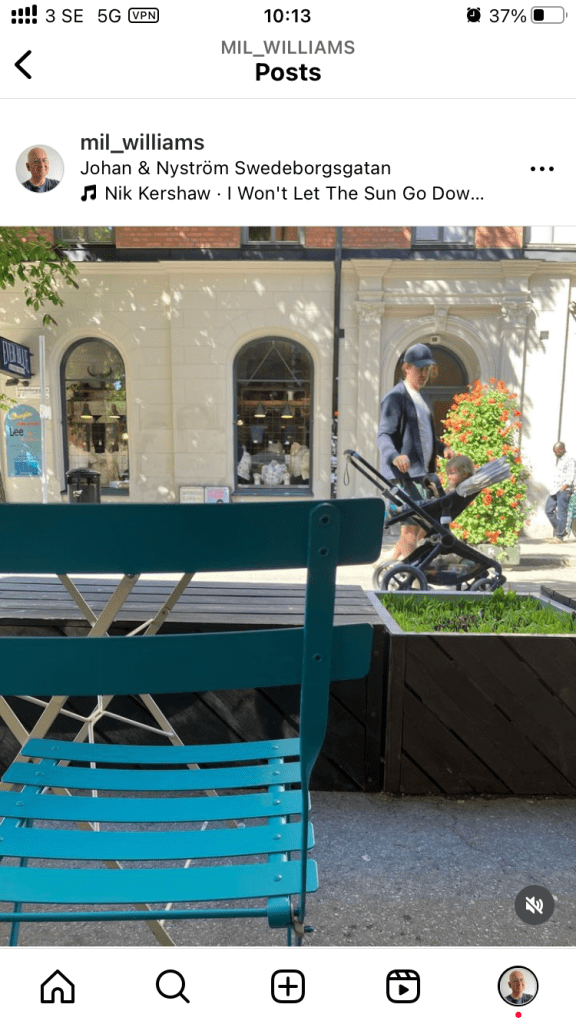
  • so many young people and children and elderly and other. and a young man with a boom-box, and then the coffee-drinkers on the terrace across the road smiling in recognition of their own youth, perhaps; and smiling, all the same.
  • and then bikes galore and bio-diesel buses, and trams and stuff, and within five minutes walk an underground and a commuter-train network.

so: this is purposeful living which liberates not suffocates. and don’t believe the anglo-saxon right-wing when they say sweden equals “smotherland”. what they say when they do … it’s utter bollocks.

more than any country i’ve been to, this is an intellectually, emotionally and socioeconomically free society. even today. even after everything we’ve all been through. even after what they think they have lost to a better past.

imperfections? for sure.

on the scale of other countries flaws and injustices? no way, josé.

just one example from the uk to illustrate. many years ago, foodbanks arrived to ameliorate real pain. a conservative minister even praised the fact: community coming together. she (i think she was a she but she only voiced what all her party, mainly men, also preferred to assert) … well … she could’ve said how terrible that they were needed in the first place. but she didn’t.

last year in the uk of johnson & co, it was warm-banks for those who couldn’t afford both food and central-heating.

and so this year, gordon brown, the ex-british prime minister, informs us of hygiene-banks: for those in the uk who already share toothbrushes, can’t buy toothpaste, and who find that sanitary products for women just ain’t something they can contemplate:


so DON’T tell me “smotherland” EVER again, when you discuss the fact of sweden and its ways of seeing and doing stuff. because if you do, if you dare to, you just really have no idea what you’re saying … no idea whatsoever.

and that’s a tangible fact for sure.

as tangible as the weekly death tolls that add up year after year, at the hands of the gun-holders who terrorise good american citizens in the name of spurious constitutional rights.

like the magdalena’s memory #911

i tasted cold coffee with soya drink just now
and the memories of a campsite somewhere in austria maybe
high up in the mountains where summer green was all around
and showers stopped automatically
and buttons had to be repeatedly pressed
and the early morning drifted smells of bacon grill and more
and the milk was uht
'cos it had to be it just had ...

so all this came drifting back to me
and all this was sharp as nines
and all this was in my head just how
and right now is when i remembered with fondness
the trials and tribulations and real pain
of being my mother and father's son

because mostly it was pain:
slashing tongues which fast cut me to the quick
nailing me to the spot like hammer hitting out
and lashing me with criticisms of everything i tried
to make emerge from me

and so only this minute
do i begin very slowly
to do the things i always wished to do
and be the man i never was
and grin to love
not grin to bear
and find at last
in human relations
the right to enjoy myself full fair
without recrimination or disapprobation
or disapproval of some religious scriptures:
what hurt me so all those years ago
and still on occasions serves to actually destroy my soul

and so now i don't care
what he might think
because now he's passed and is in his clink
and she meanwhile reveals herself
as authoritarian body
of dictatorial mouse:
scampering around and making all silent
and then patting down the violences of them both

for the passive-aggression he imposed on my child
was fully enabled by her actions of default
and whilst i was younger
and felt myself deeply
the blame of just being there and occupying a space
which was never to be mine
in the end it's true i've had this life of falsehood
and in the end it will be TRUER
you and me
or me and another
or whomsoever i shall finally meet
in joy and daily grandeur
when heads hit pillows
and the mellowness of affection
turns into
for a moment
no longer the passions of terrible and bloody rejection
for my brain is a magdalena
and my memories are beginning to heal

On talking about #intuition

Introduction to this post:

Today I had a brief video-chat with someone positively predisposed to the idea of #intuition. He even saw it as bordering the mystical. He was Indian. Indians love #intuition, it’s true. But #it-#tech Indians have caveats they all seem to share. This is something I have seen before: real deep trust in human #intuition’s capabilities but a real distrust in any chance of ever validating it usefully.

This man is also involved professionally in #it-#tech. When I gave him four examples of how not all #tech had chosen to diminish human beings in the field of non-traditional #datasets, he was still unconvinced.

The four templates we should look to when validating #intuition:

Example 1: the #film-#tech industry from its beginnings over a hundred years ago has decided to almost always amplify and enhance existent human abilities: more voice with a microphone; keener vision with a camera; greater expressiveness with the language of close-up. And in so doing it’s made billions, perhaps trillions, in the paradigmatic century of its total cultural dominance.

Example 2: in my younger years video was not admissible evidence in the #criminaljustice system of my homeland. Now it is. What changed to put in the hands of #lawenforcement and #justice’s stakeholders and subjects this tool to eliminate procedural waste so dramatically? We didn’t change any #justice system: we just introduced new tools to validate video evidence, so that the hidden knife in the real life holdup was proven to have been used via a validated electronic cousin.

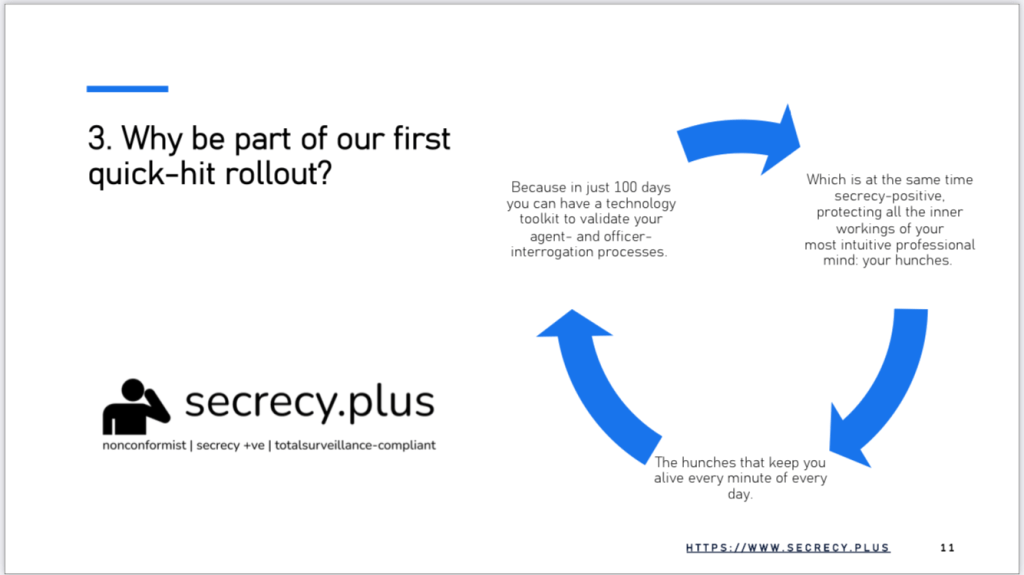
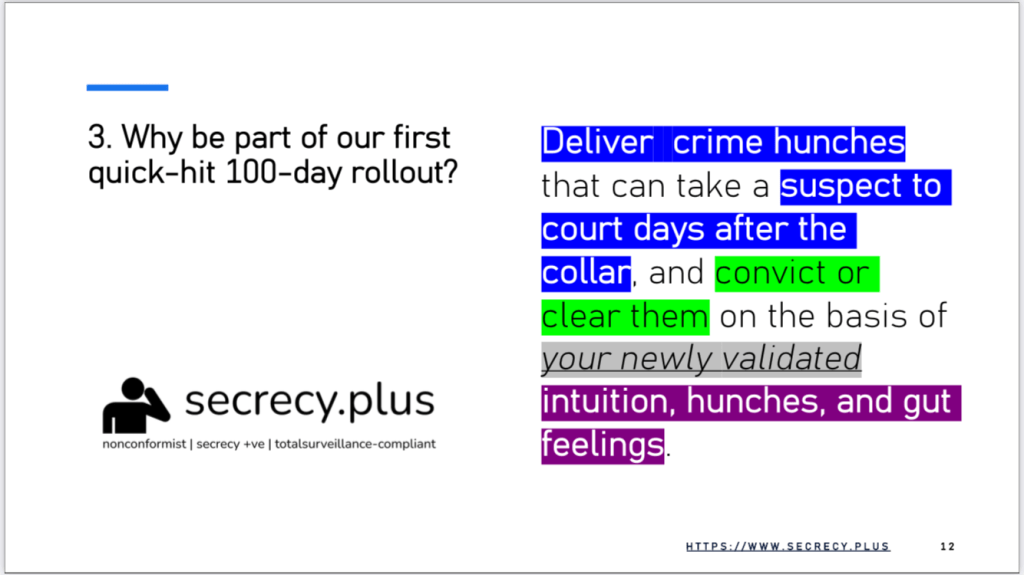
Example 3: the detective who just knows that someone is lying in an interrogation may be wrong too, on occasions; but often they all too accurate. Yet it then takes due process months, maybe years, to arrive at the same conclusion. What if we could validate — not prove right but decide definitively (as the #video example above now allows us to much more speedily) whether in truth MAYBE wrong but ALSO maybe right — so that this detective’s #hunch would bring about a conviction (or release) of the most adequate?

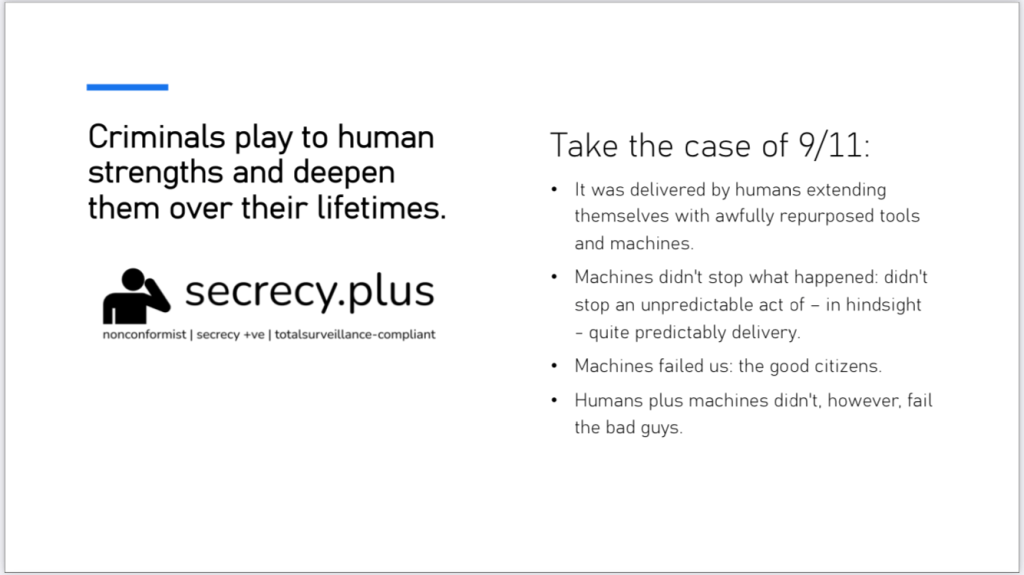
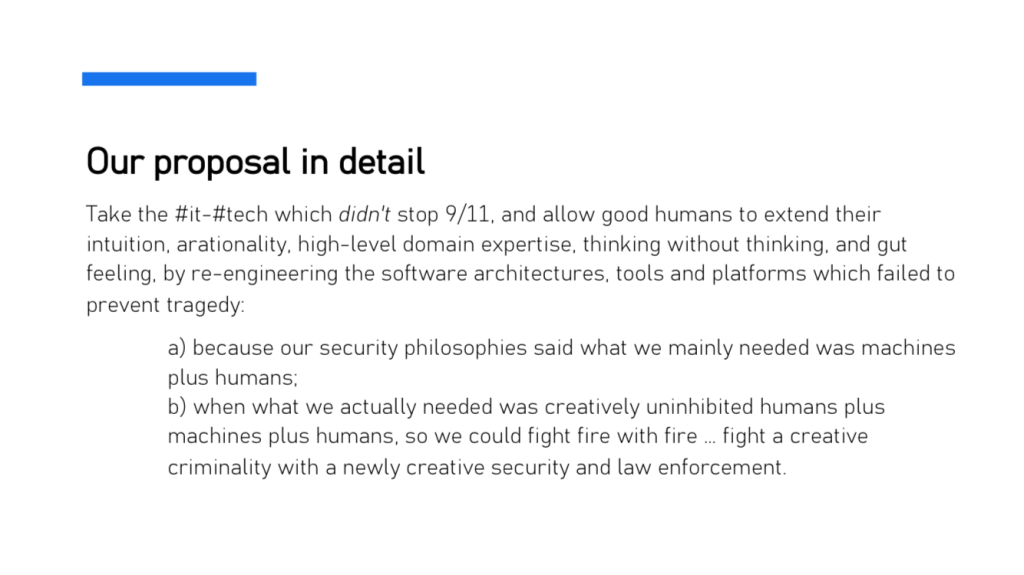
Example 4: I then suggested to my interlocutor that we should come up with a new 9/11 before it strikes us again. Here, I suggest we learn how to reverse- or forward-engineer bad human thought, so as to stop it in its tracks, with the most #creativecrimefighting you could conceive of:

crimehunch.com/terror

But not the “when” or “who” of what is already being planned out: in these cases, machine automation operates really competently on the basis of existent #lawenforcement and #nationalsecurity #it-#tech data-gathering processes …

Rather, I mean to say here the “what” and “how” of an awfully #creativecriminality. And I say this because 9/11 was a case of where assiduous machines which humans used conscientiously, and in all good faith, were roundly beaten by horrible humans who used machines as extensions of themselves terrifyingly well: being the case, therefore, of simply not supporting existent habits of #creativecrimefighting (because detectives can be immensely creative already in tussling out narratives that explain otherwise insoluble crimes) with conventional #it-#tech choices and strategies that absolutely do NOT since time immemorial care to foreground and upskill human #intuition.

What happened next and, maybe, why:

When I said to my interlocutor that these four examples surely served as robust precedents and templates for proceeding to validate #intuition and #crimehunch insights just as deeply, as well as to an equally efficient end … well, this was when he veered back to talking again of #intuition’s impenetrable workings. “Yeah,” he was saying, “intuiting is great process … but don’t dare to untangle it.”


And it’s funny how those who work in an industry — that is, #it-#tech — where the richest of its members are incredibly wealthy on the back of their particular and often mostly privately privileged visions of how the future must become … well, that these wealthy individuals then, and similarly equally, find themselves incapable of conceding that such a profoundly value-adding activity for them should have its own wider validation systems for us all. Why? Well. In order that EVERYONE who could care to might acquire a distributed delivery of similar levels of genius-like thinking: what I have in fact called the “predictable delivery of unpredictable thinking”.

platformgenesis.com

How I would, then, most like us to proceed:

I’d like us to create software, wearables, firmware and hardware environments where not only a select few can enjoy being geniuses, but where we all have the opportunity to be upskilled and enhanced into becoming value-adding, natively intuition-based thinkers and creators:

complexifylab.com | sverige2.earth/canvas


One small and hugely practical example:

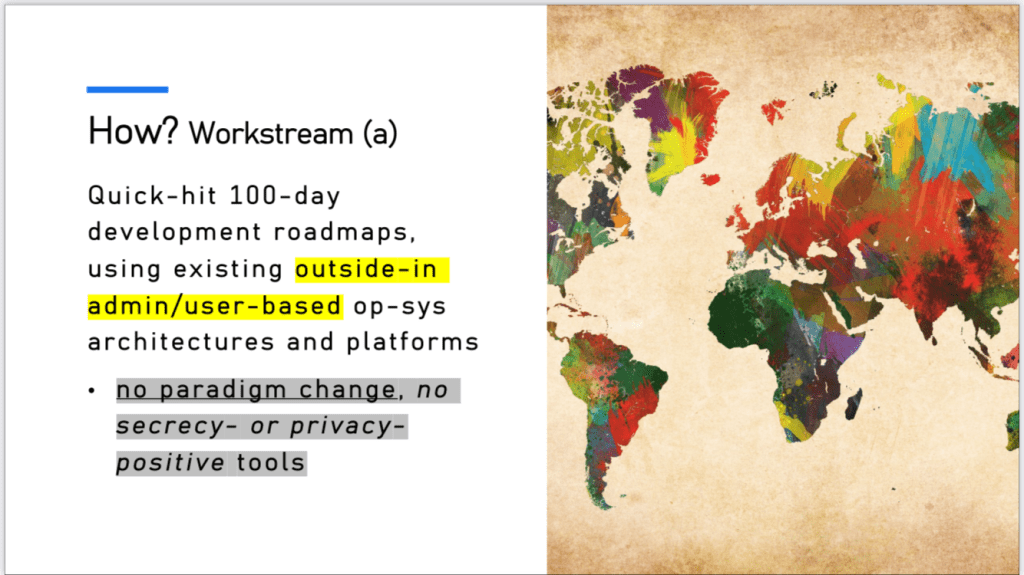
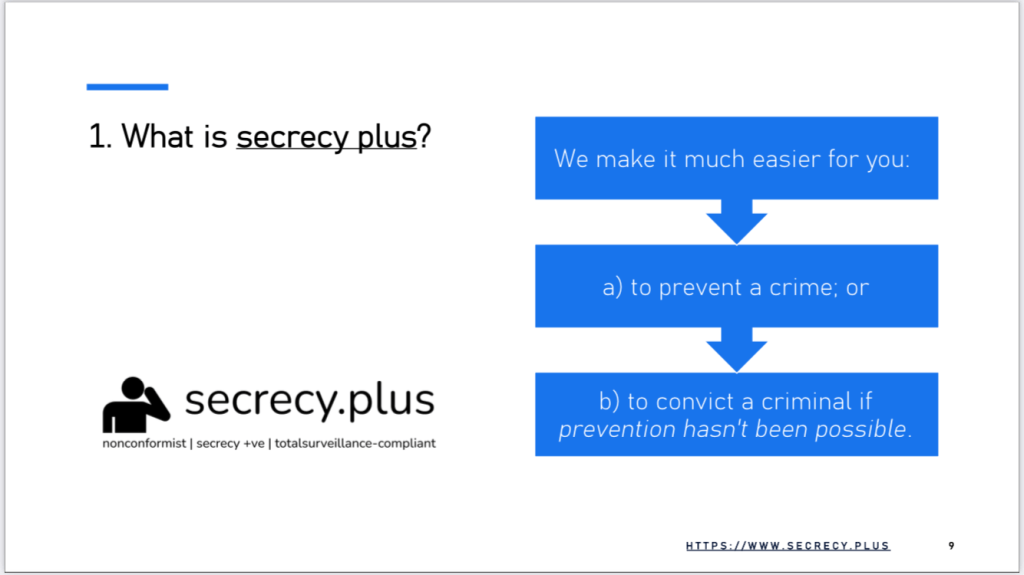
Attached below, just one small application we might develop, using existent architectures — not the particular ones I think more appropriate for truly deep #intuitionvalidation, where we conflate admin/user in one #datasubject — and with a proposed 100-day roadmap to demonstrate that the beautiful insight I had more than a year ago is actually, honestly, spot-on:

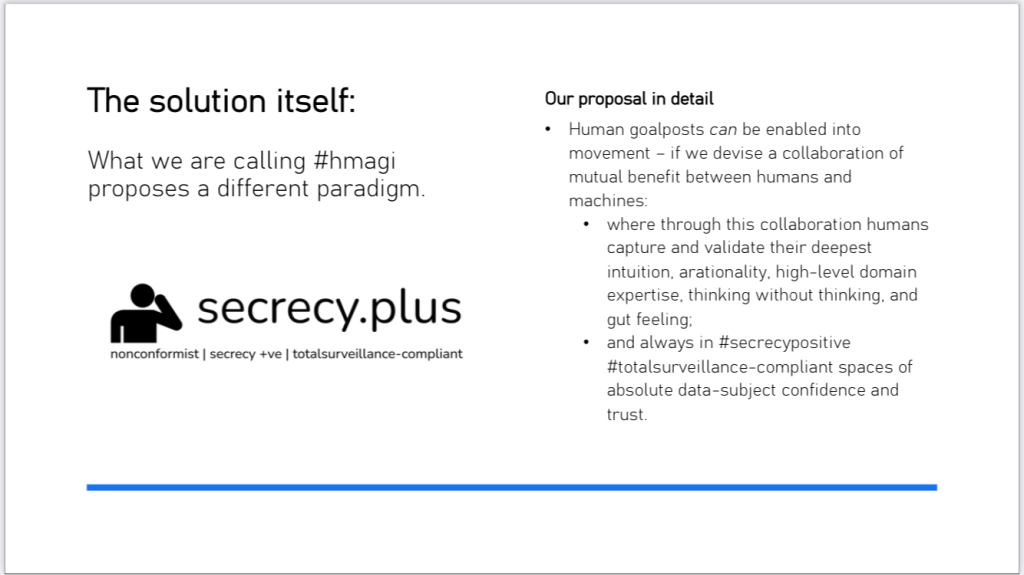
1. That #intuition, #arationality, #highleveldomainexpertise, #thinkingwithoutthinking, and #gutfeeling are potential #datasets as competent as #video suddenly became when we believed finally its validation was a real deliverable.

2. That all the above all-very-human ways of processing special #datasets actually contain zero #emotion and even less of the #emotive when it’s their processes we’re dealing with. And that when they do EXPRESS themselves emotionally it’s out of the utter frustration which the driver and #datasubject of such #intuitive processes suffers from as a consequence of the fact that no one at all, but NO ONE, in #it-#tech cares to consider #intuition and related as #datasets worthy of their software and platform attentions.

So out of frustration I say .. but never the intrinsic nature of such #intuitive patterns of collecting #data and extracting insights which people like that detective I described earlier do believe sincerely in, when driving the most mission-critical operations of #publicsafety of all.

secrecy.plus/fire


On the “Complexify Me” and “Complexify Me Holding & Lab” proposals

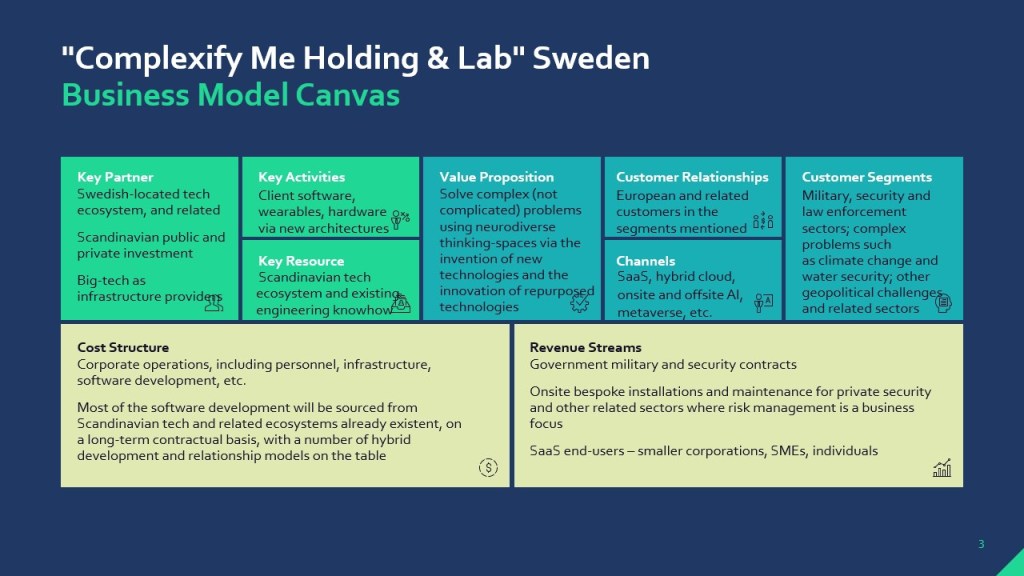
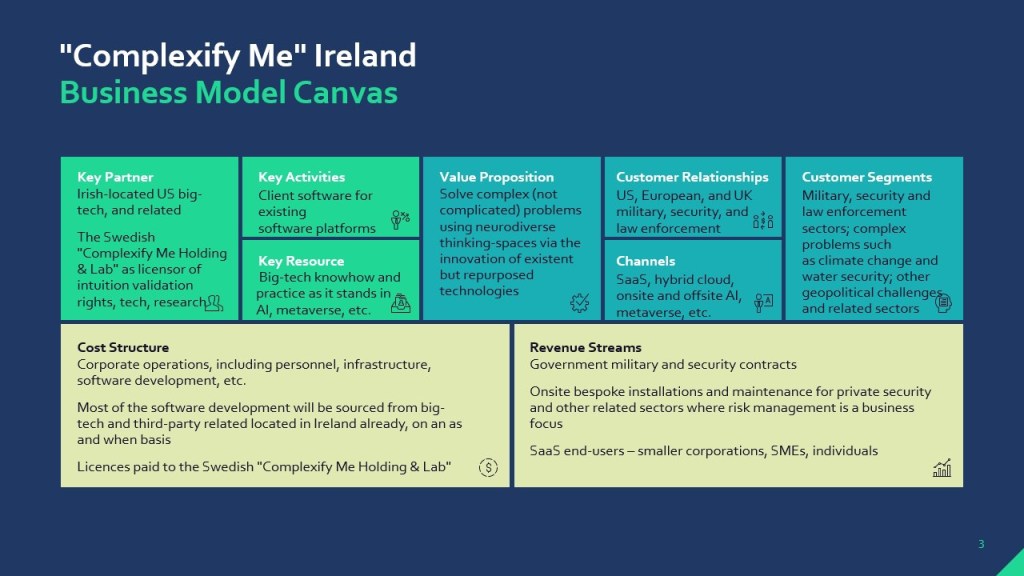
I’ve been progressing my projects recently quite a bit. See the two “business model canvas” drafts below as one example:

One observation I need to add as per the following updated sverige2.earth homepage — Ireland and Liverpool UK may now form a co-location for Workstream A with its associated AI innovation (though not invention) processes:

As you can see, Irish-located big-tech would provide circular-economy hardware lifecycle delivery and management, whilst the cloud that would sit behind an agnostic cloud management services dashboard, also located in Ireland, would itself be located in the Nordic versions of US big-tech cloud services.

Finally, in this first corporate relationship, the responsibility for AI innovation (though not, as already observed, invention) would be that of existent Liverpool AI organisations and institutions.

*

Meantime, I’ve finally been on the serious hunt for a funding flexible enough to allow me to locate in two or three countries without being imperiously tied to one. The latter has always been my objection to the UK-based government funding streams I’ve been offered: zero intention to promote ties with other countries that don’t purely involve selling to them, with no collaboration contemplated at deep levels; no transfers of technology, knowhow, or business models; and nothing, really, that talks to me of open doors, whether intellectual, technological, or even simply business-related. And this was before Brexit.

As a result of all this, I’ve now found a funding-pot foreign to UK government and agency approaches which will, if awarded, allow me to capitalise on my existing UK-based ltd company structure, establishing myself in Ireland simultaneously for what I mentioned above already that I call Workstream A, alongside a filtered Workstream B; and then taking the next step to set up a Swedish AB as Holding and driver of the Intuition and Neurodiverse Thinking Lab I want to be my direct responsibility and end-of-life work, covering off the pure research and invention that will form the basis of Workstream C and Workstream D.

This funding stream I have applied for just yesterday would enable all of the above to be kickstarted into the life it should’ve had already years ago. And I now exclude no one: simply include everyone with starting-conditions I will be firm about, it is true; but that once agreed I have no intention of us changing, ever.

Below, then, as a flavour of the tenor of my thinking, the video I was asked to make for the funding submission described above:

“Complexify Me” and “Complexify Lab” funding submission video

This video now forms part of this submission for funding, the initial decision on which will be taken by the organisation in question in June 2023.

*

Useful further reading:

Enjoy!

🙂

Oh, and have a safe Sunday … yeah?

“this, for everyone watching”


my capacity to have a decent homelife is NOT going to be the issue here.

your capacity to upturn paradigms MUST be.

we don’t deserve another ukraine.

you’ll enable one by blaming my imperfections for not taking a decision on this.

#truth

oh, and i go with governments and their defence infrastructures, not governments and their security. not even governments and their “chosen” tech partners. i’ll vet the latter myself, too: now i will.

my rationale in all this?

1. security is more often than not reactive — responding to enemy actors as they act. it also gets completely engaged by the espionage of uncertainty. it may be right when it does; it often gets enchanted in terrible ways, however, which may mean it doesn’t know fiction from fact.

2. defence as a mindset when effective is ESSENTIALLY strategic. cleanly so. cleanly.

i want cleanly and geopolitically “strategic” for this: delivering the longitudinally robust measures that arc over relatively short democratic cycles in order to ensure that putinism and the like don’t prevent the ongoing flourishing of western democracy as we desire it.

and what that is i’m not going to be prescriptive about — it’s a matter for wider debate.

but what happened in the uk when security allowed the russian oligarchs (putin) to control the conservative party, perhaps over decades without taking a single measure against, and even when this party was in government, should not be able to happen anywhere in europe.

mi5 said around 2017 that it could ringfence high-level chinese tech at the heart of its new comms infrastructure. even the conservative backbenchers, who were friends of putin & co, couldn’t stomach such an idiotic assertion. it didn’t happen: not because security changed its mind, though; rather, because politicians just decided they wouldn’t allow.

my thesis is that defence, meanwhile (even — and maybe particularly — uk defence) would never have contemplated the foolishness in the first place.

so this is the “why” of my rationale: i want defence organisations clear about the enemy always, and operating under sophisticated democratic cultures more than laws, but laws of course as well, to protect our democracies longitudinally from putinism and the like, and from the chinese and others too.

that is, to arc over our democratic cycles and protect their integrity as deeply as possible. to make it possible for a ukraine, battled back fiercely and finally into europe’s core, to one day soon enjoy the same democratic cycles as the rest of us. and for russia et al NOT to buy their way into the heart of any western democracies ever again. neither overtly with football clubs and property to launder its dirty money, nor stealthily by the gaslighting of emerging social and political notables of any age, culture or belief system that complies minimally with our treasurable desires to deliver tolerance and acceptance of every human being we are.

not russia. not china. not uk security. but maybe, just maybe, democracy’s defence organisations everywhere.


#neoterrorismontheindividual

#tech-driven #gaslighting

#geopolitical

#nato

#europeanpresidency

#europeancommission #europeanunion

Why a data-driven world isn’t everything in life … and why it’s important we understand this much much better

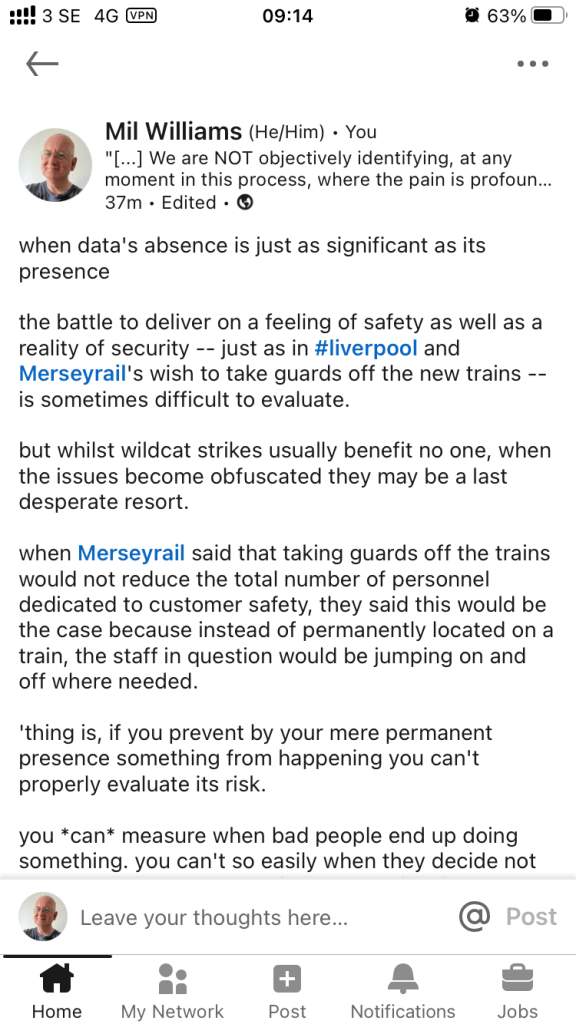
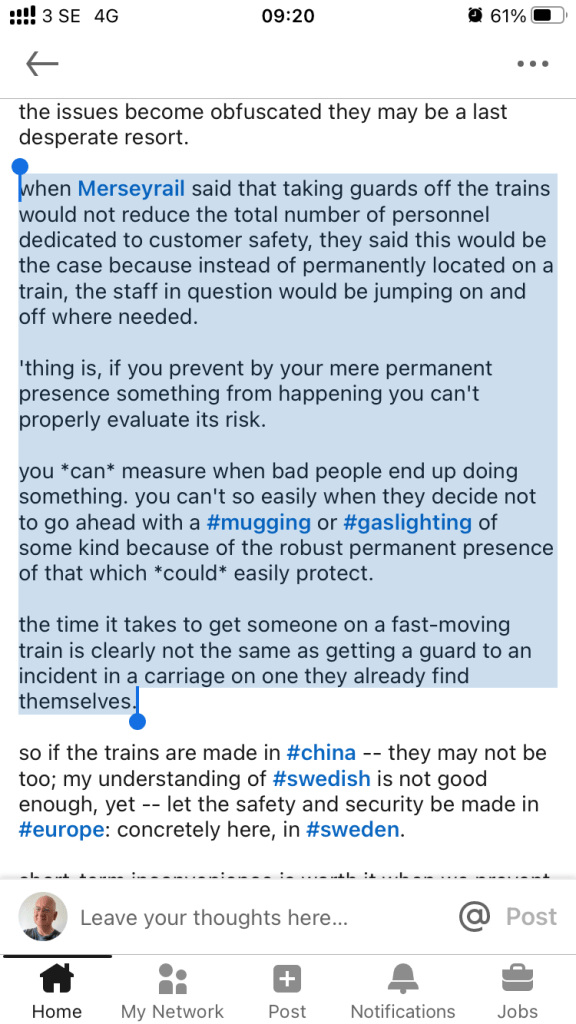
The real nub of the issue is this: in the absence of data, we can only use data that is present. Here, it’s clear when someone commits a crime and we catch them after the event with a certain number of mobile train security personnel on our payroll. That’s measurable: the ratio of events to arrests, for example. What’s not measurable by automated data science and analytics half so easily is when something doesn’t happen because a permanent guard is present to act as deterrent.

Mil Williams, Stockholm Sweden, 21st April 2023

Introduction:

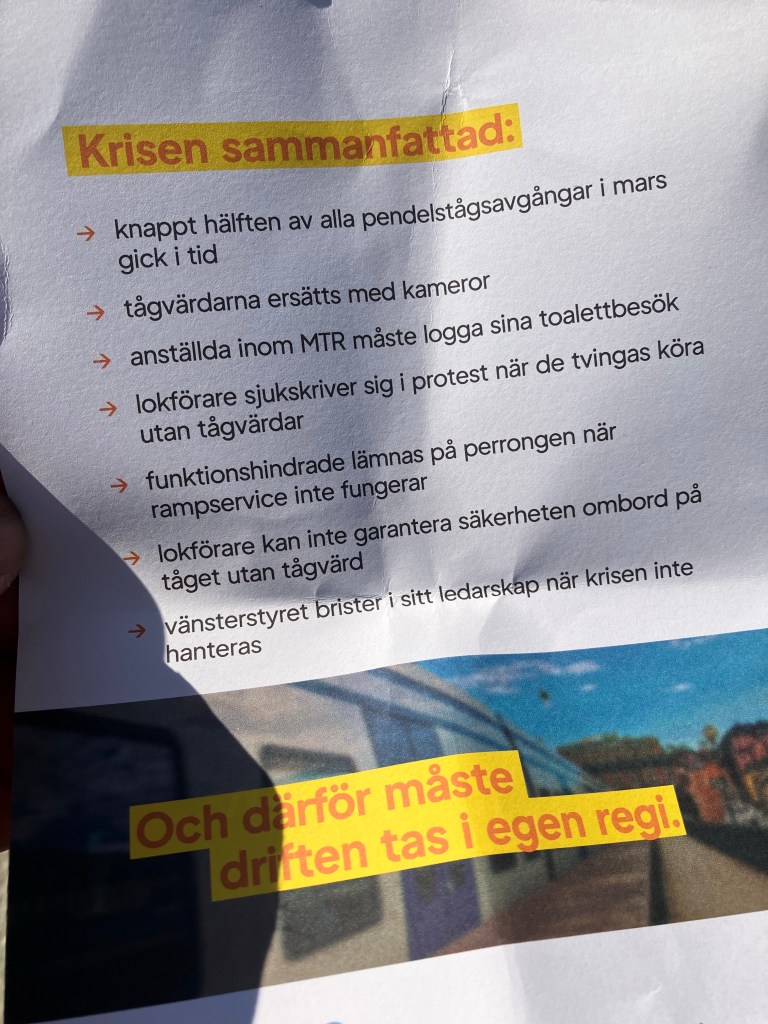
There are strikes on the commuter trains — the otherwise fabulous pendeltågs — here in Sweden: even the occasional wildcat ones. The frustration is patent: more so, because the strikers are right.


This is why:


An aside:

As a brief by the by before I continue, I think the train companies are able to claim the numbers of security and safety staff would remain the same, and yet still want to go ahead with it all, because they’re changing the type of workforce: you still need to go through with rightful and rigorous measures to vet and upskill non-train guards of all sorts it’s true, but with a train guard it’s less easy to change and chop their working locations, conditions and so forth. Or outsource the workforce, even. Change overnight who employs them and how.

No?

So …

How a data-driven world can deceive:

The thing is, here we have a perfect example of when a “data-driven world” actually needs academia more than it needs an automated data analytics and data science as we usually understand them.

The train companies in Liverpool and Sweden both I am sure will have had long-term strategies to re-engineer the structures of their employees and related re in-house and outsourcing options, and whilst taking guards off the trains in the circumstances described wouldn’t deliver immediate economic advantage, as indeed they underlined in Liverpool for sure, long-term if I’m right it definitely would.

The real nub of the issue is this: in the absence of data, we can only use data that is present. Here, it’s clear when someone commits a crime and we catch them after the event with a certain number of mobile train security personnel on our payroll. That’s measurable: the ratio of events to arrests, for example. What’s not measurable by automated data science and analytics half so easily is when something doesn’t happen because a permanent guard is present to act as deterrent.

And this is the challenge here. It really is a challenge around what we do when the evidence base is incomplete: that is, how it leads us to take quite the wrong decisions.

To the solution:

There is a solution too; I alluded to it above. Straightforward academia gives us tools to codify absences, in for example qualitative data such as an interview transcript or video, so that what isn’t said is as significant as what is.

If we could create an equal set of tools for strategic decision-making when deciding if to take train guards off trains or no, perhaps we would avoid the strikes we’re having everywhere: and at the very least, we could validate, in a less conflictive way, the common sense most users of public services have that a “bobby on the beat” engenders an incomparable feeling of safety even where a car in the neighbourhood can be evidenced to deliver on objective data relating to quantitative crime events.

Summarising:

In crime and public safety, what doesn’t happen is as important as what does: and the “why” of both these matters, too.

So.

Let’s do something after the evidence bases for both aspects of the truth: that which has a visible side and the invisible events as well.

And then let’s achieve delivery of these aspirations sooner rather than later.


Further reading:

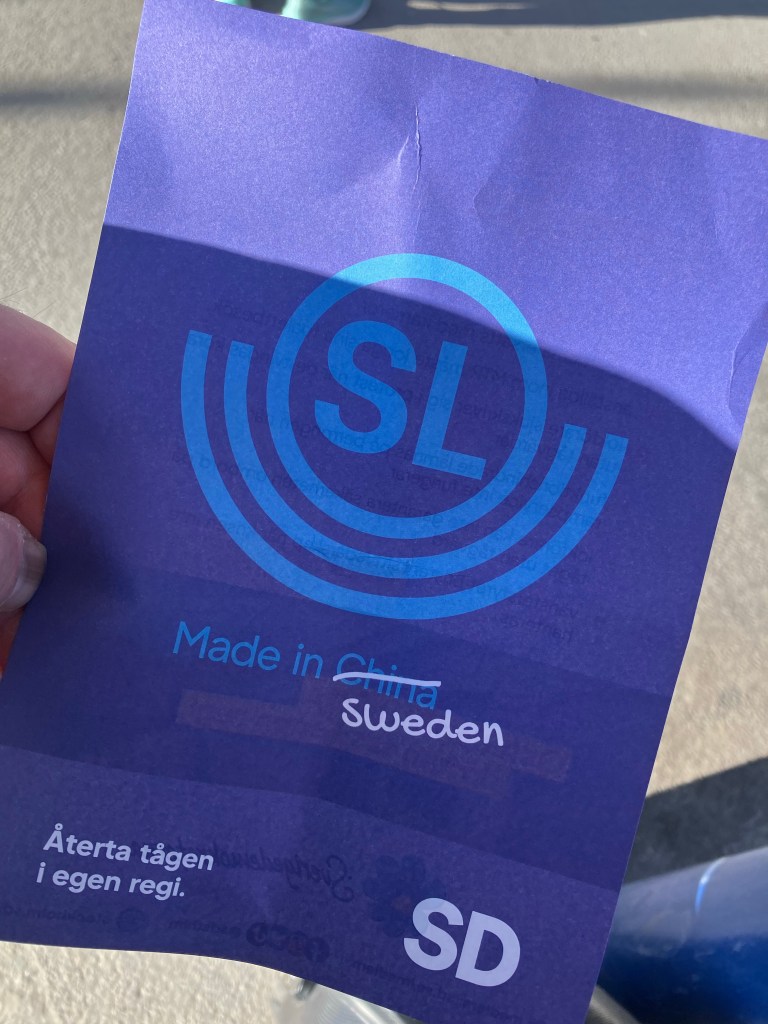
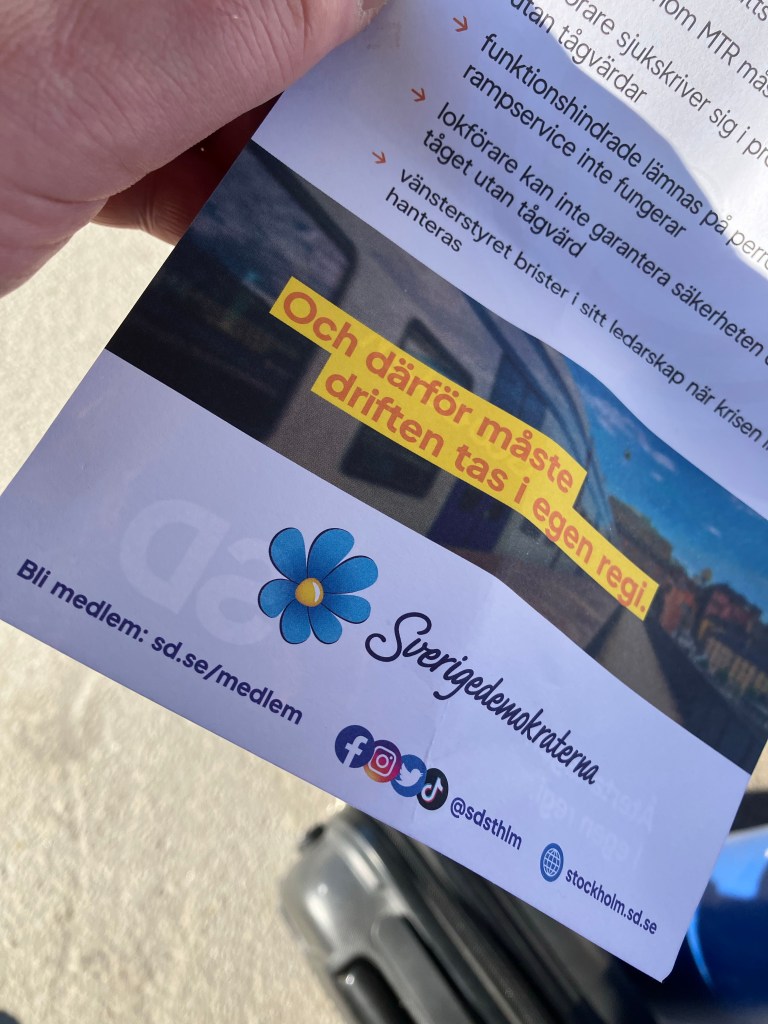
https://en.wikipedia.org/wiki/Sweden_Democrats

Another by the by: the promoters of today’s information are a further example of why we should act on the basis of what is not visible, as well as what is.

The Sweden Democrats started out as fascist and redolent of nazism of the very worst sort — at least according to the English version of Wikipedia. They themselves claim to have re-engineered their political DNA, which is not impossible but highly unlikely. Even so, medical professionals claim bespoke DNA of the human kind is very close to becoming a reality now; so we could argue that in politics it’s not unthinkable any more.

Let’s just say, however, for the moment unlikely and hard to do.

So. The risk from relying on present datasets instead of datasets relating to both what’s present and absent too? We allow people to hijack in bad faith what needs to be promoted in good faith.

The train personnel are right. Guards on trains deliver safety and security. This Swedish political party — in the current security conditions which China and Russia together have been stealthily laying out for decades together — are also correct to highlight the dangers of such, separate, narratives.

But they are wrong to a) conflate two issues like this; and b) lever the abuse and violence of both nation-states and their outliers in the fields of geopolitics to then promote an immigration narrative of their own re Sweden which delivers total obfuscation of our all too human reality and a zero confusion around their racist truths. Unless you choose to remain confused.

Sometimes it’s right to be firm: China — not all Chinese people — is a toxic regime. Putin’s Russia, too, has absolutely no redeeming qualities. But firm doesn’t mean we have to give fascism a place at the table of a wider collective progress.

Don’t besmirch the truth of the train staff by taking political shortcuts. And if this is what changing your political DNA leads to, change is what clearly you are NOT delivering.

Just occurs to me, too: even more reason to proceed with #intuitionvalidation.

on #poetry and #espionage

poets learn to codify linguistic systems and use precise forms of ambiguity very quickly. this makes them ideal for making or breaking code more widely.

mil williams, stockholm sweden, 19th april 2023

poetry and #espionage have close connections. i won’t link to the article again; but it was either the #nyt or the #newyorker i read a while back which evidenced the fact in a #longread post.

poets learn to codify linguistic systems and use precise forms of ambiguity very quickly. this makes them ideal for making or breaking code more widely.

for all we know, the most ambiguous sorts of leaders — those who show themselves to be dictators, for example — might be frustrated literati. i wouldn’t be suprised.

when i post out-of-the-box thinking on #linkedin these days, i get a message basically instructing me to give a tip or ask a question to get a conversation going. this is all well and good for basic networking and personal branding. but there are deeper things we can use language for. and i want to prove this longitudinally. a #poet interested in code: not software only, though this of course as well.

but really, how to both reverse- and forward-engineer those #crimes being committed — like #thepurloinedletter — under our very noses. the things we call random which aren’t.

this.

i think by pushing the human #brain in the directions i look at first sight to be waywardly doing is intelligent: and capable of delivering outcomes that will defend us from future #ukraines. outcomes in war and peace. outcomes in engineering and politics. outcomes everywhere.

i think where i am going with this #intuition thing is in expanding the envelope of the possible to the once considered impossible. my brain has downsides: it can be unstable. but like the #eurofighter in its origins, instability duly channelled by #tech can deliver fabulous results.

mil williams, stockholm sweden, 19th april 2023

the #poem below was written an hour or so ago. it’s by a foreign user of #castellano who only lived there some sixteen years. but it has some huge merit for me because of what it strives to communicate. and it may have a minimum merit even for #spanish speakers themselves.

i think this is interesting.

my own #brain is, you see, much better now that it was when i was in my twenties.

so.

i think where i am going with this #intuition thing is in expanding the envelope of the possible to the once considered impossible. my brain has downsides: it can be unstable. but like the #eurofighter in its origins, instability duly channelled by #tech can deliver fabulous results.

why not begin to join me in this?

i mean … the #soldier as #poet … and the #poet as #soldier.

my REAL concerns around democracy’s use of digital: an overview of the last week’s work

introduction to my rationales for a new #neurodiverse-#it in order to solve #complexproblems:

my real concerns around being #secrecypositive, or not at all, have lately had nothing to do with governments and what they do with our right to #secrecy. after all, many citizens buy #secrecypositive reading- and sharing-machines of highly controversial content quite legally in all #european countries: we call them books, and they are made of paper. nothing more #secrecypositive than this millennium-old way of sharing and spreading, both in good and bad faith, information of all kinds.

so if it’s legal on paper, with pencil or ink, and has been for centuries, why not repeat in digital — and sooner than later?

you see, the problem isn’t discovering a digital burglary has taken place. because the removal of a digital privacy or object or piece of content like this is possible to achieve by copying exactly. the removal is consequently effected without removing. but its potentially prejudicial removal is a fact all the same. just as if in a life more conventionally real:

www.secrecy.plus/spt-it

my problem is never a government access to my bedroom, and always instead a criminal usage of similar accesses:

no.

i don’t mind — really don’t mind — knowing good governments can see what i do. i wouldn’t mind, for example, the #swedish government watching me in this way, because they are a state which strives to legitimate itself always.

meantime, i have minded the british doing the same to me since they incarcerated me improperly back in 2003, using #mentalhealth legislation to achieve #nationalsecurity objectives: there really is no way the homeland of boris johnson, even now as it currently stands twenty long years later, can be called a legitimate world player of any standing whatsoever.

and certainly not for the rest of #europe. because in order to erect and democratically sustain a hierarchy of surveillance, you have to robustly aspire in an ongoing way to manifesting that same democracy of legitimation.

to challenges, then, which i’d like to answer with the project “complexify.me”:

but even governments and governances as immensely competent as the #swedish ones manifestly show themselves to be can’t respond wholly cogently to the following set of quandaries i and many others find ourselves both intellectually and emotionally suffering from right now:

  • yes, the governments of good nation-states like #sweden must act deeply to preserve the delicate balance of their societies which evidence this goodness: and more intelligently as a result of their delicacy.
  • for they, more than say the british (and not just now but, in hindsight, for much longer than we pretended was ever the case), are entirely vulnerable — out of choice … and rightly so! — to such ecosystems of goodwill being upturned by outsiders and insiders who prefer to take advantage of these profoundly democratic freedoms for their own criminal gain. for in the freedoms of such constituted trusts lie the essences of their wisdoms.
  • the quid pro quo, or the caveat if you like, is this: we must as essentially democratic peoples accept that sometimes in order to protect our treasured states there will exist a need to do less democratic acts. but for a limited period of time clear to all, and even then to proportionate measure.
  • because being this kind of democracy doesn’t mean you cannot maintain yourself with insight and firmness. you don’t have to limit yourself to rolling over and thinking of the northern lights because you are good and mustn’t defend yourself with decision on occasions. and so to deliver on this, you do need to have the ongoing capacity to gather any information and datasets that preserve these laudable states of fragile coexistence, without at the same time puncturing them.

summarising my thoughts on these matters a little:

understand me: i’m not saying don’t watch your citizens. i’m saying as citizens we have to watch each other, all of us to all of us: but as KEEPERS of each other’s human souls, so that necessary violent actions of the state are always, always, kept to a bare minimum.

finally, digital burglary — as described above — inconveniently can happen without us ever being aware of it: and in this “us”, i mean the state, its best professionals and its most intelligent citizens … all of us.

my issue, therefore, with deep surveillance is that if my government does it, even where immensely cleverly, in it will exist people with two dangerously connected roles:

a) rights of legal and proper access to state surveillance tools, datasets and infrastructures; and

b) illegitimate obligations, for whatever reasons, as humans possessed of covert and completely illegal relationships with an ever more embedded, organised, and creative criminality.

conclusions to the above:

if my state says it needs to surveill me to the extent that it can even see and hear me whilst i have sex, in order that it may protect me in more relevant matters, it will already exist as a capability of the aforementioned criminality years before. and so, as mil’s theorem suggests:

“in an almost infinitely malleable digital environment and world, if i — with my limited intellect and financial resources — can imagine a new crime, someone else with far more money and brains will already be doing it. i don’t need to prove this #neocrime exists to know it does.”

mil williams, stockholm sweden, 17th april 2023
crimehunch.com/neocrime
  • the consequences being …? we can’t fight this kind of crime only with good #neurotypical people who are naturally comfortable with such #neurotypical-#it platforms and tools.
  • we must include equally good people with #neurodiverse abilities and brand new kinds of #neurodiverse-#it, so they can then start to construct and tell the stories that describe the #darkfigure increasingly being committed out there in some of the ways i now describe.
  • stories which the existent #neurotypical professionals — properly and usefully so, too — can then begin to chase down and stop in whatever sanctioned ways the states of good faith in our #europeanunion judge to be necessary, at each historical moment in our collective future-presents.

complexify.me | www.sverige2.earth/complexify

how a characteristically swedish approach could deliver a different take on #complexproblems

so #it-#tech must come afterwards: it must come when the rest of us have designed the problem as robustly as we can without knowing if what we design is practical or not. only then will we not censor our ideas whilst we still have the capability to be ambitious and aspirational: only then will we only think of the real world.

mil williams, stockholm sweden, 16th april 2023

from my iphone’s notes app just now:

i’m open to being hired as employee or consultant or business. any of; any combination of. all too.

absolutely.

if it means i can stay in #sweden but not have to do it with the traditional kind of simplifying and incremental #tech ecosystem … well, then yes. even more so.

because i’m defo NOT looking for that if i stayed here. i’m not looking for it anywhere. wherever we took the #hq.

the #hq is a starting point but not an envelope of participation, anyway. we do live in a hybrid-working and effervescently connected world.

but i get the concerns, too.

now.

i still think best process would involve, first, an empathetic #consulting organisation; only after this, a single #tech corp (once the problem was scoped by us, i mean); and finally, an intimately connected #security complex and infrastructure, too … but always, in this field, independently managed by the country’s own existent domain experts. me only ever going so far as delivering a participation that consisted of being a consultant, ever.

if a #tech ecosystem of local and regional is preferred here, or anywhere else, it must be absolutely and heavily vetted to filter out those people and companies who won’t see/can’t see the virtues of the different architectures i am proposing. this we could do on the basis of historical behaviours and pronouncements; products and digital service rollouts over the years; and other data which could help us drill into company and individual cultural dna.

because i’m not prepared to accept intellectual and technological trojans into the projects and workstreams. and i recognise them easily enough these days, when i meet them. so no pulling any wool over my eyes on this. on other matters, maybe still. this, no longer.

i need to be firm in this. i really do. you will probably never understand why: but here i don’t budge. not any more.

and so this is why i’d prefer to scope with a #nontech ecosystem before going to #tech partners, in order to only then finally begin to implement.

so this is what i propose (though i am always open to evidenced counter-proposals):

1. a chosen #tech partner — a single organisation or a vetted ecosystem — can start by implementing already drawn-up specs, created outwith their thinking-spaces; just as liverpool did for me back in 2019, with almost fabulous effect.

2. only once they understand and embrace emotionally and intellectually the new #secrecypositive ideas, and the consequent #it implications, do they then start to have the right and duty to input at deeper and more conceptual scoping stages.

if you want to do a #consulting corp in #sweden for example, that’s obviously good and in line with my existing ideas.

or any #swedish entity in any endeavour which is not #it, of course …

yup. this as well. (engineering and most manufacturing and retail are now #tech too, but not #it-#tech for example).

so #it-#tech must come afterwards: it must come when the rest of us have designed the problem as robustly as we can without knowing if what we design is practical or not. only then will we not censor our ideas whilst we still have the capability to be ambitious and aspirational: only then will we only think of the real world.

• first we design the problem. always. the real problem

• it’s NOT NOT NOT going to slide into being “how to get paid soonest”

• it’s going to be how to reverse climate change. that’s the first #nontrad #security #complexproblem i want to deal with. that’s what will be my day-to-day. and i want citizens who don’t know what’s impossible to achieve to be scoping the envelope of the necessary over the possible

and that’s then when #tech comes in and starts to implement. and once it sees our new #neurodiverse #software and #hardware architectures work in practice is when it will also get freely enthusiastic about a totally different panorama from the #neurotypical #it they so firmly and universally believe in atm.

and so that’s when — but only then! — they’ll also be able to deliver #neurodiverse principles in their praxis. equally deeply as we will show ourselves capable of delivering in problem design. and so then, equally convincingly.

without reluctance any more.

without back-pedalling at all.

without thinking the problem needs to be reduced stealthily to how to get paid above and beyond how to save the species.

mil williams, stockholm sweden, 16th april 2023

A roadmap for thinking #complexproblems out of existence in 7 years using #neurodiverse IT-tech

Today I’m posting in full an example 7-year roadmap for ultimately delivering #secrecypositive #neurodiverse-enabling #thinkingspaces I produced the other evening: in this case, specifically focussing on #climatechange but easily lending itself to being repurposed to #security and so forth. Here’s the introduction to the first presentation and online whitepaper of the series I published a few days ago:

why simplifying problems means we have been ignoring the biggest ones

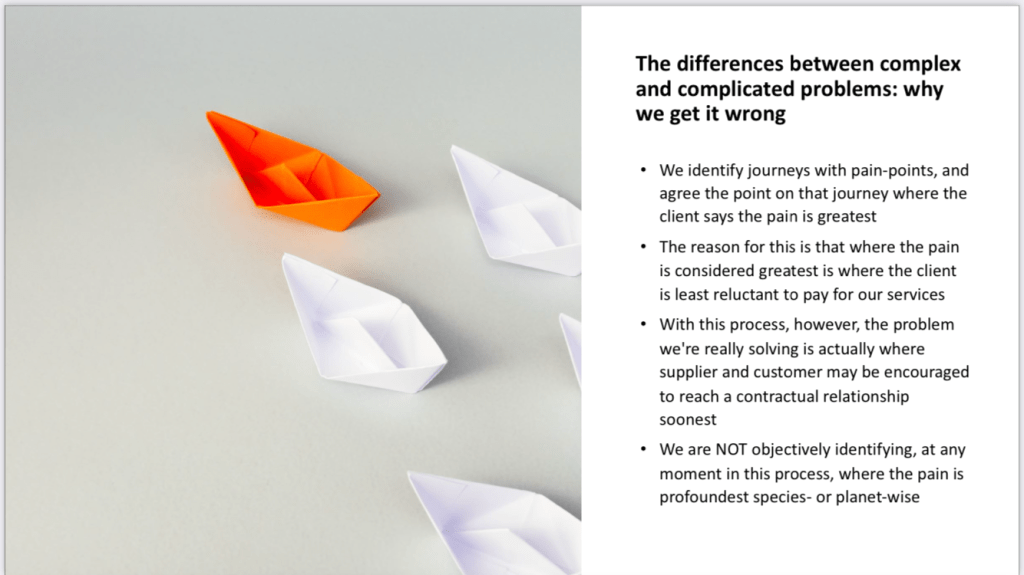
We have a global startup ecosystem which, for decades, has delivered a capability to simplify problems from a complicated journey to a set of easy-to-understand “pain-points”.

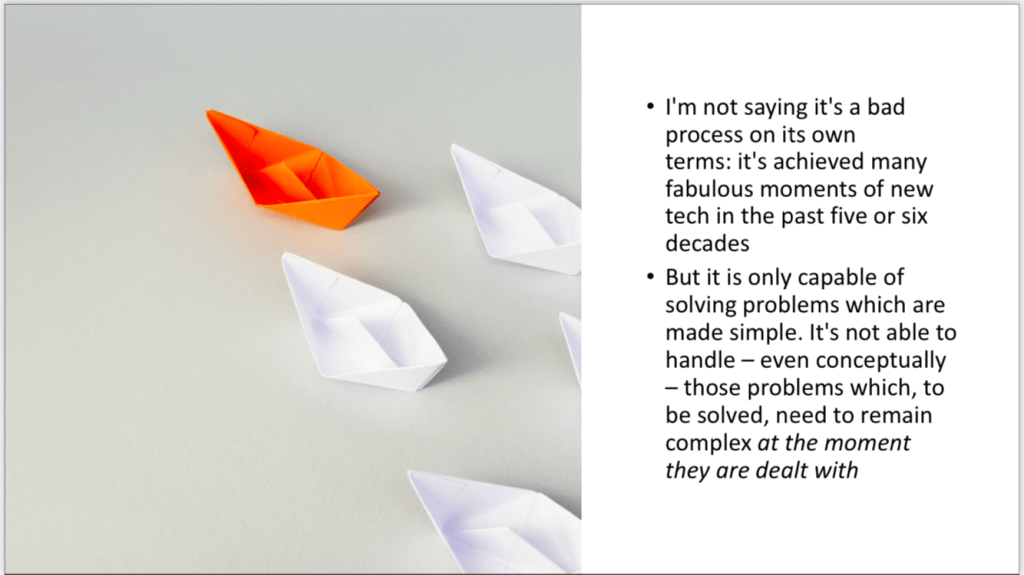
It’s solved many problems we needed solving — though sometimes has caused others which have delivered a much less happy set of outcomes.

This presentation, shown in four parts below, has the goal of beginning to stir a debate around whether the concept of incremental progress is useful for us, by itself, any more.

The question I would like you to take away from this online whitepaper is whether you think humanity can incrementally save itself from its past.

Contact details are contained within the presentation itself, as well as in clickable mailto: format at the end.

Otherwise, if you can at least reflect, I’d be really grateful.

complexify.me

complexify.me | sverige2.earth/complexify

complexify.me

I have been working on making the timelines practical, comfortable and safe for all stakeholders — whether #climatechange- or #lawenforcement/#security-focussed.

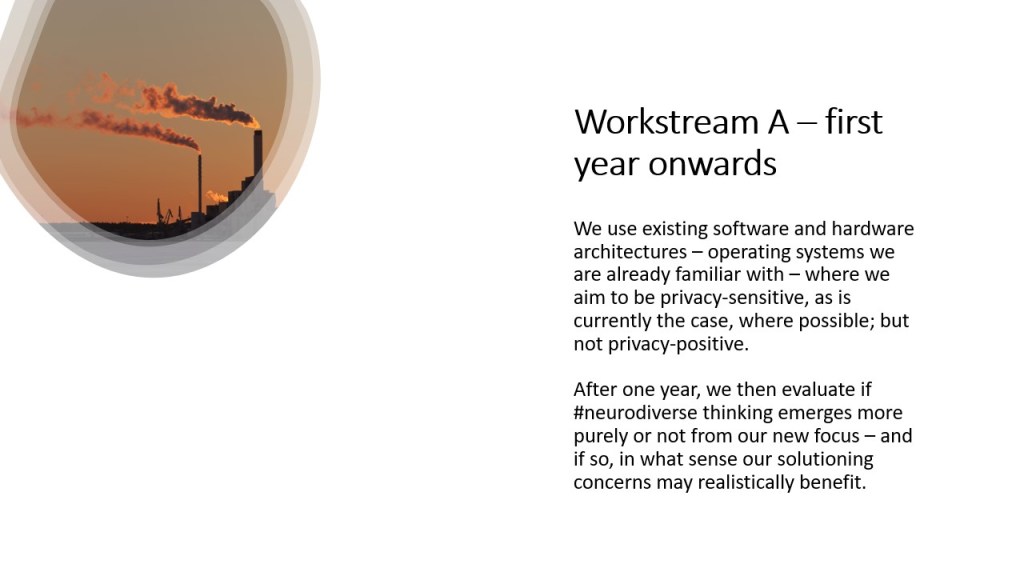
We now take things step-by-step, over the proposed period mentioned, evaluating the results of the four workstreams A-D in turn in firm but responsive ways.

Here’s the second presentation in the series, which offers an initial roadmap for #neurodiverse-solutioning #thinkingspaces to solve #complexproblems such as that which #climatechange now presents humanity on all fronts:


My suggestion is now that:

  • we locate — with #swedish, #us, #irish and #uk stakeholder engagement — the core #complexproblems HQ in #dublin #ireland, in close and permanent collaboration with one large consulting corporation and one preferred tech corporation;
  • that all IP generated by anyone be #govtech only;
  • that the project management and related responsibilities for #security and similar belong freely and entirely to domain owners in each participating country;
  • that tech partnerships and other frameworks for #security etc will also be freely entered into by the respective domain owners in each country (that is, military, agencies, and others);
  • that any of the #govtech thus created belongs in the future only to these stakeholders above-mentioned;
  • and that as everyone who contributes will have access to everything everyone else contributes, we will need to establish contribution KPIs that ensure contributions by all equal the usage we all make of others’ contributions.

I’ll be thinking more on these matters in the next couple of days and may post more here or elsewhere as a result.

Let’s see if by my concentrating on having direct responsibilities only for #complexproblems-solutioning with #neurodiverse approaches, and then acting only in a consultancy capacity in the field of #security etc when and if the separate country projects see the need, we can finally unleash all these projects in a due, proper and deliverable manner.

Comments, as always, welcome.

Email contact here:

milwilliams.sweden@outlook.com