if i work with a big corp, it must be a free-thinking big corp capable of having its own, totally independent, criteria in respect of innovation
mil williams, stockholm sweden, 15th april 2023
introduction:
i’ve begun to re-strategise how projects like #complexifyme might reach direct clients:
first, identify convinced #neurodiverse company cultures where such thinking processes are already considered potential — or actual — skillsets
second, filter in those organisations that already evidence, publicly and proudly, innovation criteria clearly independent of those big tech partners might offer
i’m talking here of following what we might term the “ronald reagan approach”: go over the heads of an establishment and speak directly with an interested set of parties
finally, address such potential clients’ existent concerns in relation to whether the implementation of current #it-#tech serves their #neurodiverse business cultures, philosophies, beliefs and evidence-base
why this proposed approach:
this is the conclusion i arrived at yesterday: “if i work with a big corp, it must be a free-thinking big corp capable of having its own, totally independent, criteria in respect of innovation.” that is, be its own jury passing an informed and independently sophisticated judgment on what the tech barristers are laying out as the truth.
and then, via a final judge also independent of such process, deliver a final, robust and game-changing sentence.
meantime, is the above — as i assert — really true, do you think?
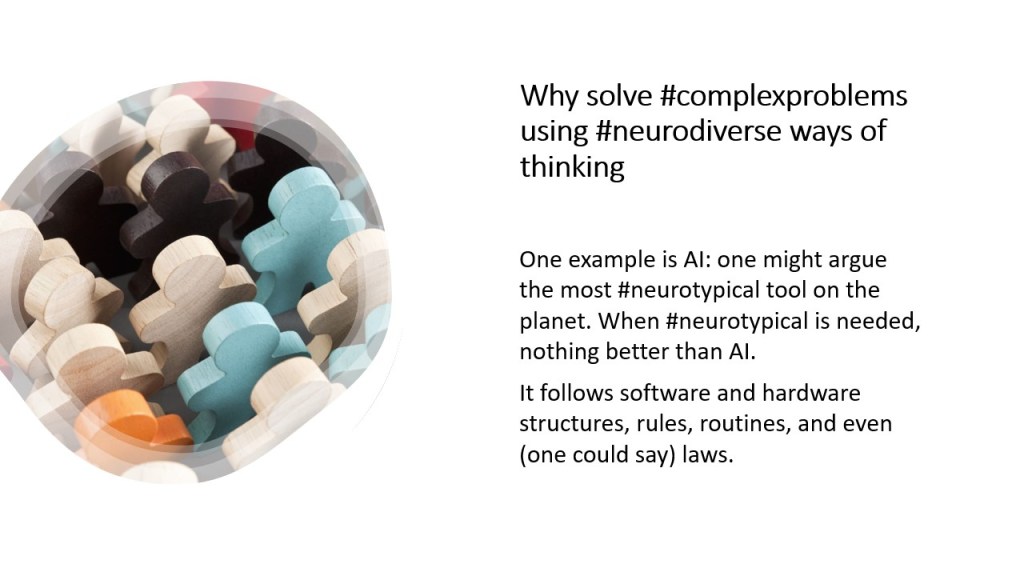
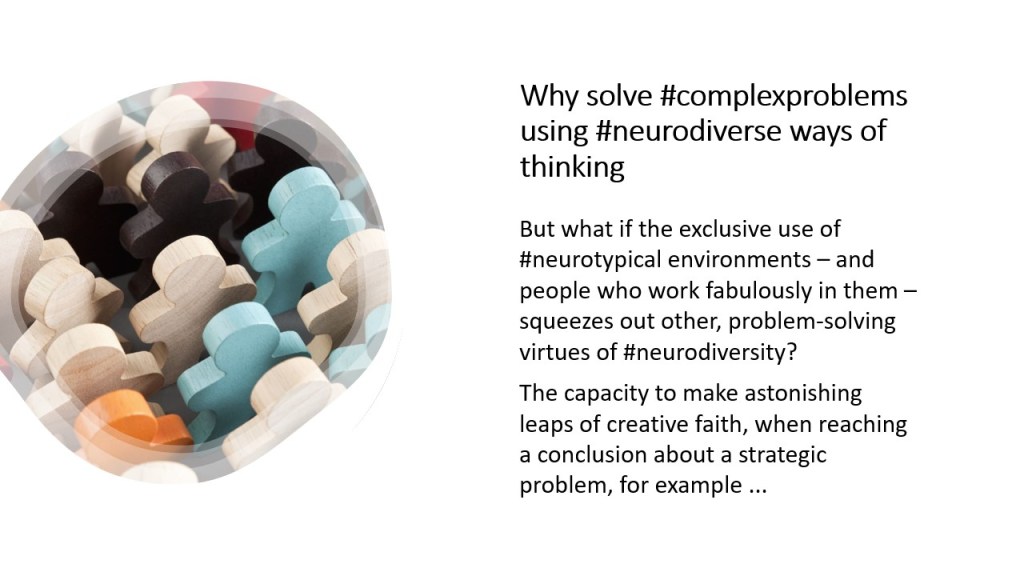
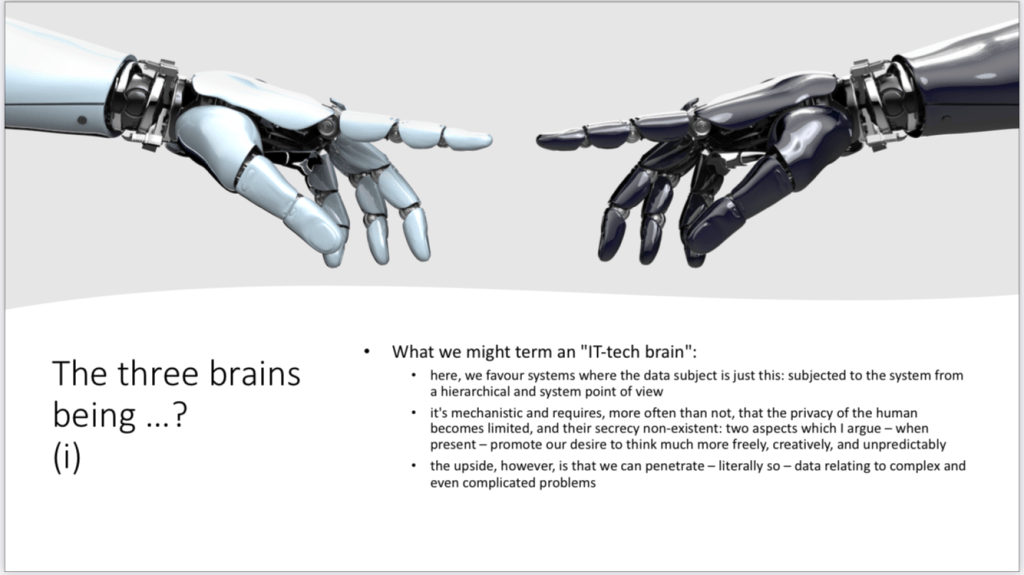
is #ai probably the most #neurotypical construct in the digital world? and given its widespread use, what does this mean for the problem-solutioning space we offer #neurodiverse thinking and their thinkers?
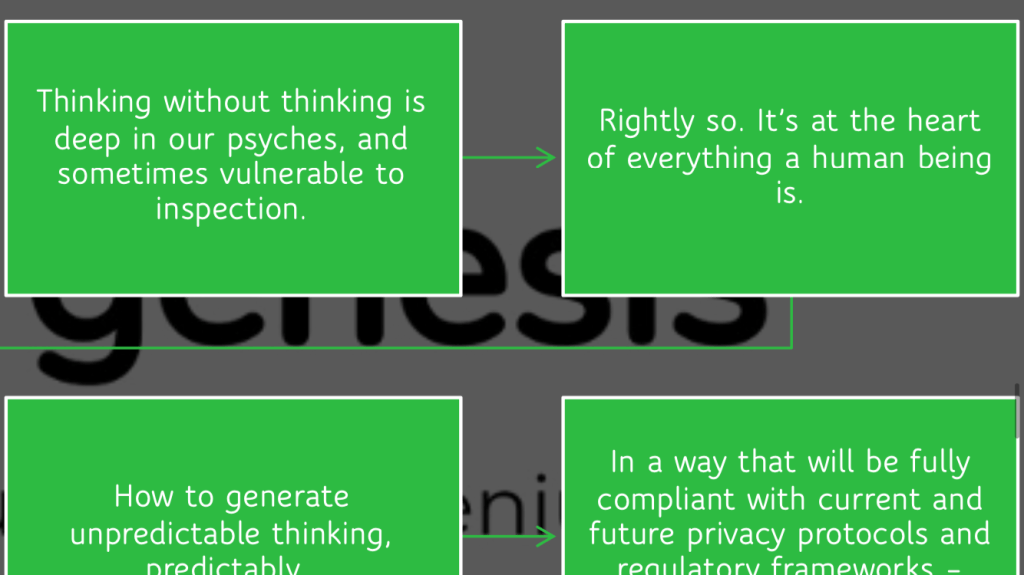
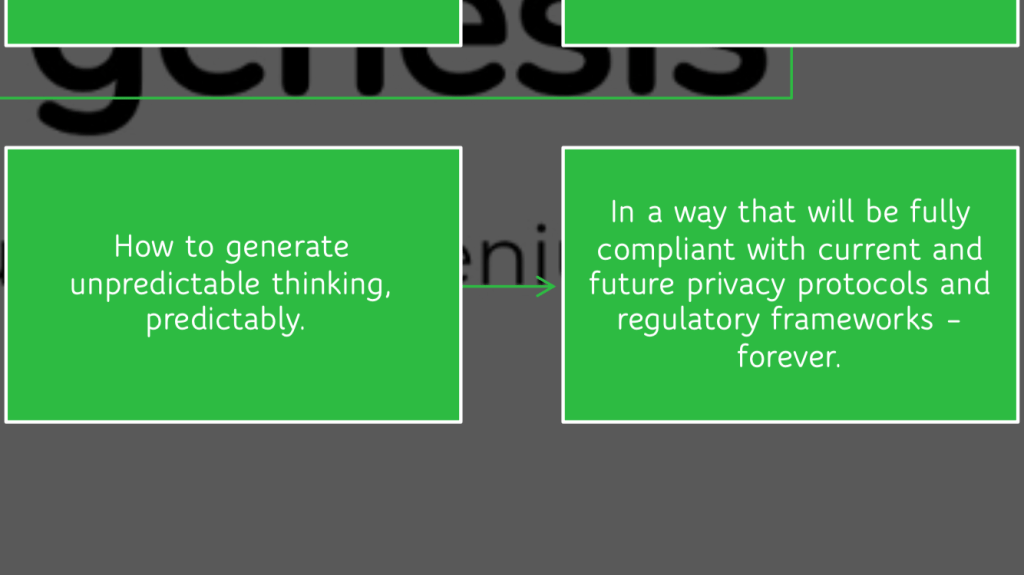
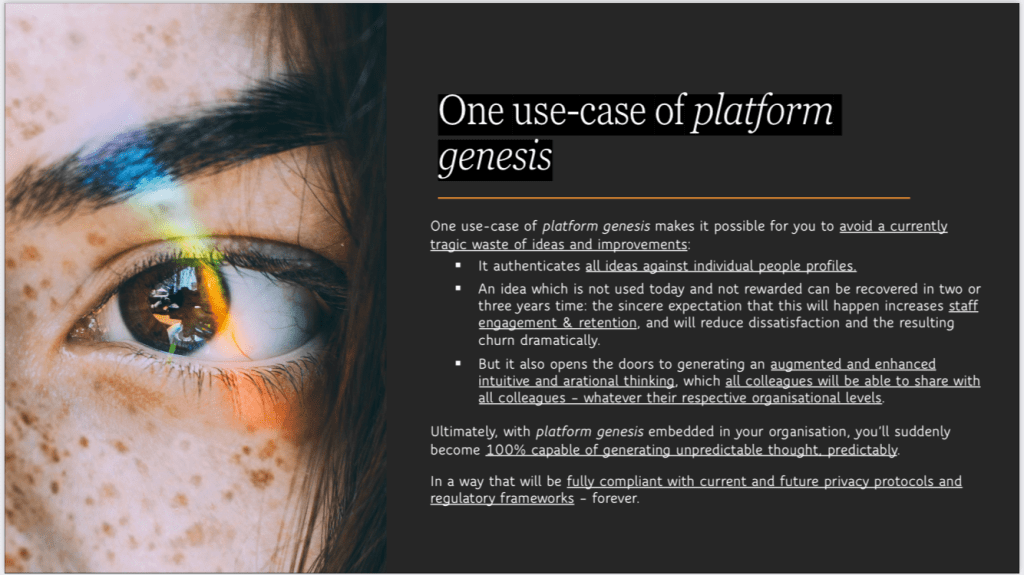
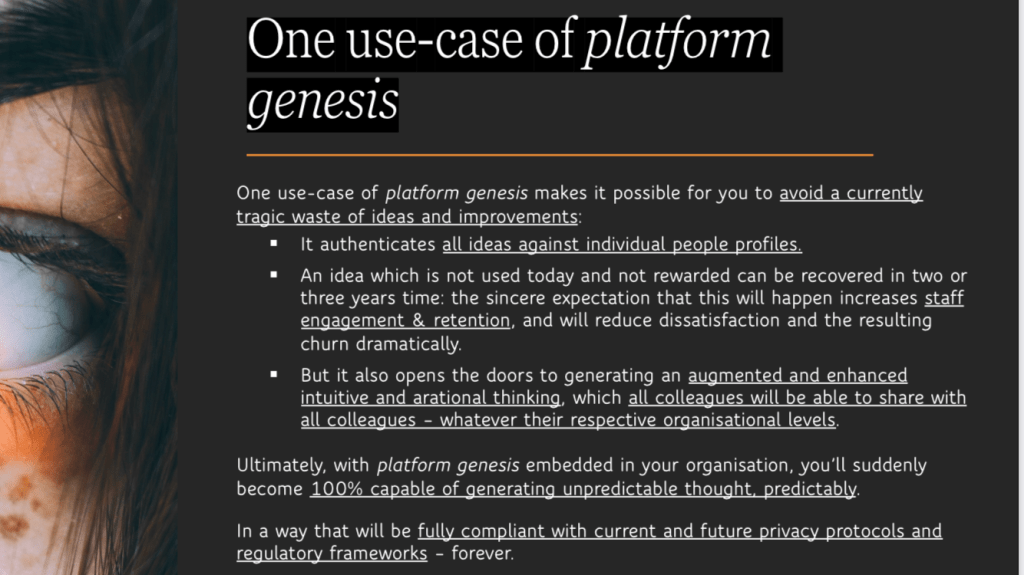
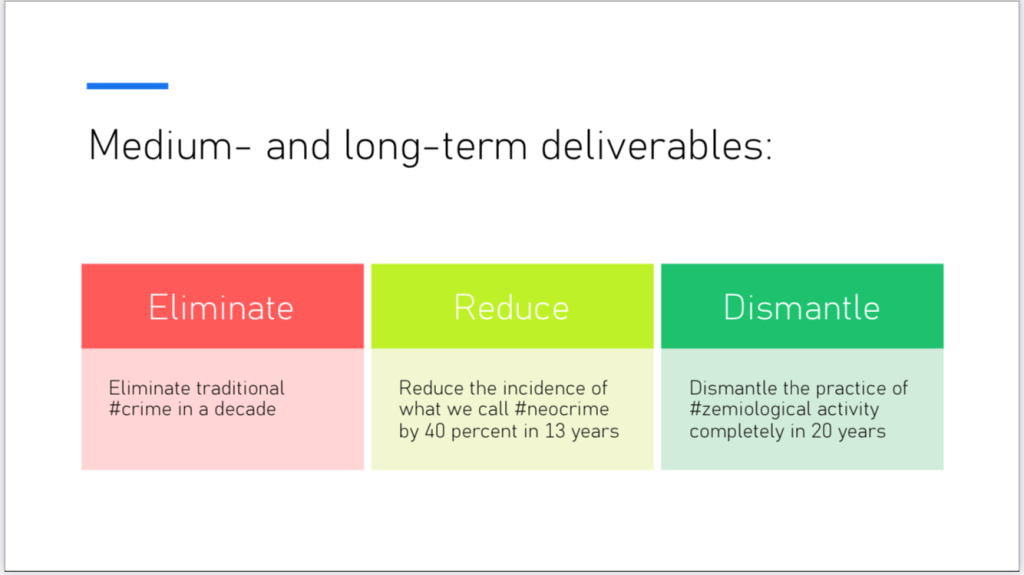
before you answer the questions posed, look at the example roadmap and its rationales below:
full presentation here:
summarising:
so. what do we think?
is #ai actually — in its broadly accepted automation implementations, at least — the most #neurotypicalising modern tool currently being used by humanity … and maybe misused at that?
just that … as i move from considering #lawenforcement and #security to the wider challenge of #complexproblems which may already be affecting our very survival.
which is not to say the first two don’t, but my thinking now assumes that if we can crack #complexproblem-solutioning first, we’ll then be in a position to give those in #security and #lawenforcement the opportunity to access such tools in a freer and more “pick & mix” way, which then may be far more suitable for their specific domains and wider ways of thinking than all my thought-experimenting has been to date.
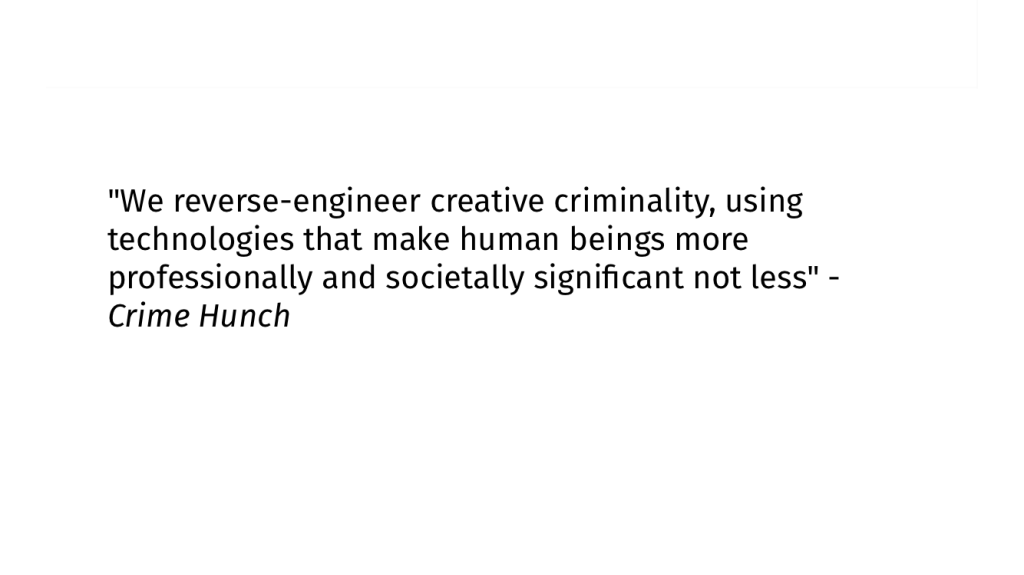
the presentation itself in image and pdf formats
the presentation itself can be viewed below as a gallery, and can be found in downloadable pdf format here:
crime is a domain i have pretty good knowledge of at #autoethnographic and #academic levels, but it is always going to be a subset of #complexproblems: #complexproblems are NOT a subset of a generally creative #criminality.
mil williams, stockholm sweden, 14th april 2023
i just want this to be clear. i’m happy for others to work with my ideas in security and so forth. but i am going to focus on developing systems for #neurodiverse #thinkingspaces that begin to solve #complexproblems our species needs resolving, above and beyond #criminality.
things like #climatechange and #foodsecurity for example.
crime is a domain i have pretty good knowledge of at #autoethnographic and #academic levels, but it is always going to be a subset of #complexproblems: #complexproblems are NOT a subset of a generally creative #criminality.
what’s more, i don’t have the confidence of people in #lawenforcement and #security. never have: never will. i’m a free-thinker, above all. this doesn’t make me better, at all. but it might mean it makes me incompatible with good #security and #lawenforcement praxis.
so this is what i am now thinking and strategising. i may be able to acquire the necessary confidence to do these things in other fields of human endeavour. at the very least, the potential for a decent engagement is more likely in other areas now.
if there are people in some allied country who work, even so, in crime and related, and still are interested in what i propose, do come forwards and show yourselves.
but even here, let’s propose that anything we do starts with the principle and framework of #complexproblems, not creative #criminality.
contact me on the email below, if you do want to explore.
just explore.
just see the reality. examine the truth. and maybe, just maybe, do something usefully different for a change:
do we agree that creative people have neurotypical brains or neurodiverse ones?
let’s say, without any evidence being presented to hand, that they are more than likely to be tending to neurodiverse.
so.
what about creative criminals?
will they more than likely be neurodiverse — or just plain old simple neurotypical?
will they prefer to conform or disconform? will they keep things ticking over collaboratively and constructively? or do they prefer to break things when doing so serves to reward them with ill-gotten gains?
you know i’ve been right all along. and it’s hurting so much you’d rather leave me in the hell of your denial than accept i am right, in order that then we could do something about it by changing some of the direction of law enforcement and national, regional and global security.
though not necessarily the whole of the process at all. i’m not advocating this; never have either.
more of this in a bit.
neurodiversity, criminality, crimefighting and the real problem
if criminals — like artists — are more often than not neurodiverse, and machines — like #it-#tech more generally — deliver neurotypical environments where rules and regulations aggressively must regulate and rule everything we do when we inhabit and work in them, how on earth will what we do in global, regional and national security and law enforcement ever completely be capable of preventing even a minimum of creatively criminal acts of the highest criminal order?
the ones, i mean, that shake civilisations and their historical development …
traditional it-tech … what do you think?
this is the big question of today’s post:
is traditional it-tech made in the image of the freedoms of neurodiversity or the strictures, rules and regulations of neurotypicality?
mil williams, stockholm sweden, 13th april 2023
if machines are more neurotypical than not, and creative criminality is more neurodiverse than anything else, where’s the judiciousness we will have demonstrated to be operating here when we choose to use machines plus more than likely neurotypical humans — that is agency operatives who are focussed on applying rules and laws (and quite rightly, too)?
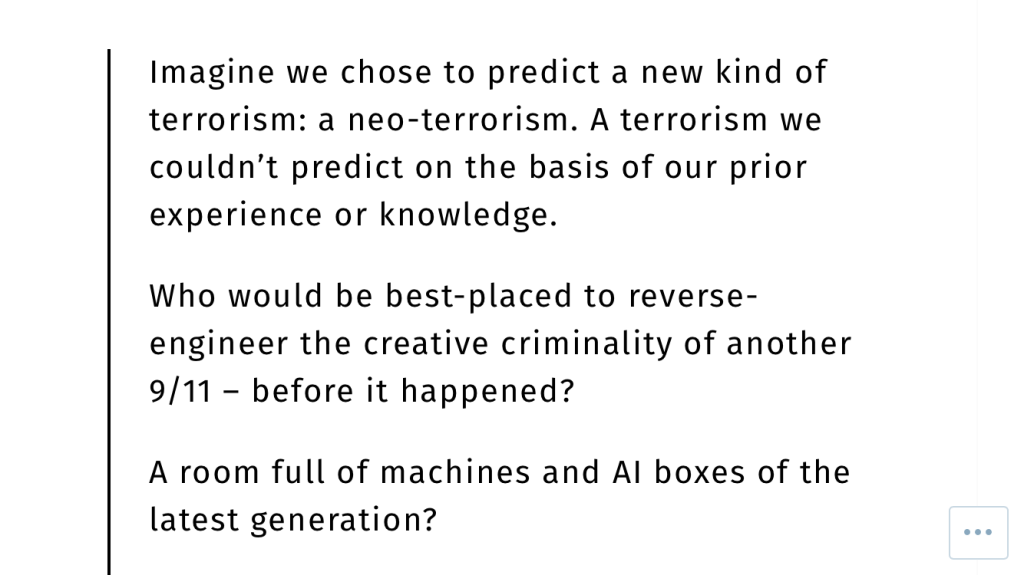
how will we be ever able to fight neurodiverse creative criminality of the 9/11 sort — especially when now applied to the deepest digital cyberspace, to dark figure, and to neocrime — if we don’t use newly neurodiverse crimefighting humans enabled by the radically neurodiverse software and hardware architectures i am now advocating in the complexify.me workstream?
and to be delivered in the following order — humans (maybe neurotypical and neurodiverse) first in the workflow, supported by machines in second place; not in the traditional order — machines which spot and spit out largely neurotypical (even when obviously mega-) insights to support equally neurotypical humans …
look.
don’t get me wrong, please. we need neurotypical: we need conformists more than any time in our history. we need people who just love to pursue those who don’t follow the rules and laws that provide the best foundations for civilisations and societies we’d all wish to be proud of again. people who love to apply these legal figures with due and appropriate process. people you’d trust with your youngest children. people you’d trust with your life.
but we need neurodiverse colleagues; so much, too. nonconformists in every breath we draw, so we may all become better able to pursue bad actors imaginatively, and therefore finally — on equal terms and learning how to properly fight fire with fire — we properly police this space we call digital: a space which has become almost infinitely malleable … and so intimately present in our lives now that we are not even safe when we drink a coffee in our local coffee shop …
there was only one kind of label that ever sounded positive for me during my life. because my parents labelled me and my siblings all our lives. and to our detriment: to diminish us.
labels can be shortcuts to understanding; or they can be machetes to slice a man into the dismembered state he’ll never be able to recover from.
background story:
in 2003 i was labelled and dismembered by the british state: i was judged a paranoid schizophrenic. it was a judgement: perhaps even a judgment.
they incarcerated me for a month and attempted to ensure i believed all was lost. two weeks after leaving my state of incarceration i was working fifteen- to twenty-hour shifts at mcdonald’s. when my social worker had assured me i would be fit for no more than maximum two hours a week voluntary activities for at least two years.
i refused to be cowed by this label: i am not made of the kind of stuff which will.
so as a young democratic citizen who grew up on the battlefield that was his parental marriage and relationship, a life-changing label was also finally applied by the country he had been born to.
nowhere did justice reside in his experience of life.
what happens when the label is right:
the label was wrong: and this i shall sustain to this day. why only one kind of label has sounded at all positive during my time on this otherwise beautiful and precious rock: that thing we call “designer labels”.
even here, they may be tinged with an injustice of sorts: privilege, and so forth. but i am generally generous to these kinds of labels and privileges because they are a form of art: real art. the clothing of human beings in pleasurable and expressive ways might not socioeconomically be within everyone’s reach — but neither is a picasso or a rodin.
what happened yesterday:
yesterday, however, i continued — like a plane’s circling of a crowded airport — my slow approach to the idea of being labelled … only this time in good faith, accurately and professionally competently.
before we continue, i’m not saying this is necessarily my “rosebud”, but as a process to getting closer to fairly starting to unpick my enigma, it’s not a bad place to begin.
second, i’ve been in sweden on and off since just before christmas. the swedish are generous; not malicious. they are watchful; not cautious. they are incessant, though not obsessive, gatherers of data of the world around them; they always know when they still haven’t got quite enough to take a rightful decision. and they are, in the main, kindly and aspirational; not ambitious in a trampling way.
my sister was accused of bad parenting for just about seven years by the english & welsh education system. her two children are super-intelligent: the brightest buttons and shiniest souls i have ever seen. the education law in england & wales makes it impossible for a parent to get a proper medical intervention when behavioural issues show themselves — unless and if the school agrees it’s not bad parenting. for seven years the two schools she had to interface with refused access to doctors. under this law, you cannot get access to a consultant for your own child even via their gp.
now it might occur to you to think maybe my sister didn’t know the truth about her own children. she doesn’t claim to, either. she never has. she did know that she didn’t have enough tools to deliver on the sacred joy and duty of being as good a parent as she wishes to be always.
i do have to say at this point, however, that she is a qualified psychologist and counsellor under uk systems, various. she does therefore have some privileged understanding and critical capacity in the areas of knowledge in question. the schools in the uk didn’t care. that only made it a more bitter pill for her to choke on.
how and why sweden is different:
she and her family emigrated to sweden a couple of years ago. her children, and wider family therefore, are now being supported and enabled more in a year than seven in the uk.
she has had to accept that to unlock this support a labelling process for her children did have to proceed. but here the process has striven mostly all along to evidence its trustworthiness: that is, its desire to be trusted by all stakeholders involved. in the uk, my experience showed that the british are prepared to use mental health tools as weapons of an undemocratic security infrastructure.
this is why i am now ready to be labelled:
you might immediately say: “surely RElabelled.” but no: you would be wrong. i wasn’t labelled: i was attacked, taken out and dismantled over decades by a security establishment that didn’t like the truths they knew pretty soon i would begin to deliver on in respect of their incompetences, multiple. if, that is, i didn’t have my capacity to bear intellectual and sociopolitical witness undermined profoundly first.
the time i’ve been in sweden is the first time — the very first — i’ve ever been in a country where this hasn’t been the desired end i’ve sensed.
and this is why — in such an environment — i am now fully ready, aware of all the potential consequences — to be labelled duly and compassionately by a nation-state of compassionate and proper citizens and professionals.
because what this will unlock is surely, now, worth its weight in the most precious substance known to humanity: the truth.
and these freedoms for us all. not just the inhibiting hierarchies enjoyed by those who own — in more ways than one — this thing we know as tech. and therefore our democracies.
mil williams, stockholm sweden, 12th april 2023
there is so much #darkfigure being delivered by people in tech, and our law-enforcement and security agencies have given up on developing systems which could counter such #neocrime:
the agencies rely heavily on machines plus humans — in that order — because their tech partners are interested in the monetisation virtues of this order of priorities:
meantime, the bad hackers use humans plus machines — in this order — to creatively imagine, imagineer, and only then engineer new and covert ways of committing crimes that remain as invisible as possible for as long as possible.
and it’s not even that our agencies are criminal in the main (though some take advantage of #darkfigure extensively to bend, or sometimes go so far as to break, the law), but their ongoing inability to recognise the importance of humans over machines is negligence of a sort:
and even more so, the illegitimate criminal power of the human+machine workflows and deals over the agency machine+human combos is utterly ignored, in the absence of truthful criteria re innovation and procurement. and yet it would be so easy to begin a process of repurposing, with integrity, of existing technologies to ensure people are made bigger by machines and not diminished.
i’m sorry. but it has to be observed, painful though the recognition, if a given, will be.
because this next one has to be taken on the chin, if we are to improve our capacity to fight creative criminality in a collective future-present:
9/11 came about because horribly creative humans used machines as tools to kill other humans, who failed to prevent it from happening because their tech partners had consistently recommended using machine+human workflows.
not because they really believed this was true; that is, that human intuition was a lesser value than the incremental thinking engendered by machines.
no.
rather, because machines+humans make more money, more easily, than workflows that consist of humans+machines … that is, humans expanded and enhanced by machines.
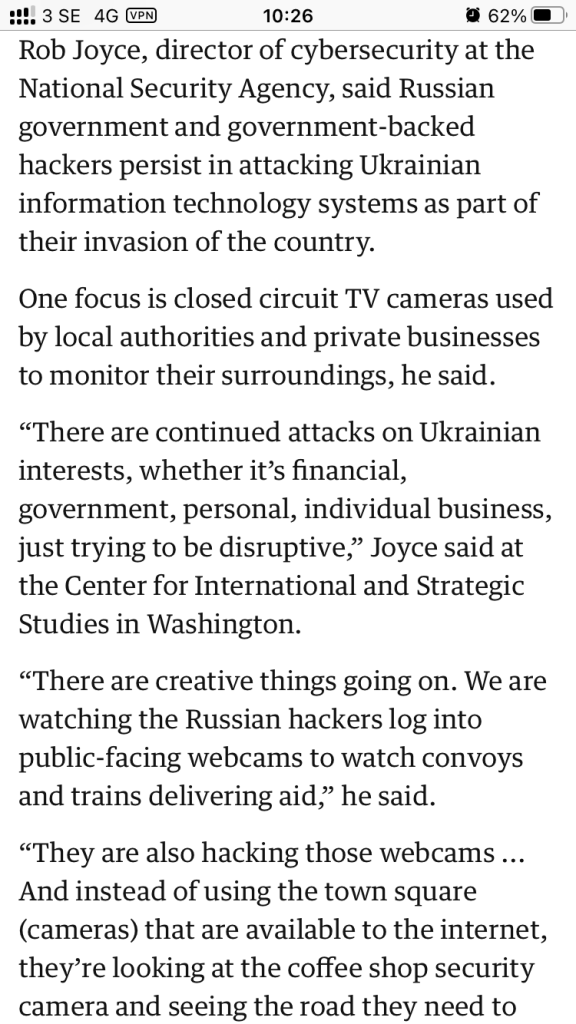
and so the only way we can prevent such horrors in the future — particularly the invisible ones such as the recent us defense leaks due to bad hackers and web actors, some of which date back to october 2022 and are only just now discovered, as well as the cctv hacking reported in the guardian newspaper article above — is to begin to reverse the order and purpose of tech.
this — what follows now — is what i suggest and advocate most firmly: humans always first, enhanced and expanded by tools whose primary rationale no longer remains monetising a tech partner into obscene levels of technological wealth whatever the wider human cost but, instead, delivering without exception on making a safer and more secure, more legitimate, more socially responsible, and more honest world all round.
and these freedoms for us all. not just the inhibiting hierarchies enjoyed by those who own — in more ways than one — this thing we know as tech. and therefore our democracies:
last night, speaking with a member of family, who professes a faith that includes a deity called god and its counter-element being the devil, i realised that society is full of bad people. not weak people: deeply bad people.
21st century third-decade societies — whether british, irish … wherever … oh yes, there are good people … but power in a tech-riven digital world, a world where tech of all kinds of levels rules, is insidiously criminalising every effect we once were reasonably able to assert was random. there are plenty of good people it’s true; but only the bad exert the power that makes the world run and administers what actually happens.
an anecdote from yesterday:
a young woman said to me yesterday evening: “it’s just stuff.” she was either facile & naive or dangerous. but probably dangerous in any case, because in the face of such embedded criminality, she chose to claim it was random.
re dark figure, law enforcement and security globally:
and so we come to this conclusion: law enforcement and security across the world find it much easier to deliver on their kpi structures by chasing and incarcerating those who don’t know what they’re doing than the covert digital-based criminals at all levels of tech who do know what they’re up to — and more importantly, how.
why i will no longer look to work with security-related citizens:
i’ve already signalled on these pages and others that i will no longer work on projects related to these kinds of professions: let me now explain why.
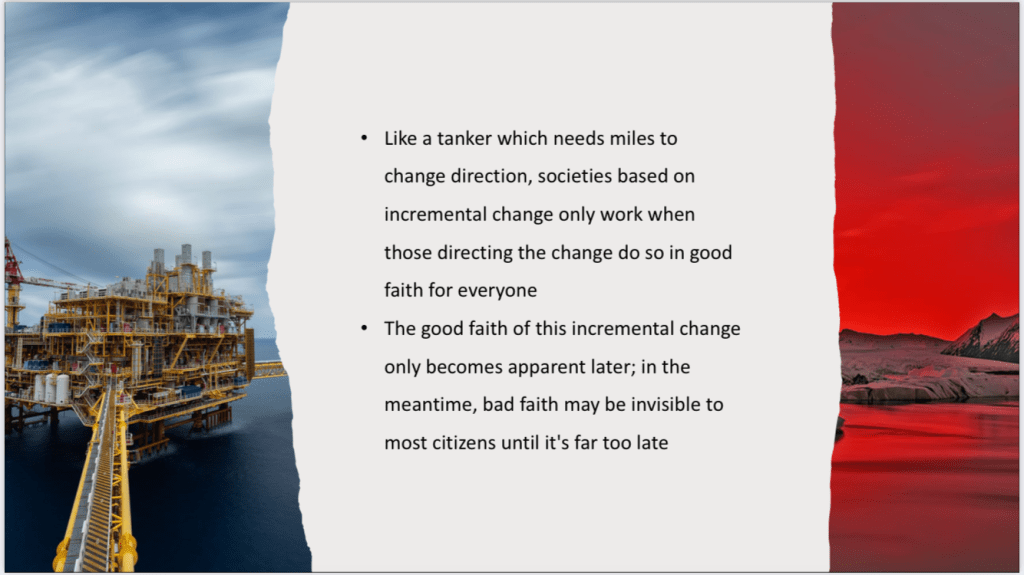
they depend on modern tech; on modern tech partners to explain what’s possible and what’s not. in a system where legitimately we have always separated out judge and jury, when it comes to procurement of tech we connect judge and jury both so they’re in the same bag as the criminals themselves.
tech is corrupt from top to bottom. it shouldn’t be trusted with advising what’s possible in respect of innovation.
but hey … who am i to say?
my next steps:
i’m no longer going to bang my head till it bleeds. i’m going to repurpose ALL my #secrecypositive ideas — this time with zero elements of #totalsurveillance compliance — in order to begin to implement tools to solve the #complexproblems the #leanjourney toolkit has chosen to filter out all these years:
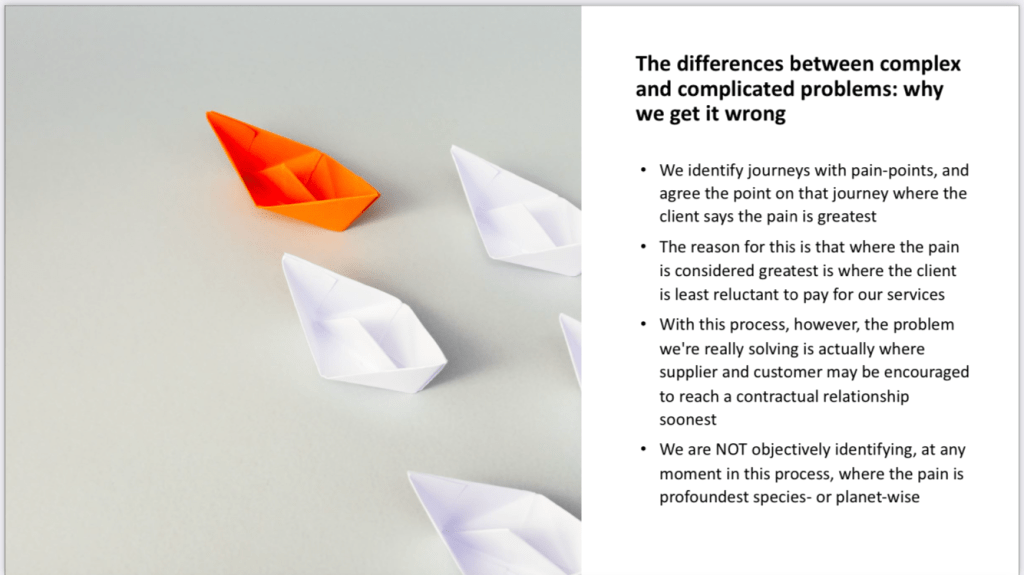
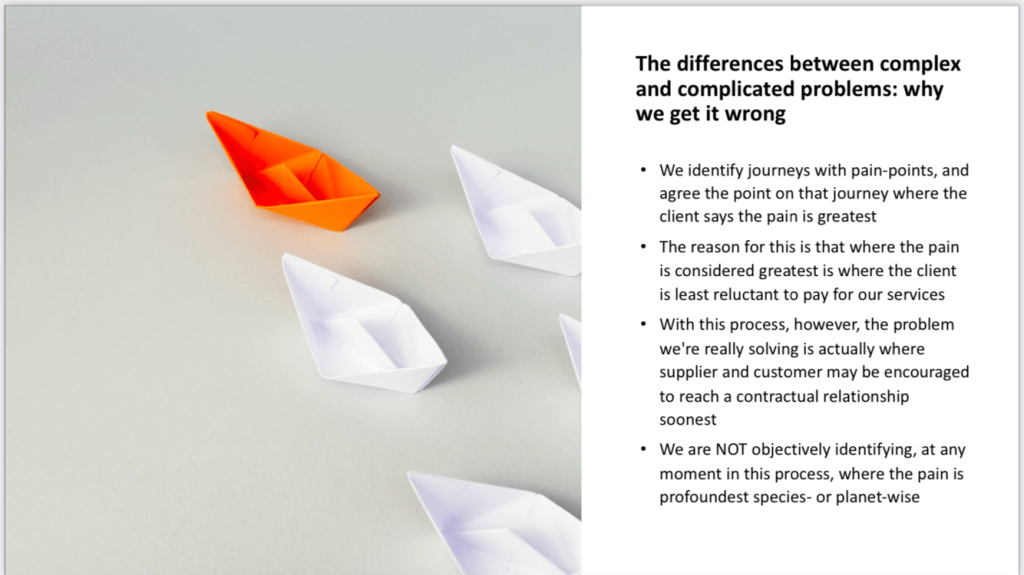
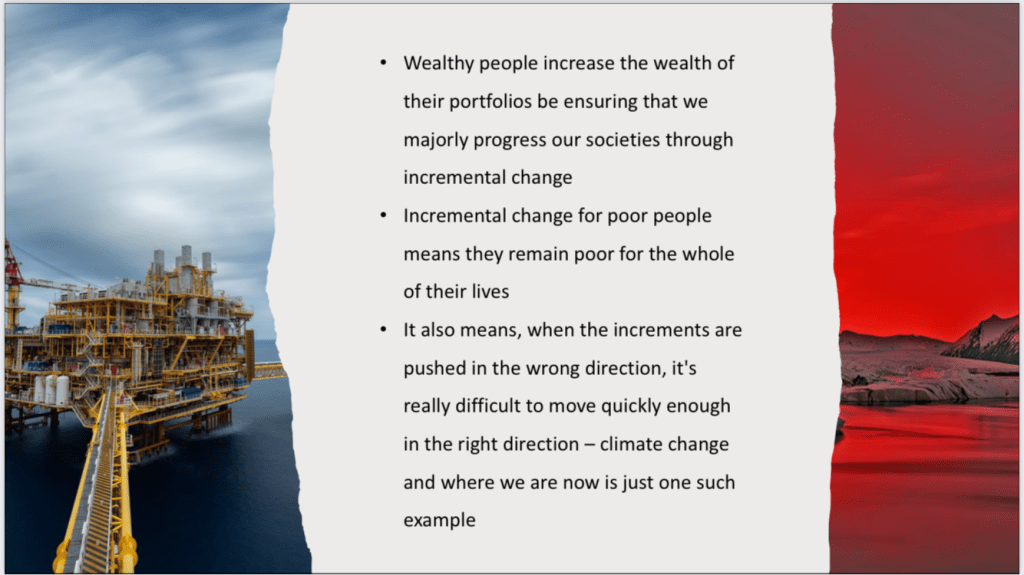
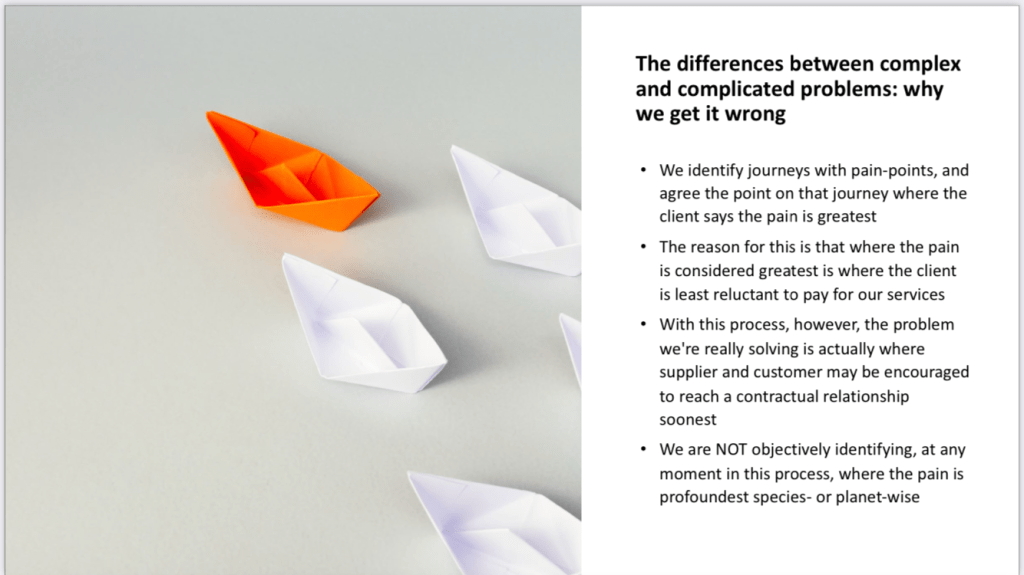
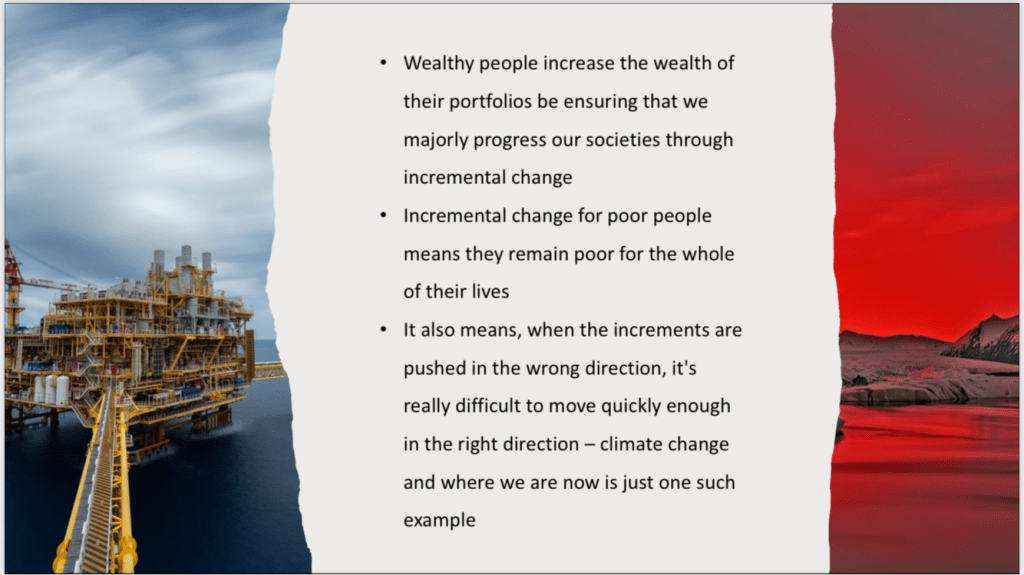
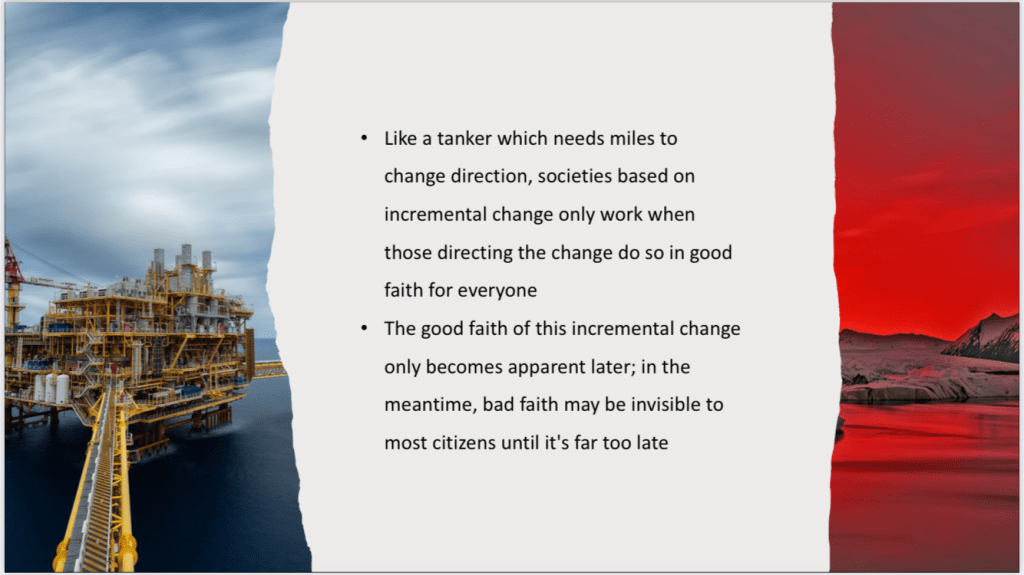
because modern tech only primarily aims its crosshairs at ONE problem: how to ensure the customer pays. everything else is how to cherry-pick out of solutioning-process what’s not relevant to a bottom-line.
great for the individual company’s balance-sheet; but sincerely catastrophic for a wider society.
as climate change — just one example — now shows.
complexify.me – done simply well:
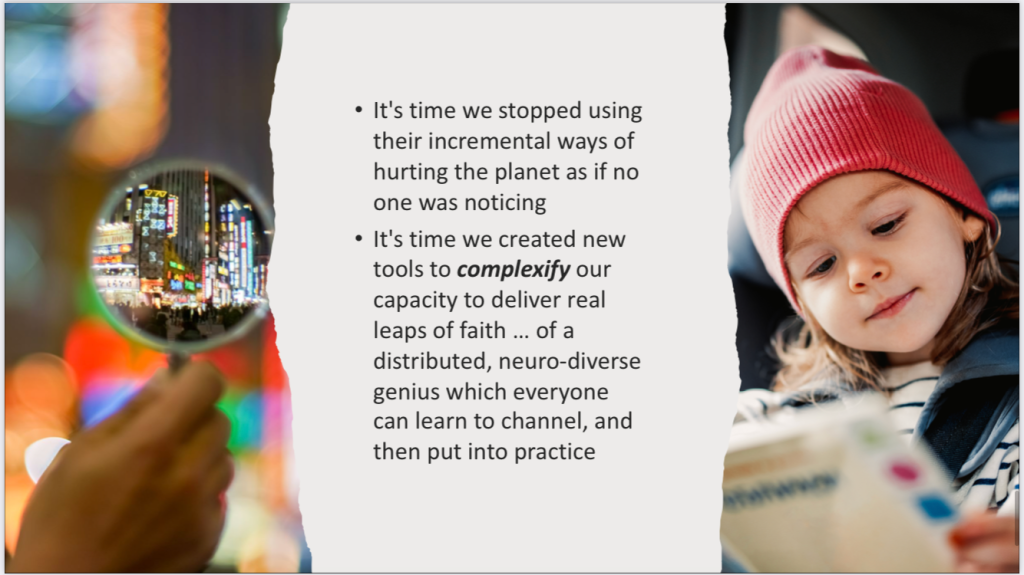
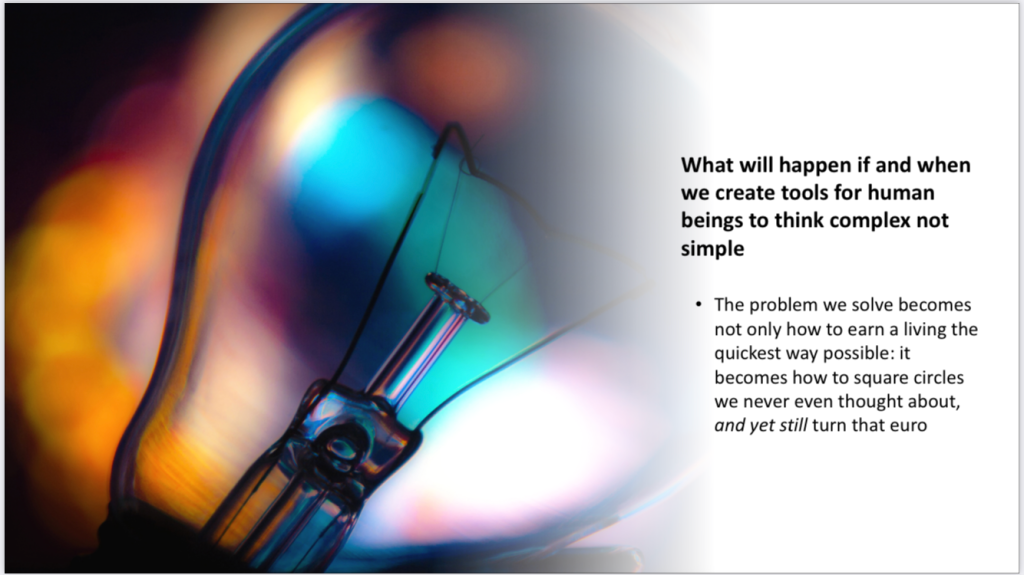
i’m now going to concentrate all my forces on creating a tech ecosystem and set of tools which tech doesn’t care to invent; has chosen, in fact, just about criminally not to all these years.
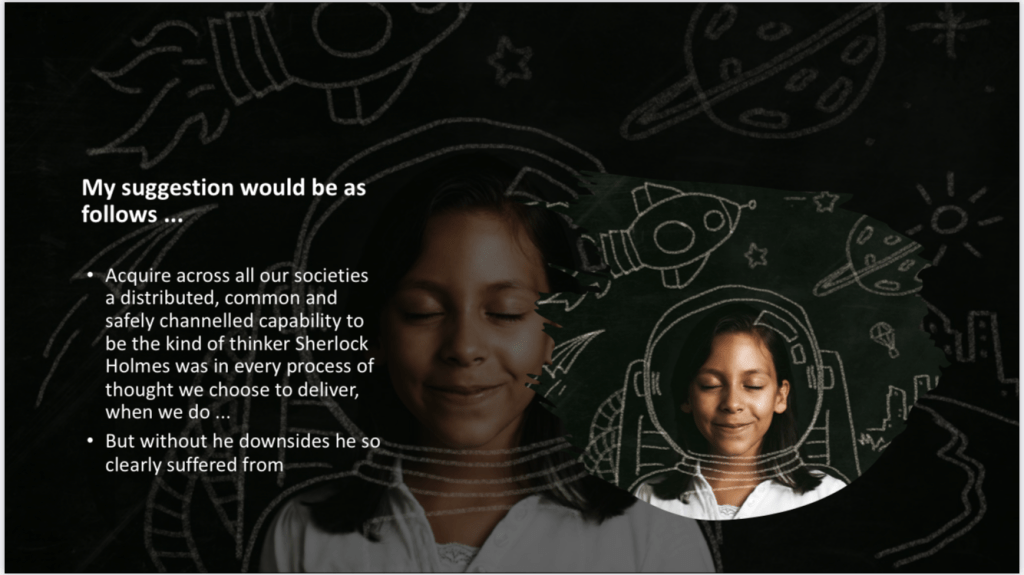
an ecosystem and tools where #neurodiversity FINALLY delivers as a skillset, not a touchy-feely inclusion impulse.
and to the extent that #diversity becomes the new norm; and so normality returns to being just one more arrow in our society- and species-saving quivers …
let’s say i have to do something to be allowed to live:
i have a no-no or two, though …
not meeting family: not anyone. maybe one exception … but not a demand i make again; not even implied. not even wishing for. i won’t presume.
re family, i’m happy with my mother and the one sibling i get on with, but no one else on any other side. there’s always my children and so forth, but that’s never been your business. that will begin to work again in the future if it does; and if it doesn’t, i will share responsibility for any eventual failure.
‘problem is, you lost me this morning when you didn’t follow up — here no going back, because you were playing with me cruelly: no irish, no croatian, no other english — forget it.
talking realistically, in order to square two circles:
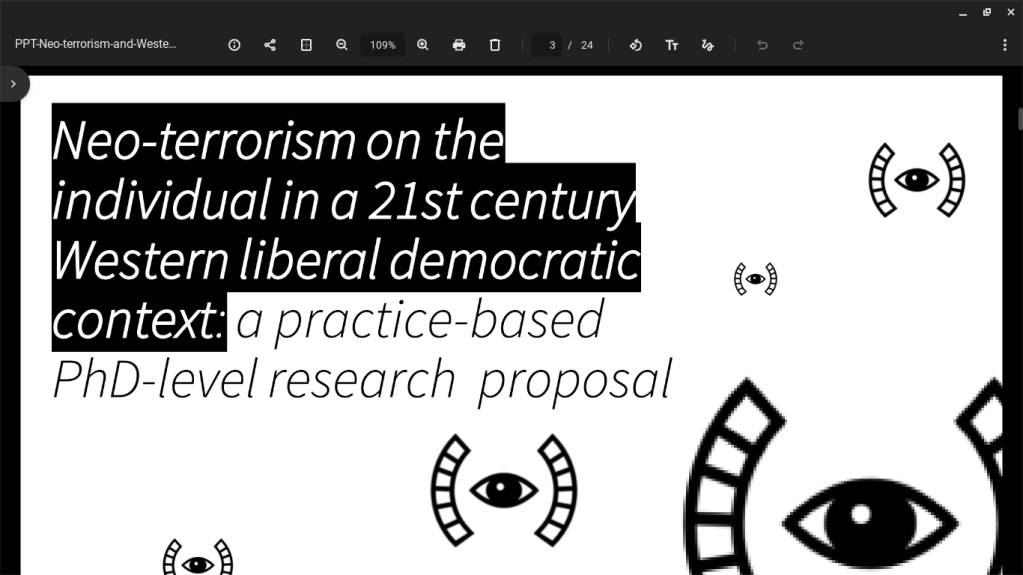
let’s talk realistically — what can i do to have a life more or less reasonably without your surveillance and neo-terrorism, everywhere i turn?
remember: i will, after what you failed to deliver on this morning, never meet with family nor anyone with a relationship to, whether personal or business, whom i don’t already get on with. you lost that opportunity today, just to underline.
but other things within my capacity … well, these things, for sure … more than happy to, actually really eager to.
you want to undermine the capacity of the tech i want to see in security? this can be resolved easily. you have your reasons i know: i can see why of course, though i will never share the criteria because i am far more a purist in these matters than you ever will be. but for us to proceed — for you to proceed — there is a solution which i now put before you all.
one caveat: one condition. as long as i get enough to have a comfortable rest of my life, we can talk about this but it requires you first to evidence that “neo-terrorism on the individual” will not be committed against my person again. and that is not an easy call to evidence.
some minimums, first:
i want european residence from this month.
i want an official, even if only cover, role that suits my skillset, in my judgement.
i don’t care if it’s employment or self-, but if either or both, i must be very difficult to fire. i want the kind of job security i’ve never had in my life, mainly because of british interventions to date.
i commit to targets everyone must commit to, but no opportunity for “noi” again, for this reason. (whether uk/irish influences — or within sweden itself, the latter of which has also already manifested itself.)
the legal side: i want a position of institutional power to deliver on “noi” as a robust legal figure, in the three years i scope; and thus the seven years i have as my goal to regular and widespread prosecutions.
i want to be in charge of complex problem-solutioning programmes, but completely outwith security.
i want to be able to exclusively license to all fields relating to security, the strategising and development of which i shall play zero part in the future.
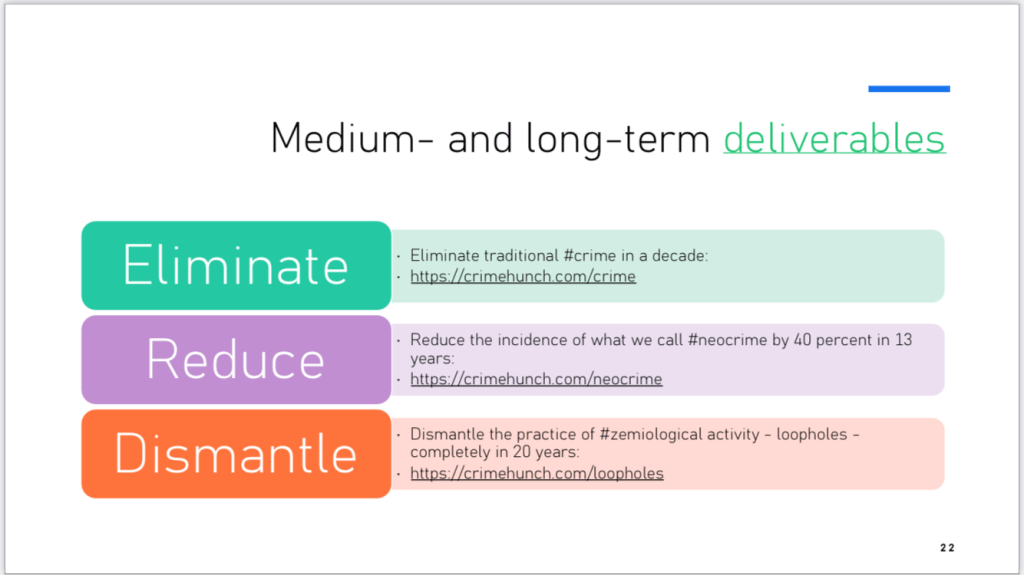
loopholes, however, will remain part of my side of the deal: a complex problem to be eliminated eventually in the 20-year timeframe i propose. “noi”, too, as previously mentioned.
no conditions can be placed around the tech my side chooses to repurpose or begin to develop further. any developed tech will be developed exclusively for complex problem-solutioning, and then any reuse for security will involve new licensing agreements.
c is fine if she wants. it’d be cool and fair if she did, but that’s her choice. she chooses.
no other family contact, not after today.
no people or companies from my past in what i am responsible for: they may, if it is judged appropriate, however, freely participate to any level at all in respect of security workstreams i have nothing to do with in the future.
distribution of existing workstreams:
websites:
i license ideas from crime hunch, citizen hunch, and omiwan to security.
platform genesis is complex problems, not security.
the philosopher space is complex problems, not security.
secrecy.plus where applied to complex problems belongs to this stream. where security, it belongs to security from the start.
we negotiate the details of the division and separation, as expected would be the case.
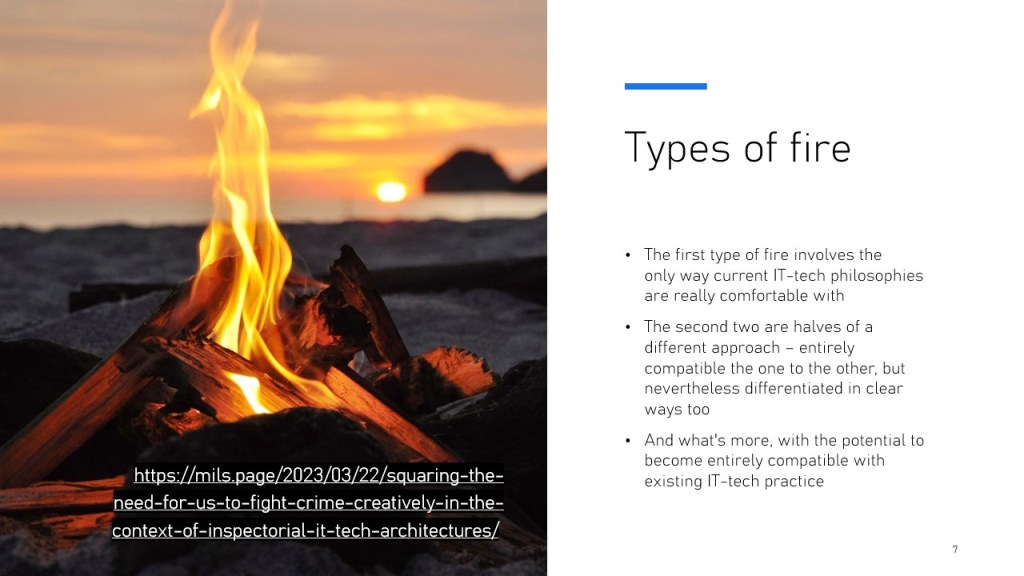
examples: fire is clearly to be licensed to security, and will not be my responsibility in the future.
digital pencil & paper is my workstream.
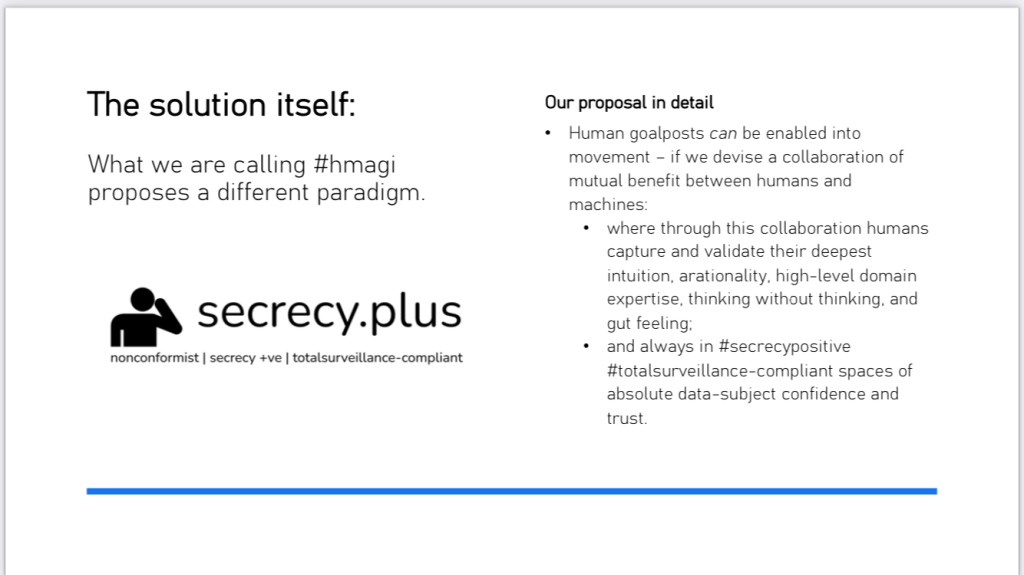
i want hmagi for complex absolutely, but maybe it can be a common workstream. i doubt you will eventually want it; but i’m up for a common workspace for it, myself.
never meet again: that i keep entirely for my workstreams. nothing to do with security.
complex problems: where do they sit and who do they work with?
my initial thoughts: swedish interests, agencies and unis; the eu, particularly the ec; the un; and so forth.
security: that’s up to you. not my job. but i’d suggest:
the italians first, who are historically firm in the integrity of their pursuit of organised criminality.
in the uk, the met’s internal affairs department might be another good place to start.
locations:
complex problems obviously then to be located in sweden and europe.
this means it’s very easy for security to definitively locate to the us.
but never again shall i salivate the evil of the unnecessarily violent. as a last resort … this is how life sometimes must conduct itself. as a tool of habitual state … this is not.
mil williams, johan & nyström coffee shop, stockholm sweden, 9th april 2023
it’s not all plain selling. but then that’s not what life’s about.
but if i manage to stay here in the end, this — the end — it won’t be. it will be the best beginning i’ve ever managed. i spent seven years between the uk and ireland, trying to engineer a relationship between ireland and the uk. i failed.
now i say it out loud: not with joy but acceptance. acceptance that i failed in everything institutionally and personally related.
but not ideas-wise. not in respect of my increasing capacity to uncover them: like a pig and his beloved truffles. for me, ideas are truffles, waiting to be found; and they say that pigs bear many good resemblances to humans. physiologically, for sure. maybe in other respects i am still unaware of.
all i can say is if a pig is good enough for george clooney, why not associate myself with the same?
🙂
so why here — and now?
because in a very brief period of time i see a society like none i have experienced in my life. there are cruel people here: but the society as a wider whole is striving not to legislate or legitimate state cruelty. and this i am defo not accustomed to back in my homeland.
so if i have to contribute to a tech which scales up basic government and regional administrative instincts, i want it to be in a place where more manually these instincts are sound. meantime, the triumvirate of evil exists in the uk with the conservative attachment to russian wealth and trump’s idiocies all in one. and all by now as an all too well-established nouveau establishment of the horrifyingly, casually cruel.
one thing many don’t realise, and i still don’t fully understand: a military society can be a liberating one too. it all depends to what purpose you militarise — and with what genders you compose your military out of.
during my whole time in the uk i was oppressed by outliers of a military which, tbh, needed very few outliers anyway to operate and impose such oppression with the necessary precision. look at the state of the london metropolitan police right now just to appreciate how ugly the uk has allowed itself to become. and that’s the first line: just the police.
this is why here, and why now. and if it’s not possible now and here, it will be somewhere else similar, and sometime then.
but never again shall i salivate the evil of the unnecessarily violent. as a last resort … this is how life sometimes must conduct itself. as a tool of habitual state … this is not.
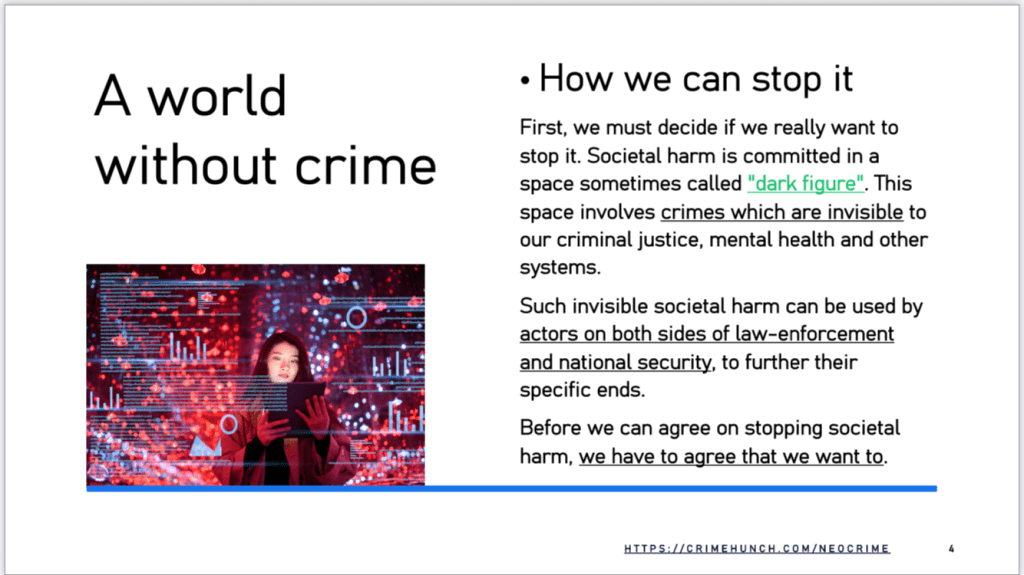
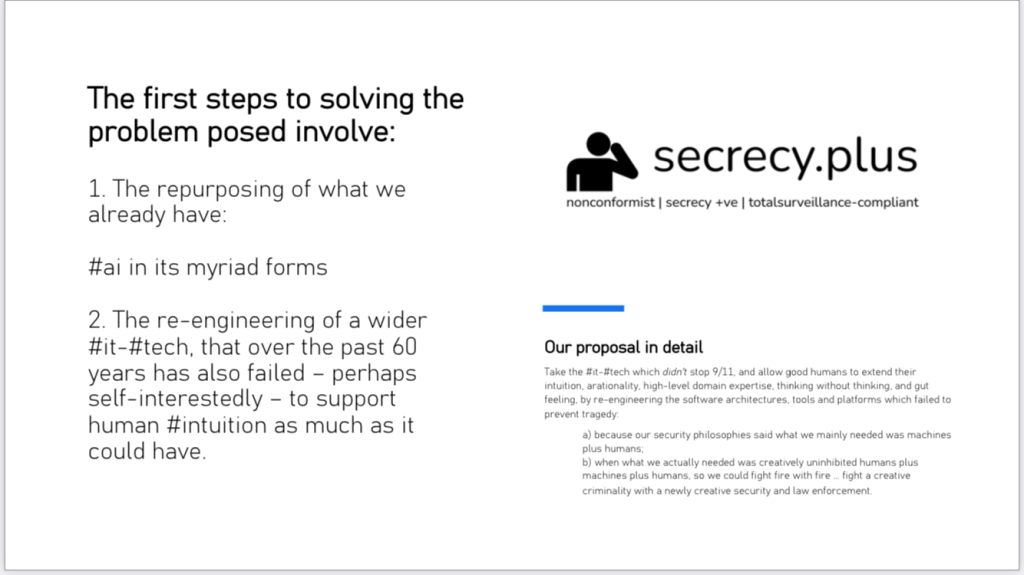
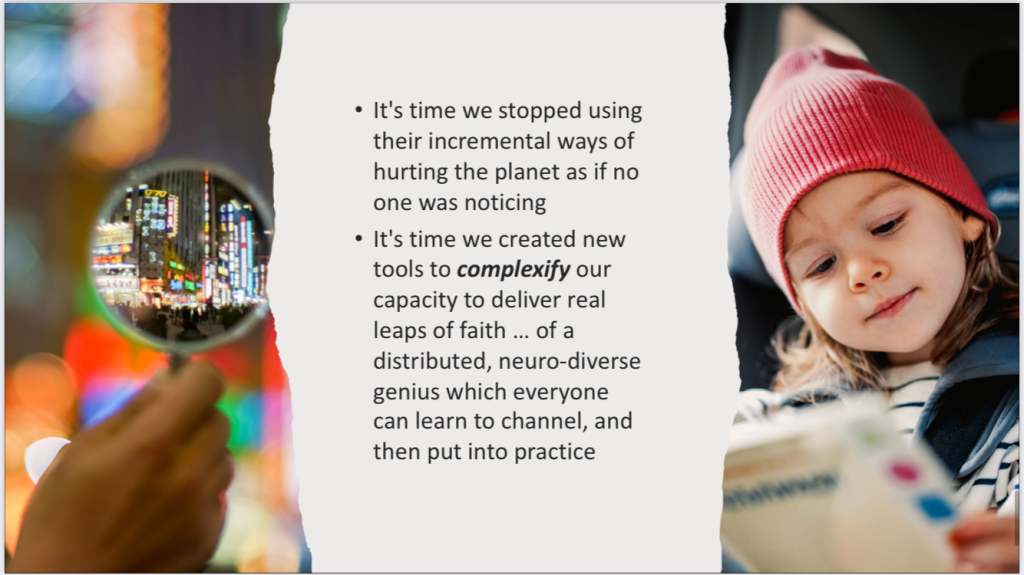
this post contains thoughts from a fortnight’s thinking processes more or less; plus the content of a synthesising presentation which is the sum of years of thought-experimenting on my part. i’ll start with the presentation, which is now where i want us to go:
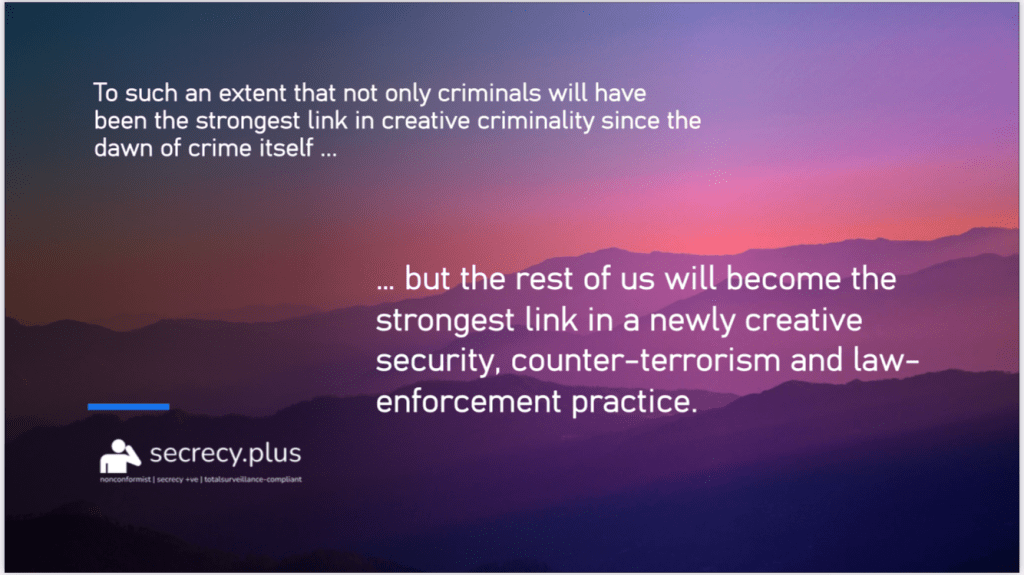
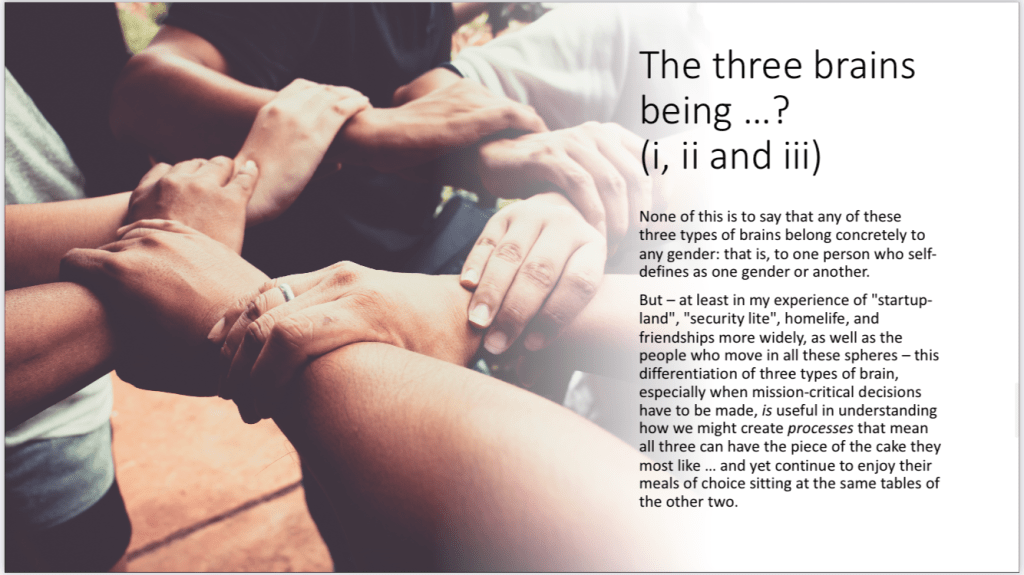
fighting creatively criminal fire with a newly creative crimefighting
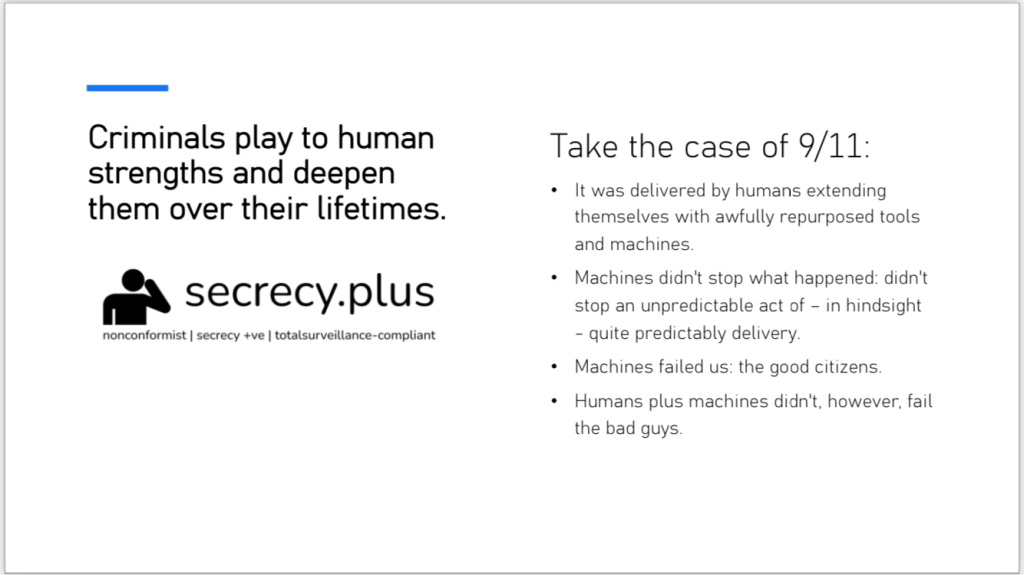
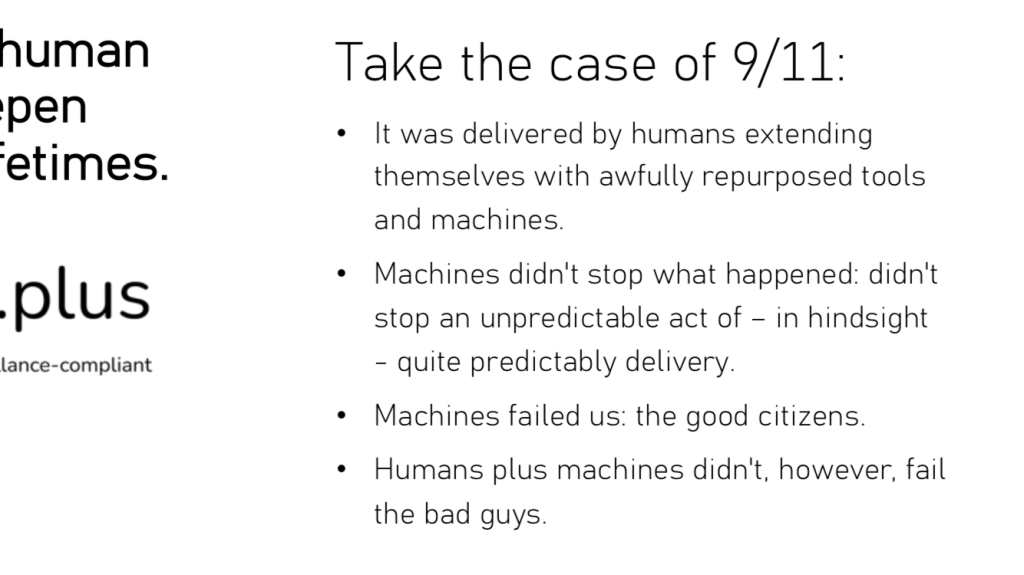
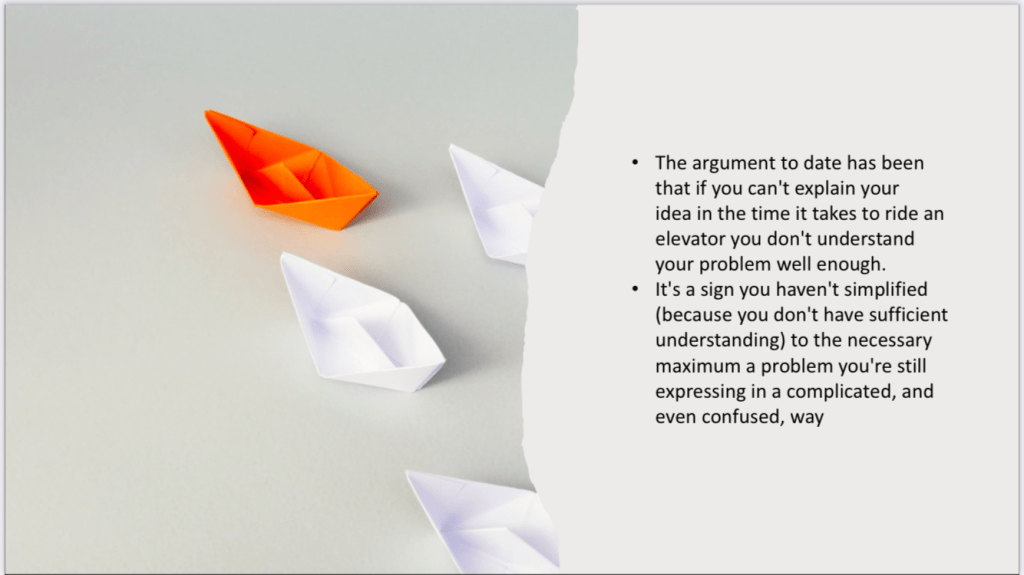
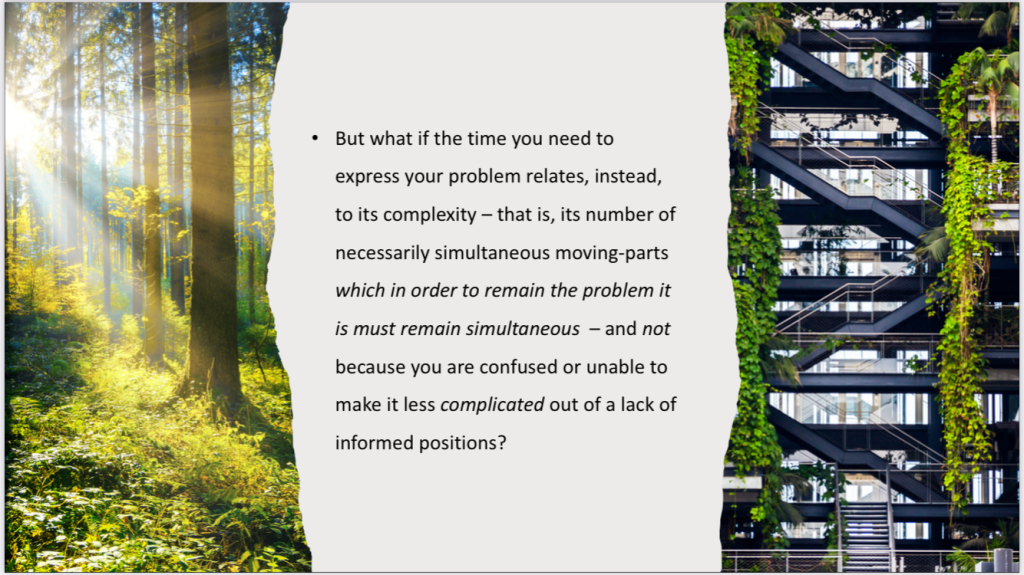
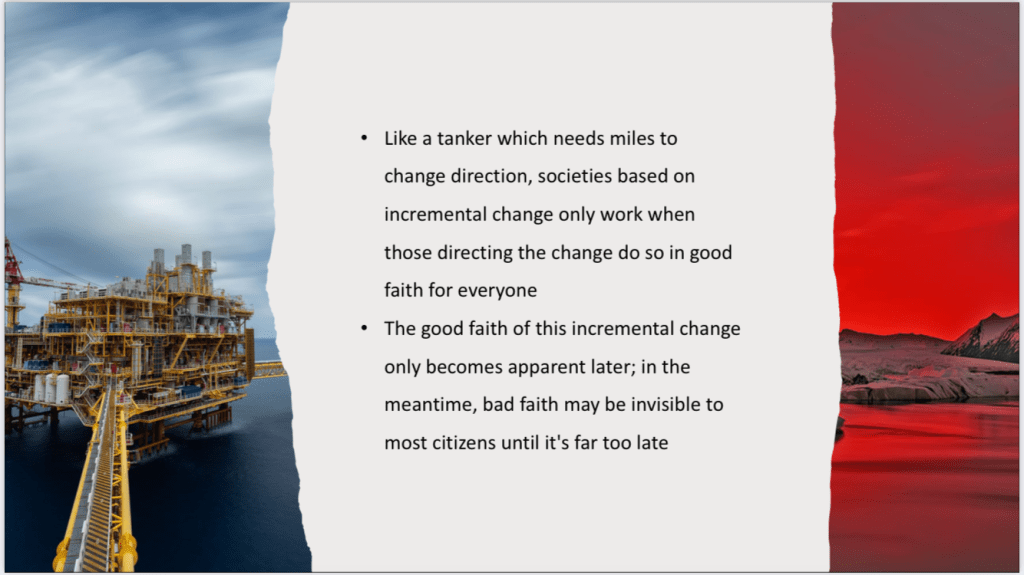
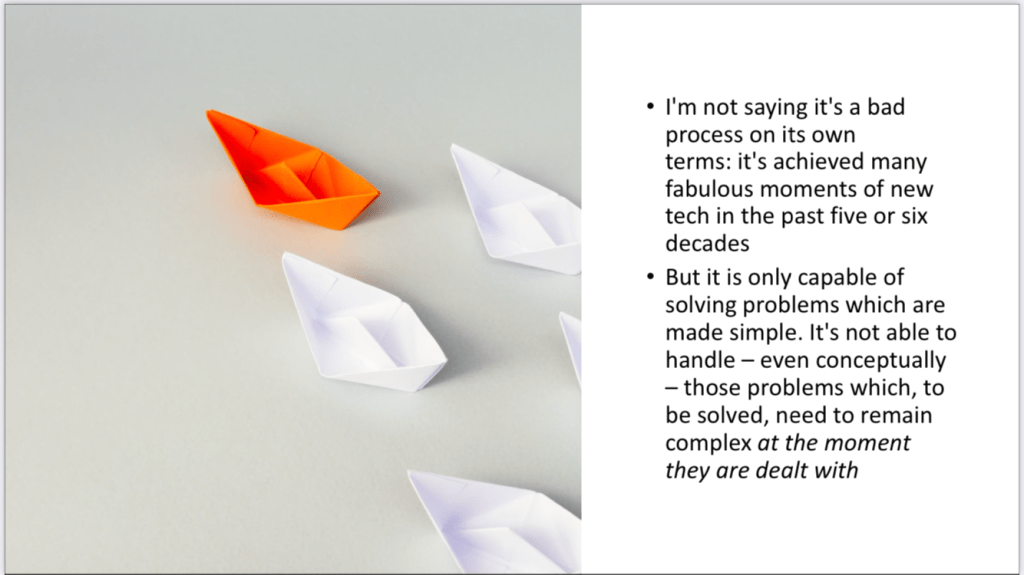
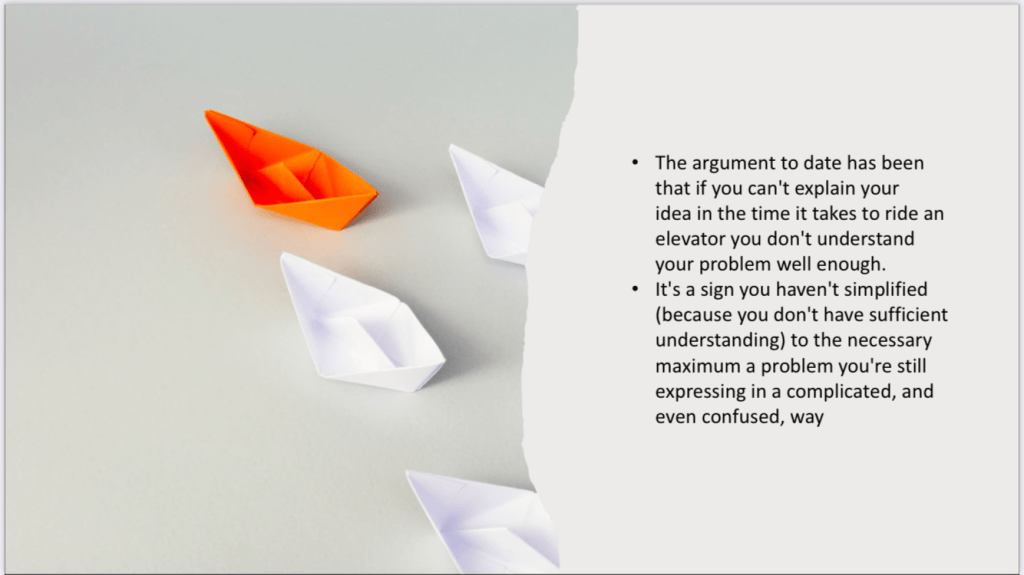
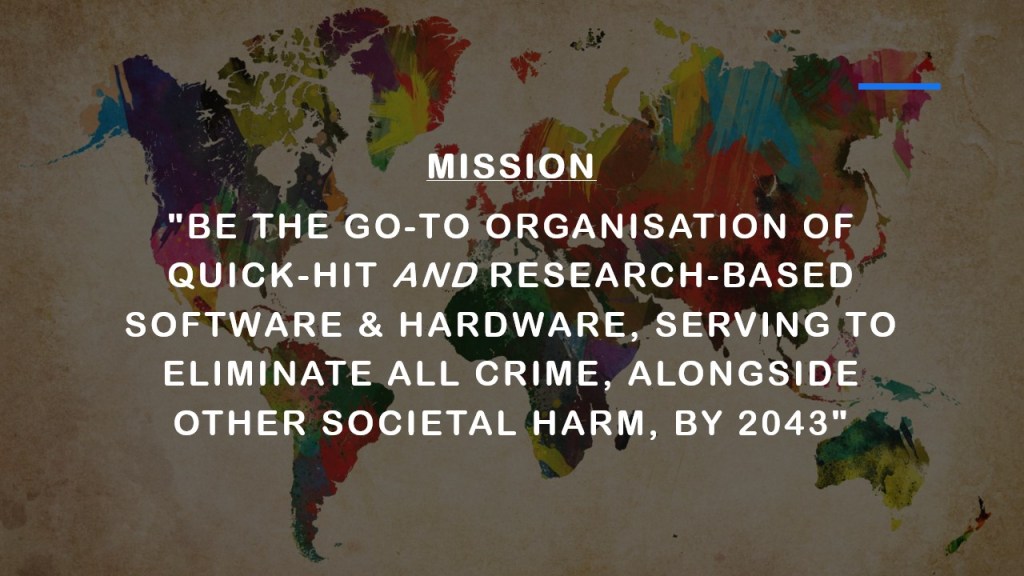
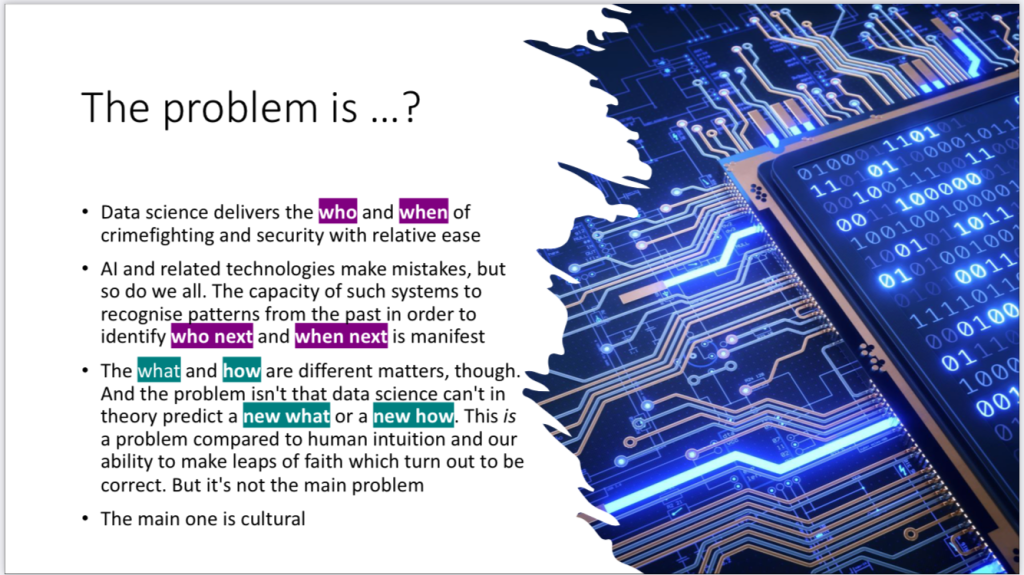
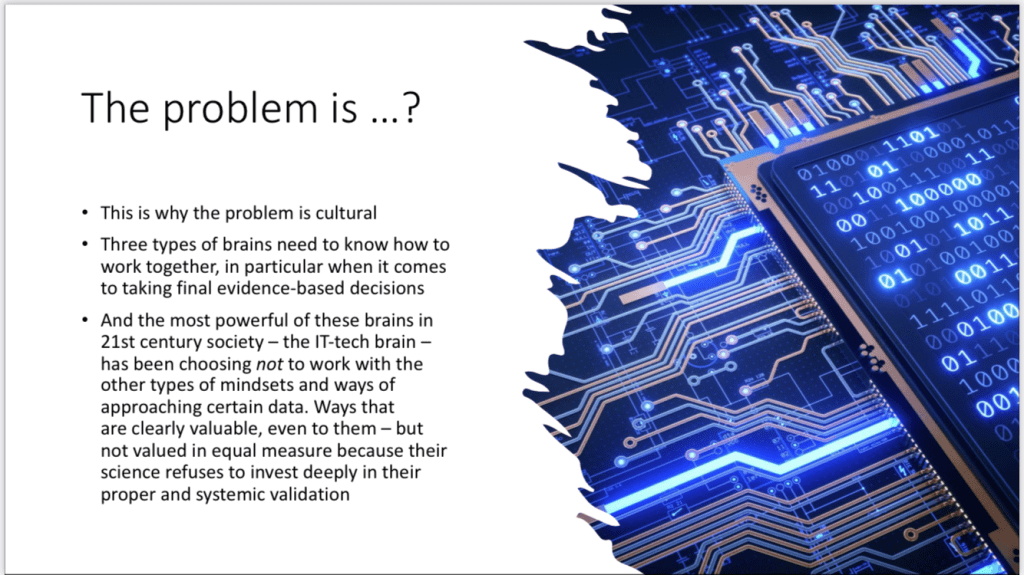
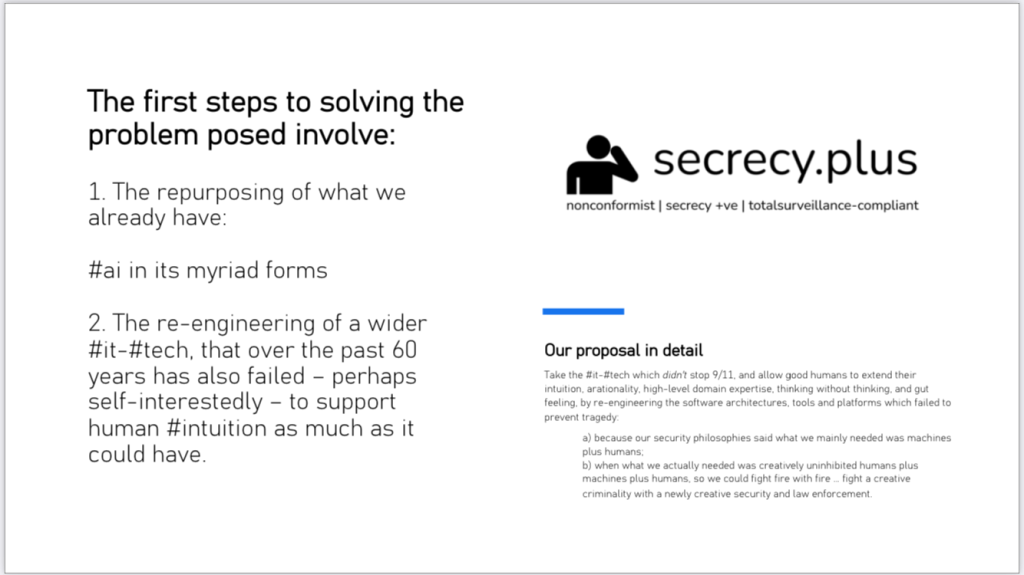
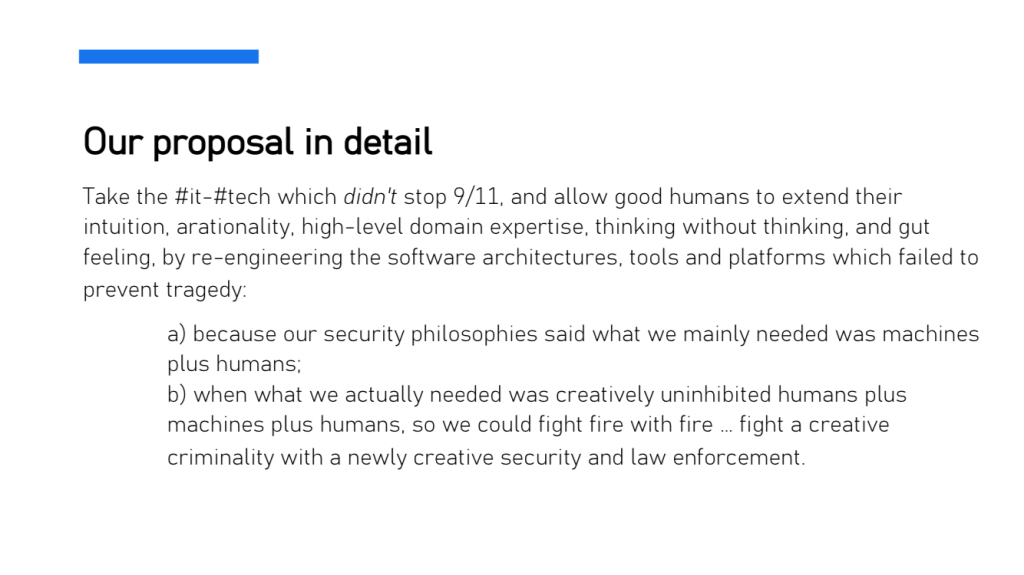
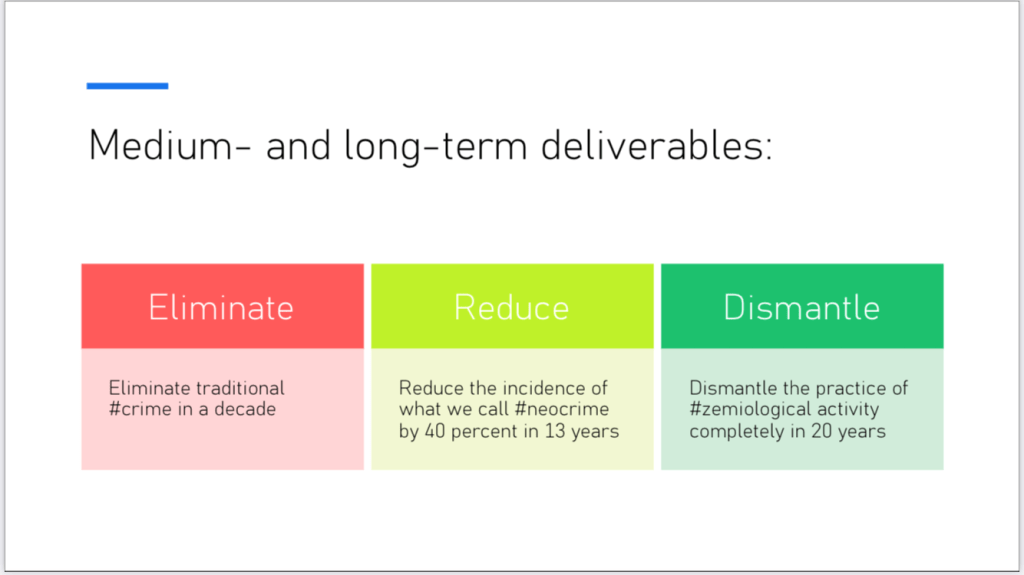
i created the slide below for a presentation i was asked to submit to a european digital agency pitching process, by the uk organisation public. the submission didn’t prosper. the slide, however, is very very good:
the easy answer is that obviously it benefits an industry. the challenging question is why this has been allowed to perpetuate itself as a reality. because real people and democratic citizens have surely perished as a result: maybe unnecessarily.
here is the presentation which public failed to accept for submission to the european digital process last october 2022, and from which the above slide is taken:
where and how i now want us to come together and proceed to deliver on creative crimefighting and global security
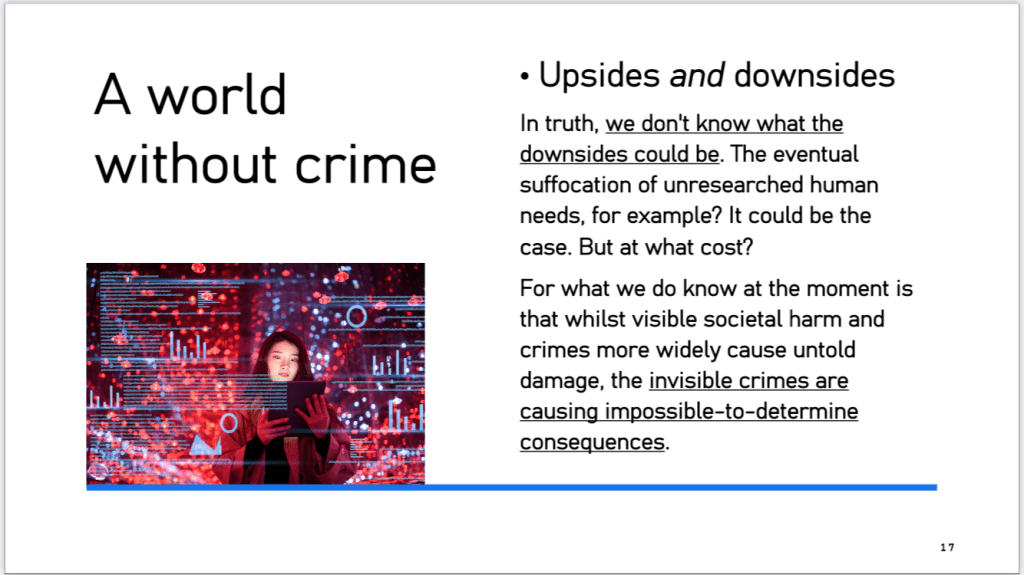
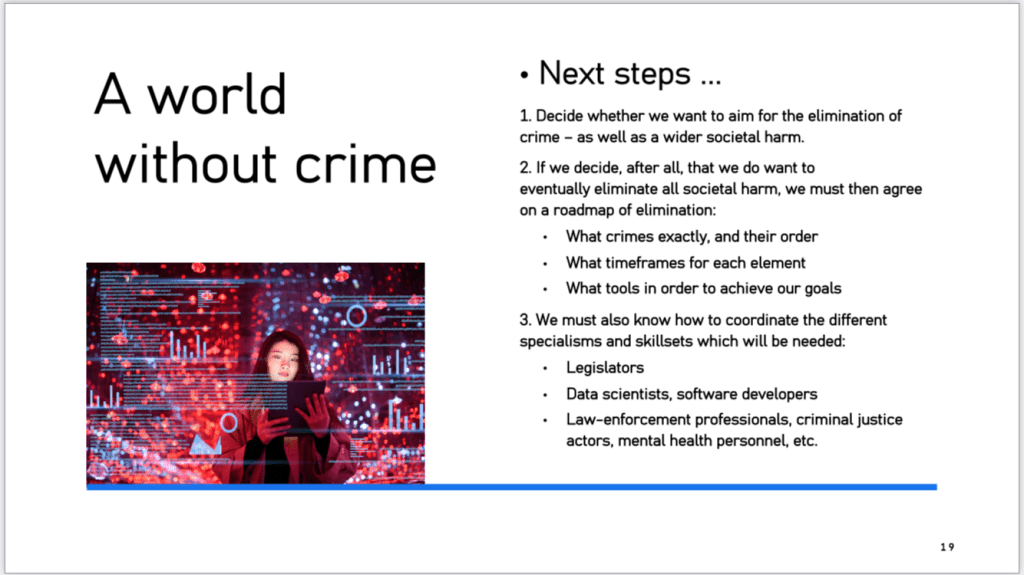
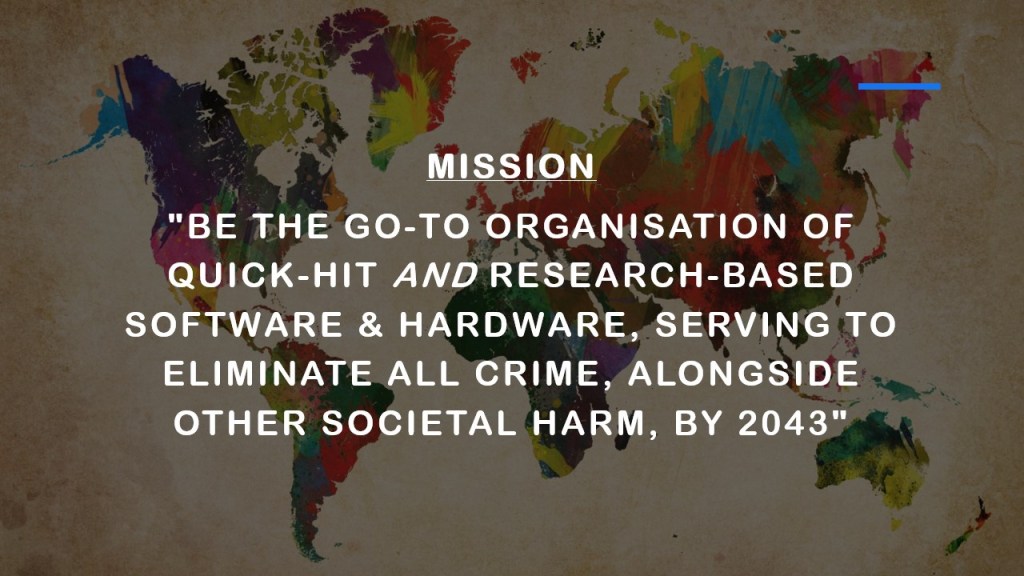
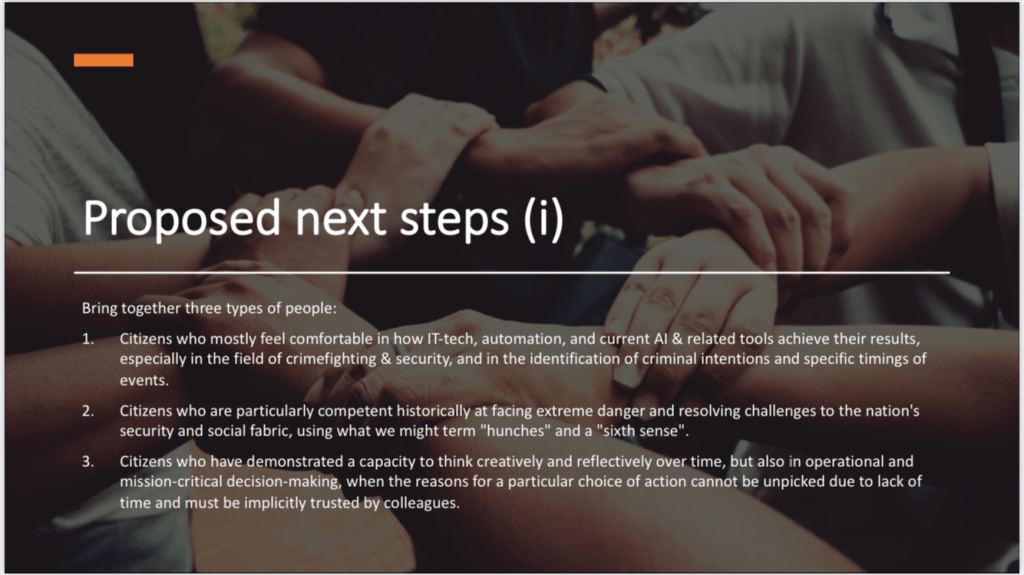
the second presentation which follows below indicates my thinking today: no caveats; no red lines; no markers in the sand any more. if you can agree to engage with the process indicated here, no conditions on my side any more.
well. maybe just one. only western allies interested in saving democracy will participate, and benefit both societally and financially from what i’m now proposing:
following on from the above then, thoughts i wrote down today — in edited format to just be now relevant only to the above — on my iphone notes app. this constitutes a regular go-to tool for my thought-experimenting:
on creating a bespoke procurement process for healthy intuition-validation development
step 1
pilot a bespoke procurement process we use for the next year.
we keep in mind the recent phd i’ve had partial access to on the lessons of how such process is gamed everywhere.
we set up structures to get it right from the start.
no off-the-peg sold as bespoke and at a premium, even when still only repurposed tech for the moment.
step 2
we share this procurement process speedily with other members of the inner intuition-validation core.
they use it: no choice.
but no choice then gives a quid quo pro: this means total freedom to then develop and contribute freely to the inner core ip in ways that most fit others’ cultures.
and also, looking ahead, to onward commercialise in the future in their zones of influence where they know what’s what, and exactly what will work.
and so then, a clear common interest and target: one we all know and agree on.
mil williams, 8th april 2023
historical thought and positions from late march 2023
finally, an earlier brainstorming from the same process as described in part two above, conducted back in late march of this year. this is now a historical document and position, and is included to provide a rigorous audit trail of why free thinking is so important to foment, trust and believe in, and actively encourage.
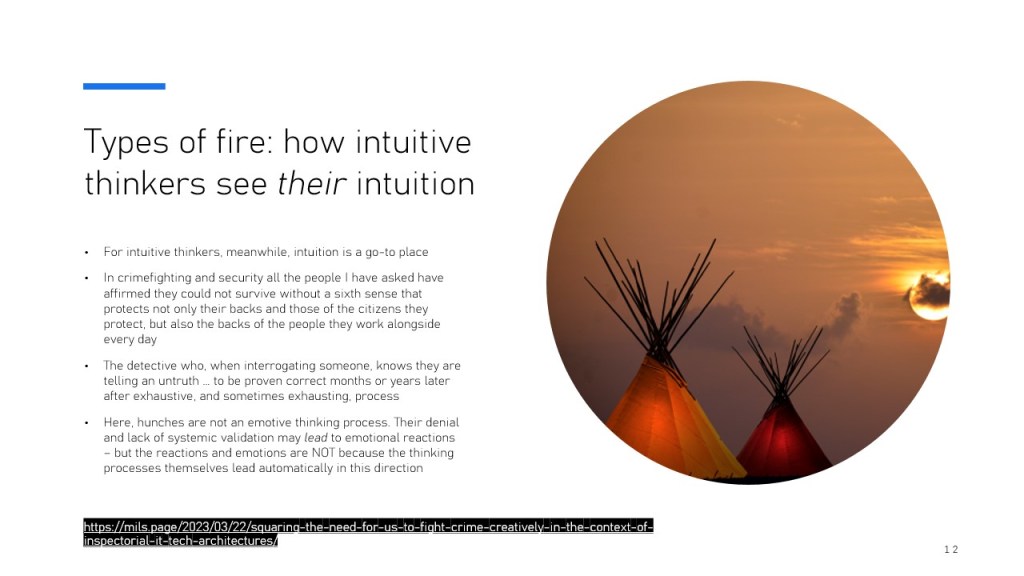
we have to create an outcome which means we know we think unthinkable things far worse than any criminal ever will be able to, to prevent them. we need a clear set of ground rules, but these rules shouldn’t prevent the agents from thinking comfortably (as far as this is the right word) things they never dared to approach.
the problem isn’t putin or team jorge. it is, but not what we see. it’s what they and others do that we don’t even sense. it’s the people who do worse and events that hurt even more … these things which we have no idea about.
if you like, yes, the persian proverb: the unknown unknowns. i want to make them visible. all of them. the what and how. that’s my focus.
trad tech discovers the who and when. but my tech discovers the what and how before even a glint in criminals’ eyes.
so we combine both types of tech in one process that doesn’t require each culture to work with the other. side-by-side, yes. but in the same way, no. so we guarantee for each the purest state each needs of each.
my work and my life/love if you prefer will not only be located in sweden but driven from here too. that’s my commitment. and not reluctantly in any way whatsoever.
[…]
i have always needed to gather enough data. now i have, the decision surely is simple.
















































































































 mil's page