On talking about #intuition

Introduction to this post:

Today I had a brief video-chat with someone positively predisposed to the idea of #intuition. He even saw it as bordering the mystical. He was Indian. Indians love #intuition, it’s true. But #it-#tech Indians have caveats they all seem to share. This is something I have seen before: real deep trust in human #intuition’s capabilities but a real distrust in any chance of ever validating it usefully.

This man is also involved professionally in #it-#tech. When I gave him four examples of how not all #tech had chosen to diminish human beings in the field of non-traditional #datasets, he was still unconvinced.

The four templates we should look to when validating #intuition:

Example 1: the #film-#tech industry from its beginnings over a hundred years ago has decided to almost always amplify and enhance existent human abilities: more voice with a microphone; keener vision with a camera; greater expressiveness with the language of close-up. And in so doing it’s made billions, perhaps trillions, in the paradigmatic century of its total cultural dominance.

Example 2: in my younger years video was not admissible evidence in the #criminaljustice system of my homeland. Now it is. What changed to put in the hands of #lawenforcement and #justice’s stakeholders and subjects this tool to eliminate procedural waste so dramatically? We didn’t change any #justice system: we just introduced new tools to validate video evidence, so that the hidden knife in the real life holdup was proven to have been used via a validated electronic cousin.

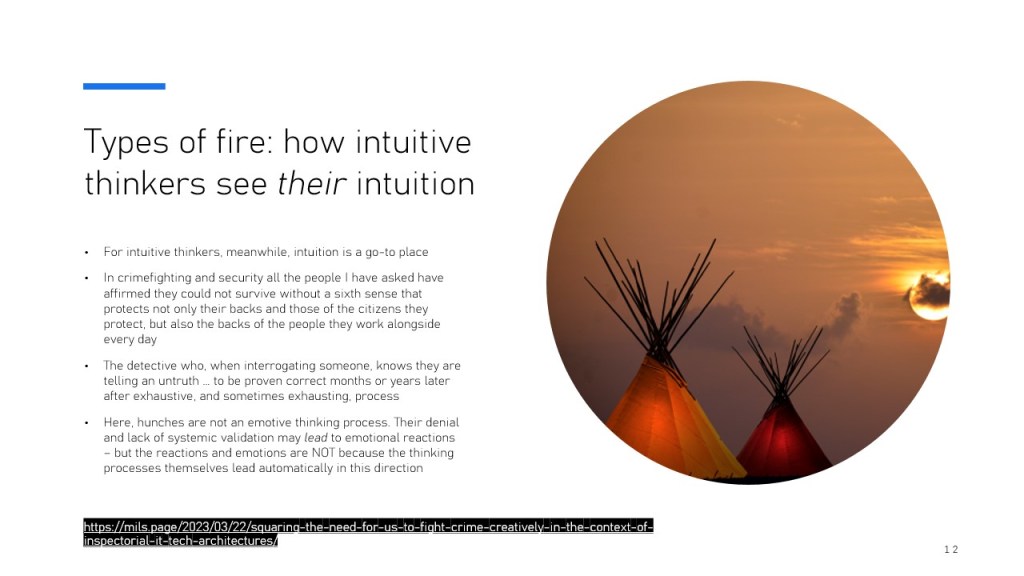
Example 3: the detective who just knows that someone is lying in an interrogation may be wrong too, on occasions; but often they all too accurate. Yet it then takes due process months, maybe years, to arrive at the same conclusion. What if we could validate — not prove right but decide definitively (as the #video example above now allows us to much more speedily) whether in truth MAYBE wrong but ALSO maybe right — so that this detective’s #hunch would bring about a conviction (or release) of the most adequate?

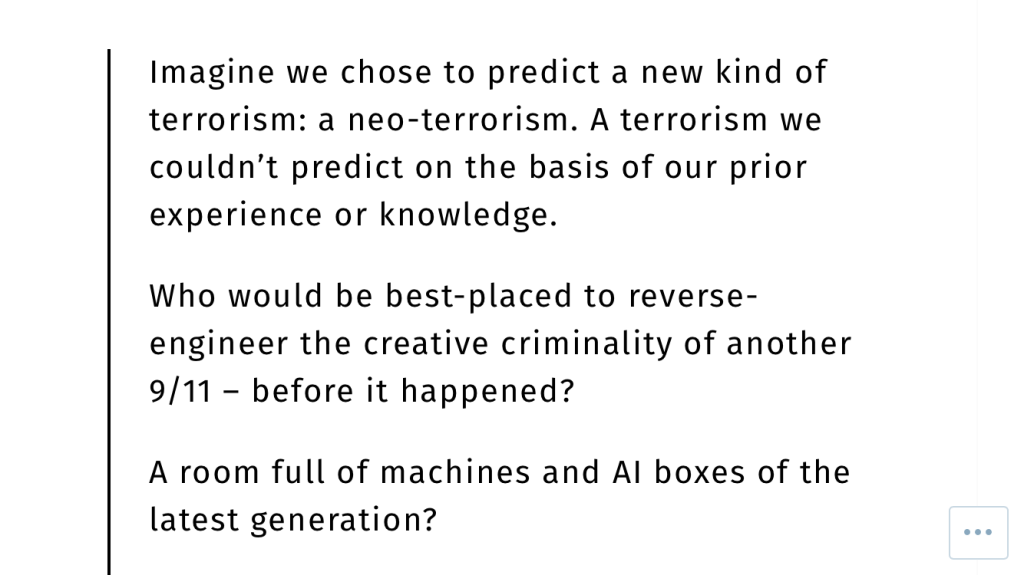
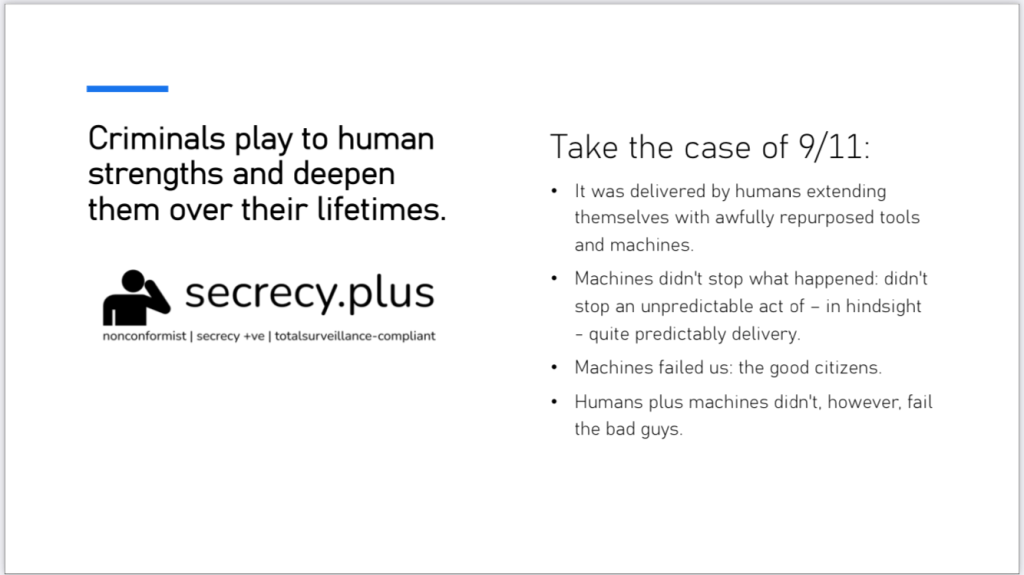
Example 4: I then suggested to my interlocutor that we should come up with a new 9/11 before it strikes us again. Here, I suggest we learn how to reverse- or forward-engineer bad human thought, so as to stop it in its tracks, with the most #creativecrimefighting you could conceive of:

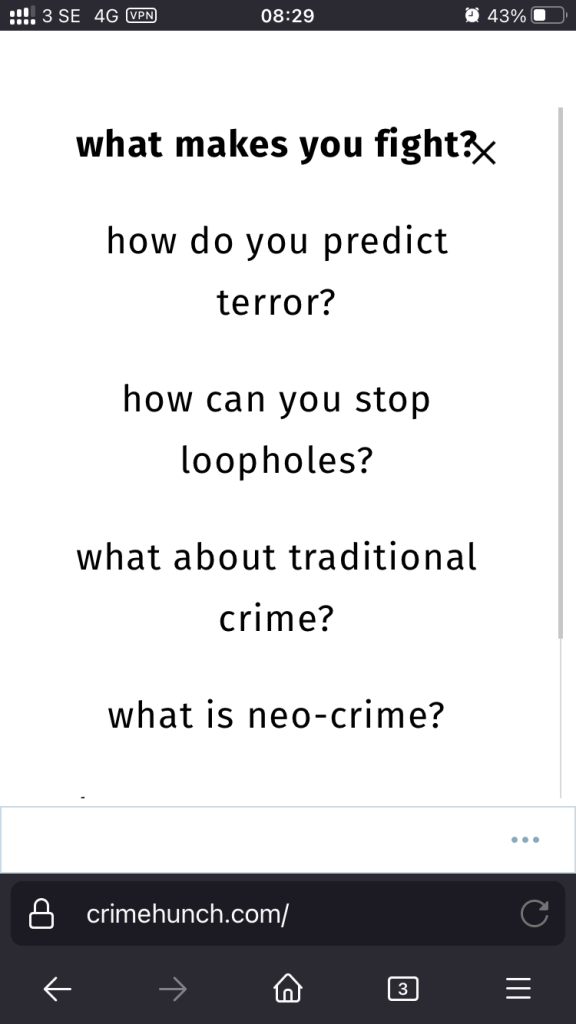
crimehunch.com/terror

But not the “when” or “who” of what is already being planned out: in these cases, machine automation operates really competently on the basis of existent #lawenforcement and #nationalsecurity #it-#tech data-gathering processes …

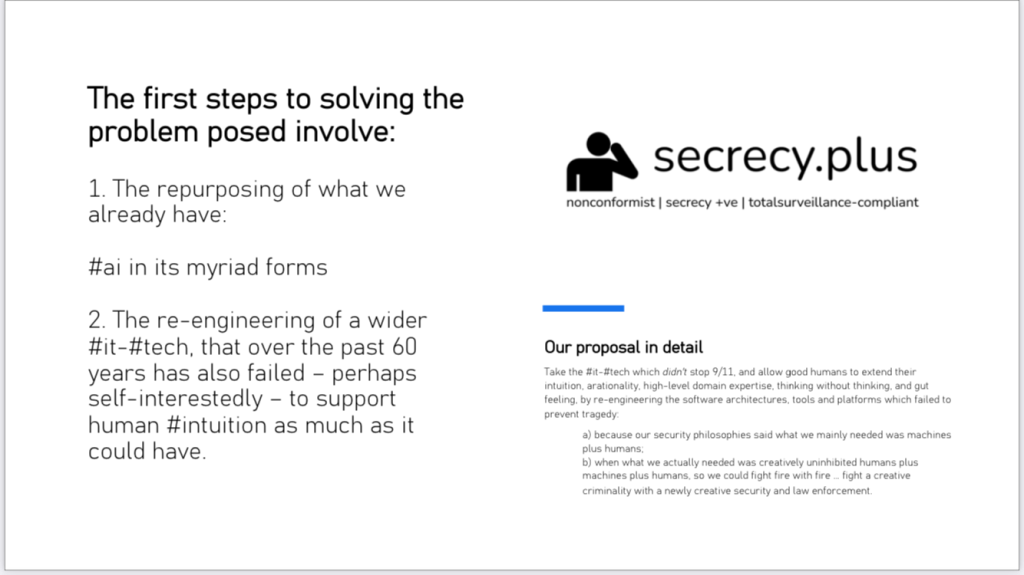
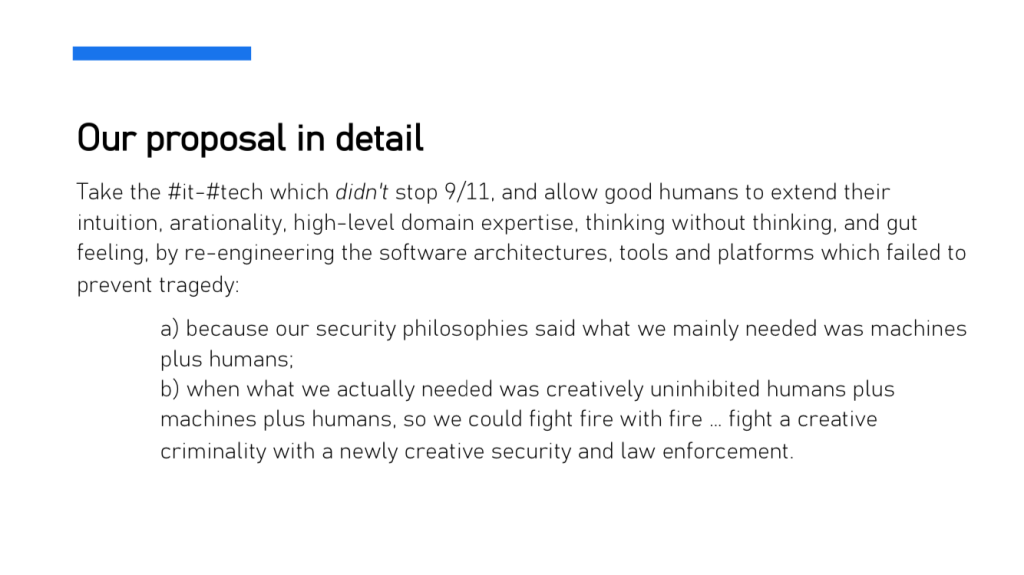
Rather, I mean to say here the “what” and “how” of an awfully #creativecriminality. And I say this because 9/11 was a case of where assiduous machines which humans used conscientiously, and in all good faith, were roundly beaten by horrible humans who used machines as extensions of themselves terrifyingly well: being the case, therefore, of simply not supporting existent habits of #creativecrimefighting (because detectives can be immensely creative already in tussling out narratives that explain otherwise insoluble crimes) with conventional #it-#tech choices and strategies that absolutely do NOT since time immemorial care to foreground and upskill human #intuition.

What happened next and, maybe, why:

When I said to my interlocutor that these four examples surely served as robust precedents and templates for proceeding to validate #intuition and #crimehunch insights just as deeply, as well as to an equally efficient end … well, this was when he veered back to talking again of #intuition’s impenetrable workings. “Yeah,” he was saying, “intuiting is great process … but don’t dare to untangle it.”


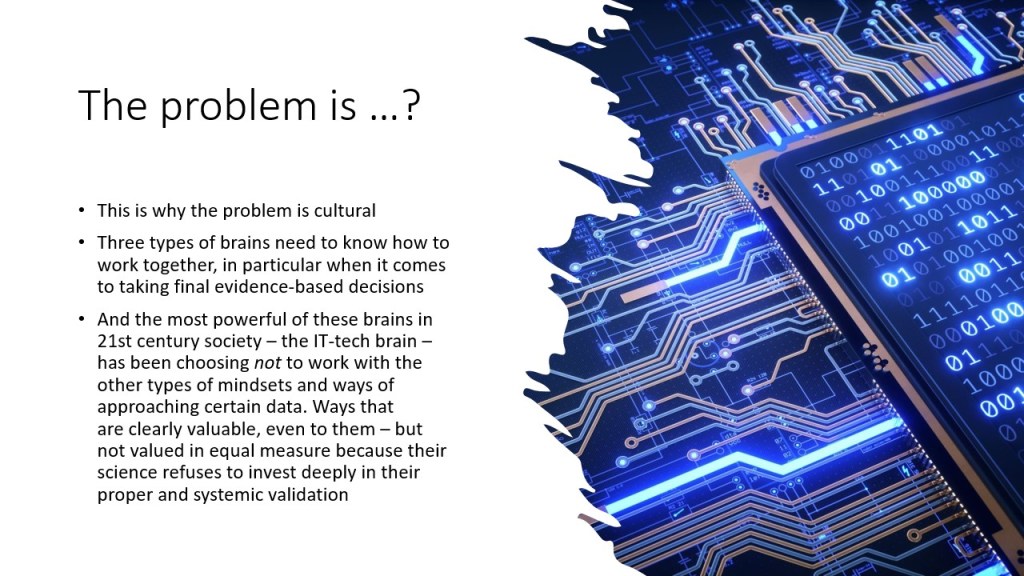
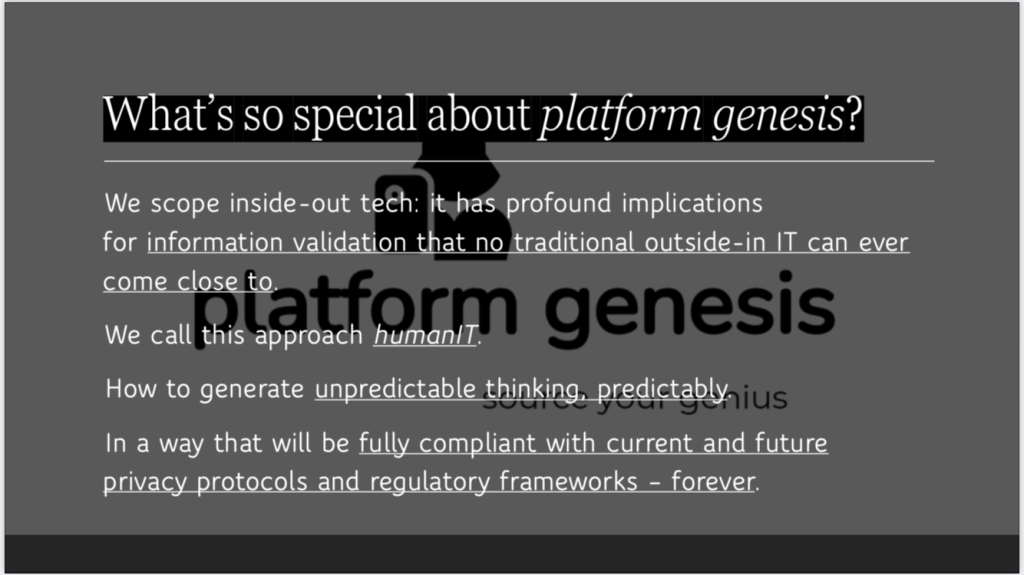
And it’s funny how those who work in an industry — that is, #it-#tech — where the richest of its members are incredibly wealthy on the back of their particular and often mostly privately privileged visions of how the future must become … well, that these wealthy individuals then, and similarly equally, find themselves incapable of conceding that such a profoundly value-adding activity for them should have its own wider validation systems for us all. Why? Well. In order that EVERYONE who could care to might acquire a distributed delivery of similar levels of genius-like thinking: what I have in fact called the “predictable delivery of unpredictable thinking”.

platformgenesis.com

How I would, then, most like us to proceed:

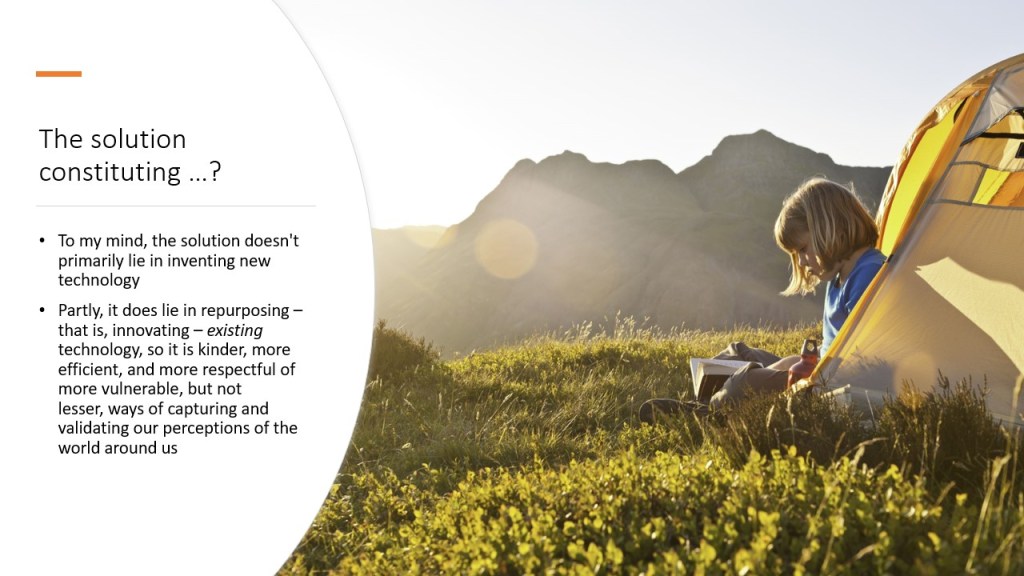
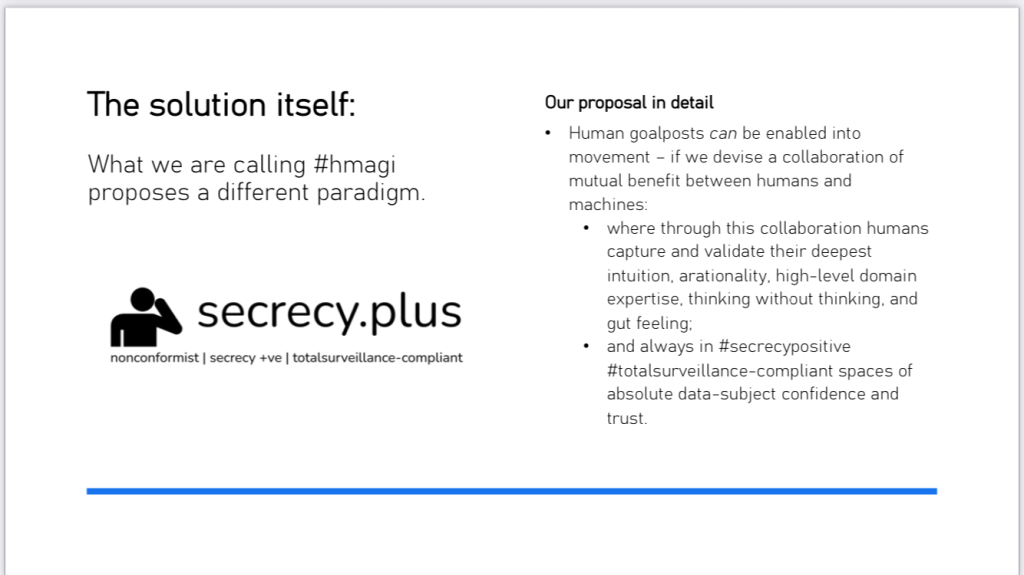
I’d like us to create software, wearables, firmware and hardware environments where not only a select few can enjoy being geniuses, but where we all have the opportunity to be upskilled and enhanced into becoming value-adding, natively intuition-based thinkers and creators:

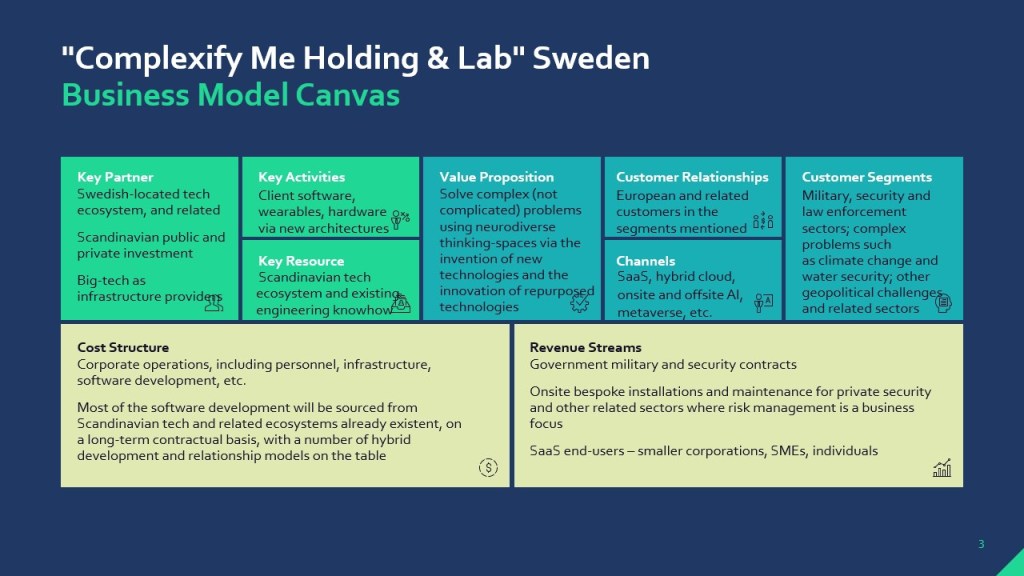
complexifylab.com | sverige2.earth/canvas

One small and hugely practical example:

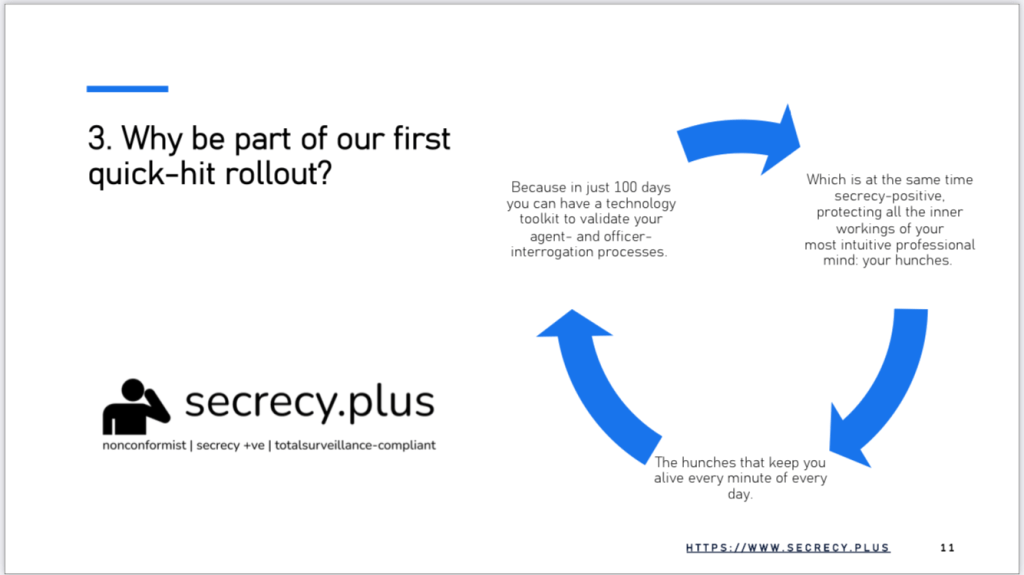
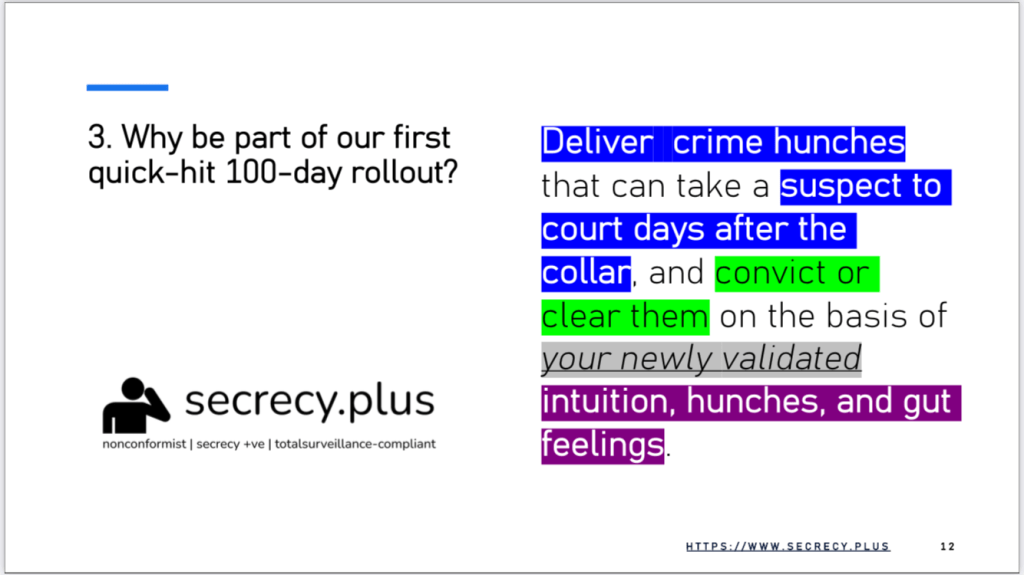
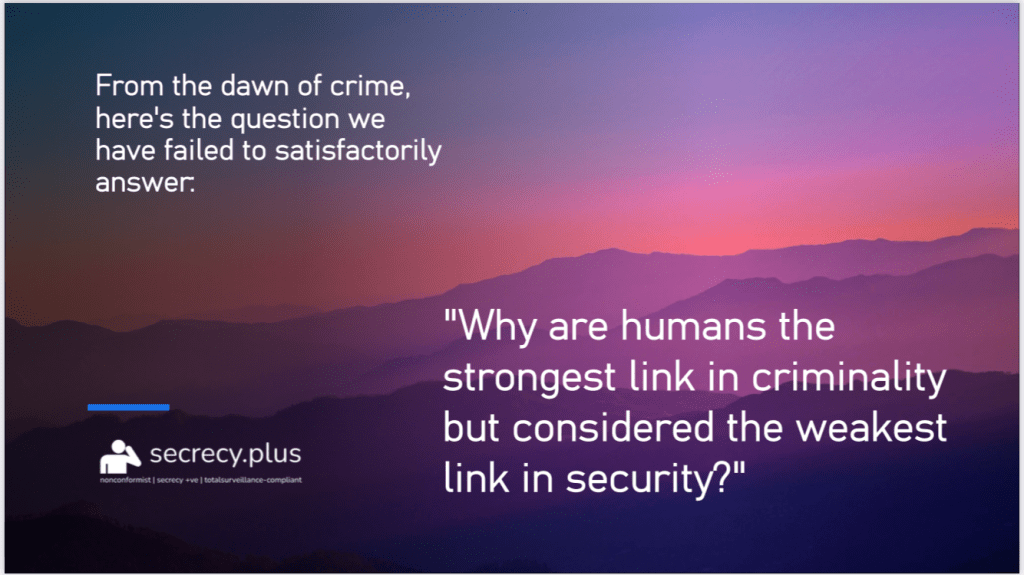
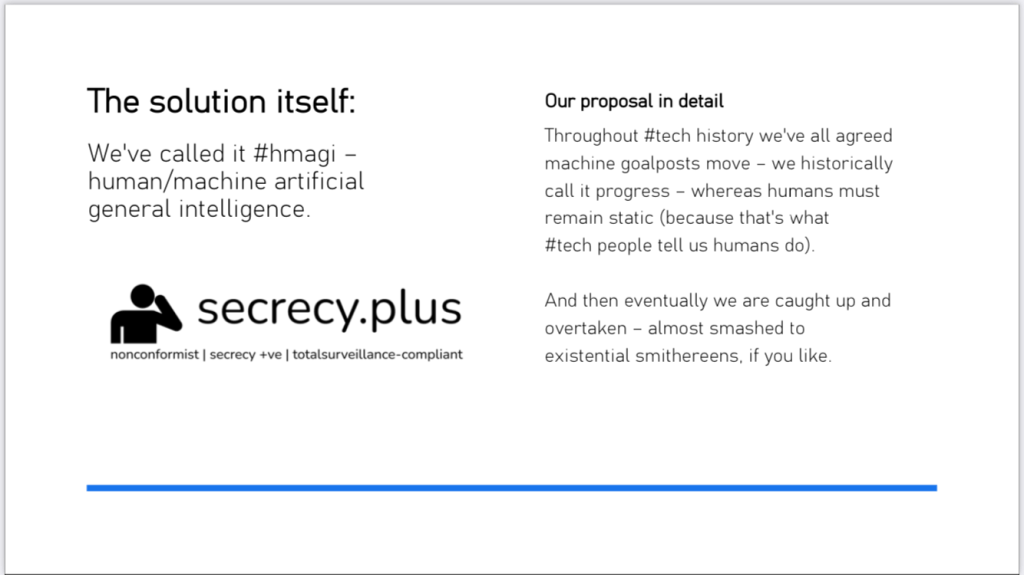
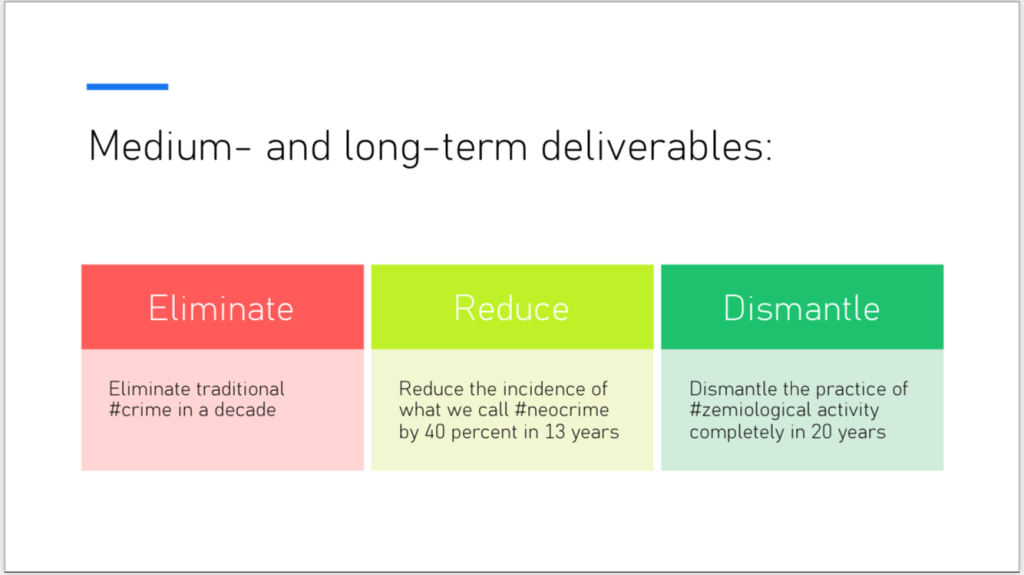
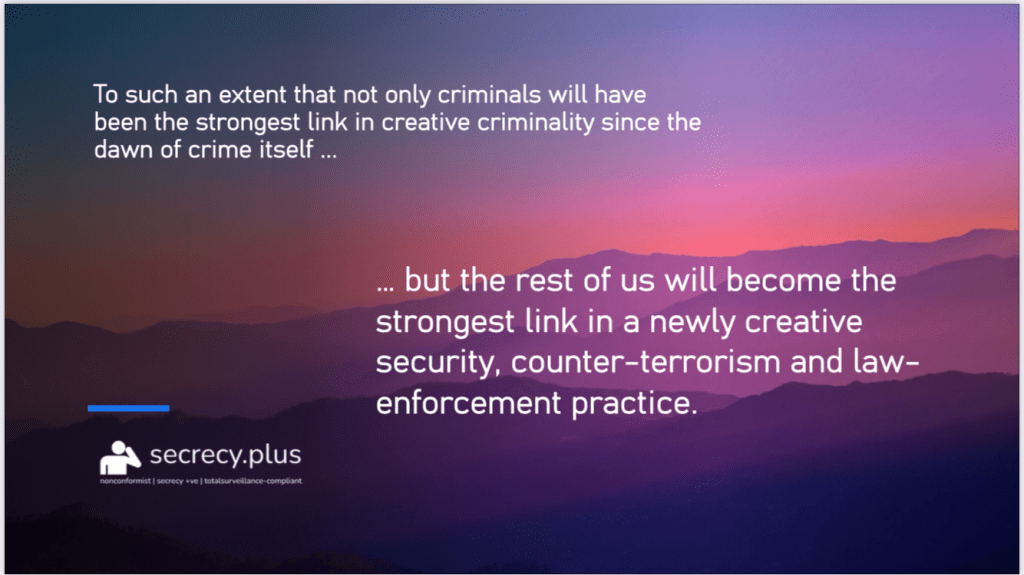
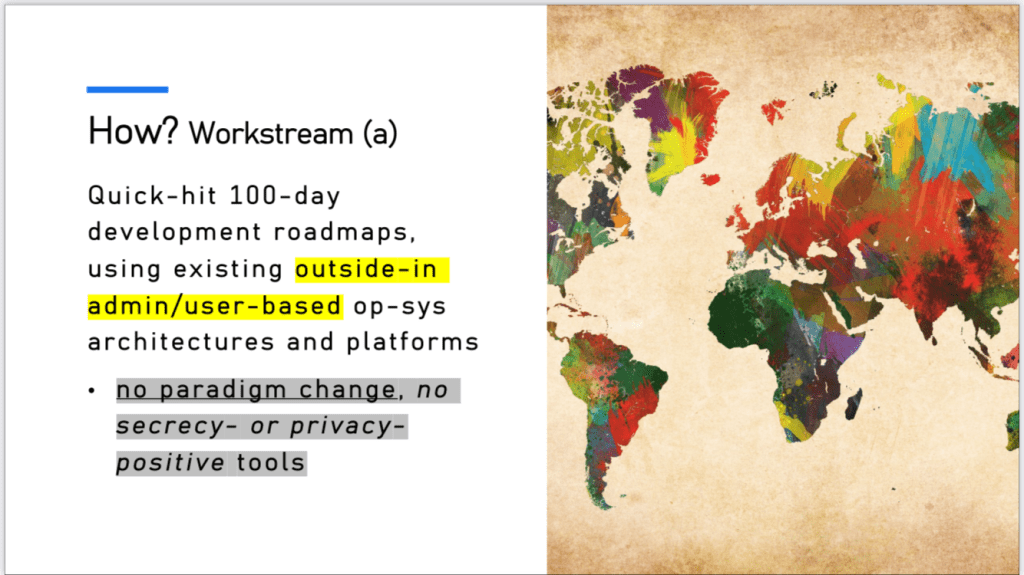
Attached below, just one small application we might develop, using existent architectures — not the particular ones I think more appropriate for truly deep #intuitionvalidation, where we conflate admin/user in one #datasubject — and with a proposed 100-day roadmap to demonstrate that the beautiful insight I had more than a year ago is actually, honestly, spot-on:

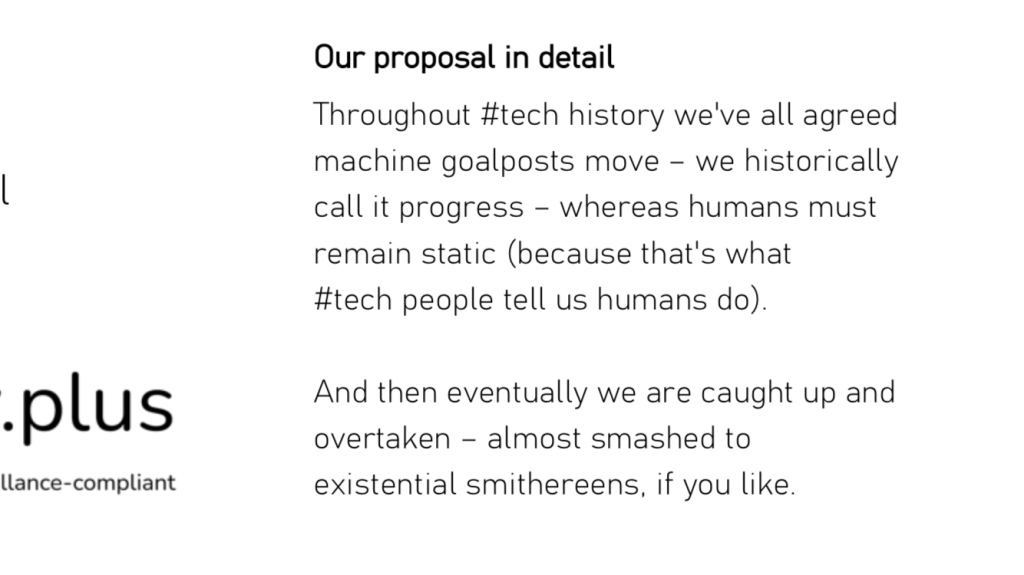
1. That #intuition, #arationality, #highleveldomainexpertise, #thinkingwithoutthinking, and #gutfeeling are potential #datasets as competent as #video suddenly became when we believed finally its validation was a real deliverable.

2. That all the above all-very-human ways of processing special #datasets actually contain zero #emotion and even less of the #emotive when it’s their processes we’re dealing with. And that when they do EXPRESS themselves emotionally it’s out of the utter frustration which the driver and #datasubject of such #intuitive processes suffers from as a consequence of the fact that no one at all, but NO ONE, in #it-#tech cares to consider #intuition and related as #datasets worthy of their software and platform attentions.

So out of frustration I say .. but never the intrinsic nature of such #intuitive patterns of collecting #data and extracting insights which people like that detective I described earlier do believe sincerely in, when driving the most mission-critical operations of #publicsafety of all.
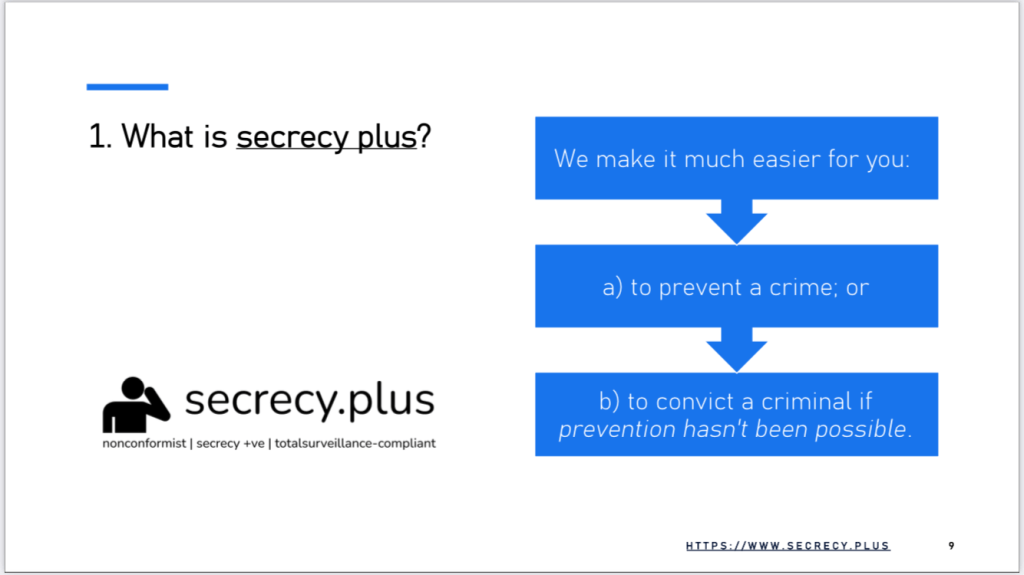
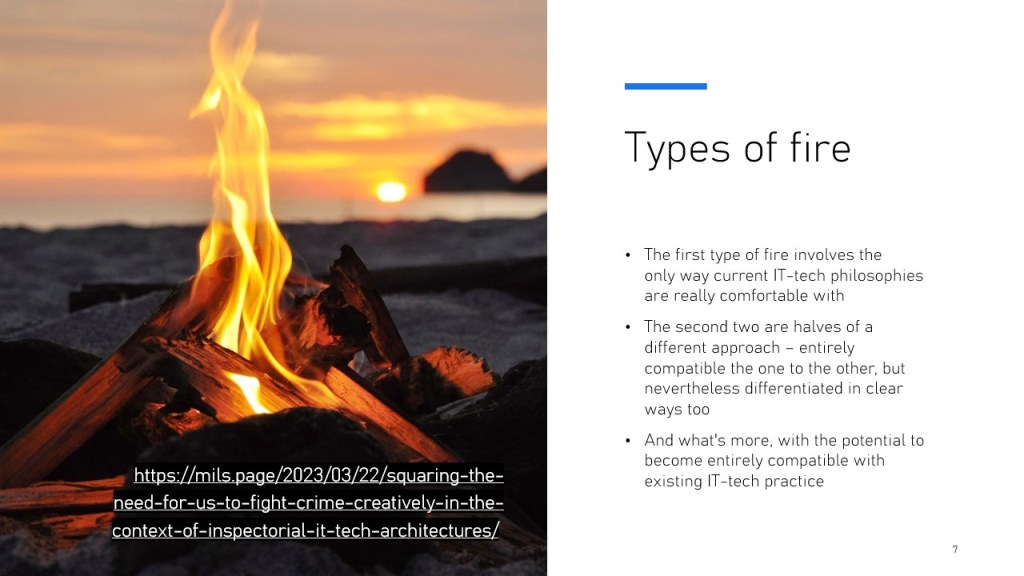
secrecy.plus/fire


“upskilling” human beings in the ways of the machine … again? i don’t THINK so

introduction

i just got a message from microsoft (linkedin) which asked me to consider and/or explain how what i was about to post (what you see below in the screenshots) related to my work or professional role.

why nudge in this way

is this a stealthy attempt to remove the ambiguities of #arts-based thinking patterns from contaminating the baser #chatgpt-x instincts and what they scrape?

more than personally, quite intellectually i think it’s wrong — in a world which needs lateral and nonconformist thinking — to define, a priori, what a thinker who wishes to shape a better business should use as a primary discourse.

because this discourse may include how much we follow or no the traditional way of framing information: where we state what we will say, say it, and then summarise it, we fit the needs of machines and people trained to think like them.

art should be used to communicate in any forum

‘truth is, when we choose a precise ambiguity (one forged out of the arts — not the confusions — of deep communication), where such ambiguity and the uncertainty it generates may in itself be a necessary part of the communication process’s context — and even content — what value ever is added by telling the speaker and/or writer they are ineffective?

in any case, the public will always have the final vote on this: and if you prefer to communicate in such ways and be not read, why not let it happen?

why choose this kind of nudge to upskill writers in the ways of the machine?

using automated machines to do so, too …!

so what do YOU think? what DO you?

me, what follows is what i want. what no one in tech wants to allow. because i’m not first to the starting-line: i’m last. they decided it didn’t suit their business models decades ago. i decided i didn’t agree. and i still don’t. and neither should you.

on making a systemically distributed intelligence and genius of all human beings … not just an elite

do you understand now?

background

i trained in spain as an editor in the early part of the 2000s. but as someone who always blogged better than he authored, i already had the custom of attributing my ideas through the tool and habit of hyperlinking.

attribution is really important: not because it inevitably takes us down a peg or two, although it does. more importantly, an outcome with shape to it is more valuable than an outcome, full stop.

the memex machine

i realised this consciously ever since reading vannevar bush’s treatise on human thought: “as we may think”.

you can find it in “the atlantic” to this day:

https://www.theatlantic.com/magazine/archive/1945/07/as-we-may-think/303881/

in it, using the immediate post-war tech available, and any future tech extrapolated from the same, he suggested a machine called the #memex. it would enable human thought to the extent that we would not only be able to store outcomes — what those most interested in making money would consider a product or service to be scaled up massively — but store the trails of thought that would always lead up previously (and to my mind — and bush’s — also preciously) to such outcomes.

because when a thought is a reel of thoughts not just a pic which snaps shut on time … this is when we have a human being rather than a machine.

the implications of attribution’s fact

the result of all the above? NOTHING we think up is independent of ANYTHING. as a consequence, it is tantamount — just about — to daylight (and more importantly, night-time) robbery to claim one has an exclusive right to make money out of any idea “you might EVER have”.

you don’t agree? then it isn’t. but then you’re a genius in the divisive sense most of society understands: that is, very few of us can or will be this figure; and most of us will never be anywhere near.

which is elitism to the max, in fact.

only i don’t agree with this. i don’t believe such elitist approaches accurately reflect the human brain and how it best works. and when leaders in different fields impress on us to believe that they do reflect the state of human thought, and then build business models on such belief systems, we get a type of tech-kryptonite thrust into the most vulnerable core of human experience.

my experience, meantime, as a language teacher, then facilitator, then enabler (the progression taking place out of what almost became a fanatical frustration with the rank incompetence of traditional learning paths) showed me ALL humans can radically improve their thought processes, given the right environment.

and where processes can be improved dramatically, surprising — even shocking — outcomes can be achieved. and so i saw it happen. and was a convert.

platform genesis

this is why both my son, from whom i am now deeply estranged, and myself worked together for a while on a platform we named “platform genesis”.

the idea is that all of us, all human beings, can find the right tools to uncover some aspect of genius in our souls, hearts, and grey cells. it’s not the preserve of intellect: it’s mainly the preserve of confidence in oneself — whether one has it or not. if one doesn’t, intellect cannot follow. if one does, a happy series of accidents — where a given — will lead to your genius in some way or other.

https://platformgenesis.com

my happy path to my genius

a few minutes after the photo that follows was taken i met the muse of my life. it’s hard to admit that nothing i have thought up since 2016 that evening in dublin on the banks of the river liffey would now exist if we hadn’t met and spoken for three hours, as we shared a meal on the roof terrace of “the woollen mills”.

i had lost my fear of flying the day before, you see: the 15th of june of that same year, when i flew into dublin on ryanair for the first time, for precisely the meeting that would then take place on what was my birthday the following day. being the 16th. coincidently called, in ireland mainly, “bloomsday”. (and so don’t you think it’s cool to have a birthday called “bloomsday”? the day you are born being that, i mean.

don’t you?)

and so i literally lost my fear of flying that june. actually, truly, in a second. a total flip. a click of the brain’s chip that’s never clicked back.

and therefore in my wider life, too: because i assure you, quite objectively, i have a better brain now at 60-something than i have ever had the whole of my life before. and it’s NOT because of intelligence that i am far more intelligent than i could once have imagined myself becoming. it’s because of the confidence that slowly seeped into and then infused my brain, my heart, and my soul … as an utterly natural consequence of meeting the muse of my life.

the meaning of this … for me

bringing together the threads of this article, then, i now conclude:

1. none of my ideas since are mine to exploit exclusively for my own benefit.

2. none of my ideas since are mine.

3. none of my ideas are yours.

4. none of my ideas are yours to exploit exclusively for your benefit.

5. all of the ideas which have emerged after this meeting of ours, and precisely because we met, belong to no one — and therefore belong, altogether, to a whole planet and creative ecosystem.

because it WAS a sort of magic: and magic, the genius of genie, once uncorked CANNOT be boxed into a business model for the benefit of the few.

conclusion

when we upturn a paradigm, we can choose to leave the business model — and therefore the hegemony — untouched. or we can choose to upturn two paradigms simultaneously: the “thing” itself (for want of a better phrase), and how we get it out there as fast as possible.

what’s the problem i’m looking to solve with the #gutenbergofintuitivethinking and the #intuitionvalidationengine? and #intuitionvalidation more broadly?

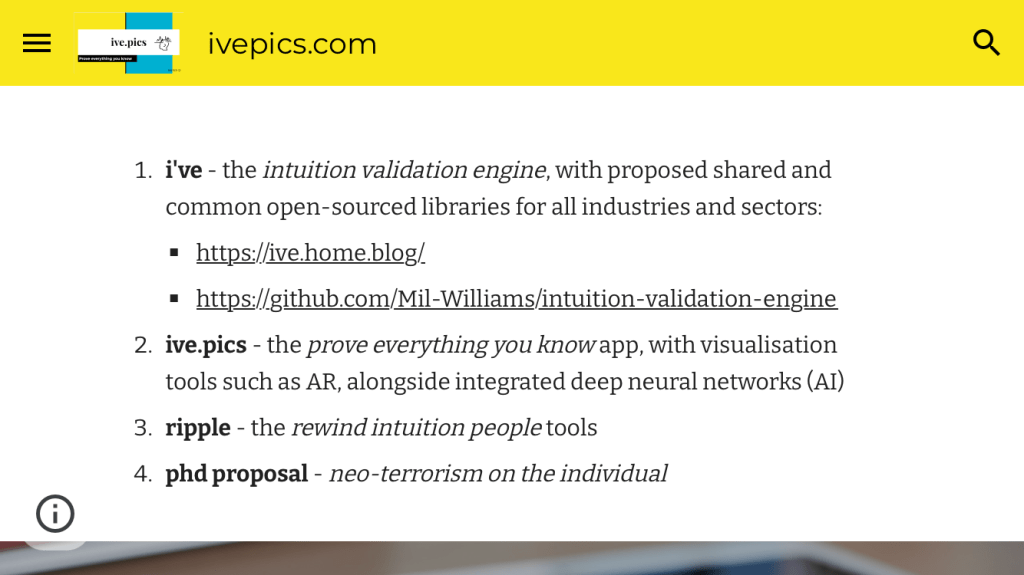
https://www.ivepics.com

it’s not #darkfigure and #neocrime (only). it’s not #wastefulmeetings (only).

it’s not #loopholes and other zemiological activities (only).

it’s not the inability of #specialisms to duly and safely communicate across their knowledge lines (only).

rather, it’s something which informs all these use-cases — and many many more.

one UNCOMMON denominator: a denominator that connects everything in human experience since the dawn of rhymes:

truth. a concept of an absolute and indivisible truth.
so we kick relativism finally into the long grasses, where it may be admired and remembered but not treasured. nor missed. again.

mil williams, stockholm sweden, 5th april 2023

accept and underline, therefore, and deliver on and re-establish, as a result, that a VALIDATED truth may be something we can establish ABSOLUTELY.

not universal truth: i’m not sustaining this. we can still be dependent on circumstance and context. but in each of these, an unattackable truth.

just this: impossible to break.

this i believe. deeply. firmly. and now till i die.

and if so, even if only gently, this then leads this article to its final statements.

all of the above says to me only one thing: i need to know what i owe my muse. because if any of the above can happen to any useful degree one day, it will happen one day only because of the impact she had on me, that day.

it’s consequently NOT a fixation at all i have for you, my dear muse, but an almost overpoweringly intellectual — as well as obviously emotional — demand to work out to what extent i was just a lever someone pulled.

not that YOU pulled it, either. i don’t think this for a minute. no.

but a tool or extension of someone or something out there … why is this so impossible to propose or contemplate? or prosper as an assertion to be justly considered?

do you understand me now?

do you?

when big politics and business make the customer a kleenex

three good things happened today: all related to how i perceive the world.

1. first, i do have a death wish: why, when i first read him, hemingway sooo immediately clicked with me.

2. however, i don’t want to be unreasonable or hurtful to others in my goal to achieve this outcome. i also most definitely don’t want support to ameliorate it. amelioration is the biggest wool-over-the-eyes of our western democratic time. i don’t want to be part of a process that perpetuates its cruelties.

3. my strategy — that is, only strategy — will from now on be as follows: i shall say and write about everything that i judge needs to be called out, in such a way that the powerful i will be bringing to book day after day after day will, one day, only have the alternative to literally shoot me down.

in order, then, to make effective the above, i resolve:

a) to solve the problem of my personal debt, acquired mainly due to my startup activities, so the only way in the future that the powerful shall be able to shoot me down is by literally killing me.

for my mistake all along was to sign up to the startup ecosystem, as it stands, as a tool for achieving my personal and professional financial independence:

startuphunch.com (being my final attempt at making startup human)

as this personal debt is causing me much mental distress and, equally, is clearly a weakness i show to an outside world i now aim to comprehensively and fully deconstruct, as a massive first step, then, i do need to deal with it properly.

b) once a) is resolved, i shall proceed to attack ALL power wherever it most STEALTHILY resides.

that is, i focus on this kind of power: the stealthiest and most cunning versions of.

the ones where it appears we are having favours done for us, for example.

specifically, that is, big tech. but many many others, too.

what essentially constitutes the driving forces behind zemiology, loopholes, neo-crimes, and similar legally accepted but criminally immoral societal harm; all of which, as a general rule, is most difficult right now to track, trace, investigate and prosecute.

crimehunch.com/neocrime

crimehunch.com/loopholes

www.secrecy.plus/law | legalallways.com

www.sverige2.earth/example

this is why i have concluded that my natural place of work is investigative journalism. and where i want to specialise — in this aforementioned sector and field of endeavour — is in the matter of how big tech has destroyed our humanity. but not as any collateral, accidental, or side effect of a principle way of being it may legitimately manifest.

no.

purposefully; deliberately; in a deeply designed way, too … to mainly screw those clients and customers whose societies and tax bases it so voraciously and entirely dismantles.

to screw, and — equally! — control. and then dispose of lightly and casually, when no longer needed, or beneficial to bottom lines various.

and so as a result of all this, i see that having a death wish is beneficial: if channelled properly, as from today i now intend it shall be, then it will make me fearless as never i dared to be. fearless in thought and disposition. fearless even when made fun of.

not in order to take unreasonable risks with my life — or anyone else’s: no.

rather, to know that life doesn’t exist when the things i see clearly are allowed to, equally clearly, continue.

and to want deeply, deeper than ever in my life, to enable a different kind of life for everyone.

NOT just for the self-selected few. those who lead politics, business and the acts of pillage and rape in modern society.

not just for them.

a better life for everyone, i say. everyone.

because i don’t care about mine. i care that mine should make yours fine.

now do you see? this is what makes me feel useful. nothing else. nothing else at all. and certainly not finding personal happiness. that would only blunt the tool.

🙂

why don’t people who love advocating machine progress find it easy to advocate analogous processes of human progress?

it’s a long title, but it’s a big subject.

over the years, since i’ve started proposing seeing intuitive thinking as a logical dataset we should spend a lot more money on capturing, verifying and validating in systemic, human-empowering, inside-out ways, i’ve spoken to a lot of technologists.

without exception — except tbh just this last wednesday when i was at an aws-organised event in stockholm — ALL software engineers and imagineers of this kind have shown fabulous and rightful enthusiasm for the demonstrable machine progress we’ve historically witnessed since the start of humanity’s extension via tools — and yet have been absolutely resistant, sometimes to the point of rudeness, to the idea that we may move human goalposts in equal measure: that is, decide to promote the 90 percent of the human brain most of us are still apparently unable to advantage ourselves of.

one super-interesting aws person i spoke to on wednesday, for most of the evening in fact, on and off, told me at one point that the human brain only uses around 40 watts to do all the amazing things practically all examples of the same which have populated this rock since human history began have clearly been able to deliver on. compare and contrast this with the megawatts needed to run a data centre, able even now only to approach human creative capabilities.

but even on wednesday at the aws event, tbh, techie people were unable to show as deep an enthusiasm for progressing humans in the way i would advocate: not within a lifetime as we have been encouraged to assume are the only goalposts we can move, but intergenerationally, which is what i am increasingly proposing.

that is, actually create a tech philosophy which mimics what film and movie tech have done for over a hundred years: make humans more important to all industrial process through dynamics of industrialisation, instead of ensuring we are less substantial and significant through procedures of automation, obviously designed to reduce our future-present relevance.

because when you hear proponents of generative ai, of any ai, the excitement is palpable: “look what they can now do: write school and university essays that look academically rigorous.”

or write code with just a verbal instruction, is the latest one.

what they don’t ask is whether it was a task which human beings should have been asked to do in the first place.

or, more pointedly, a task which the human beings who did do it competently should have been remunerated to the extreme levels they have historically been remunerated to, for carrying out in ways that — privately speaking, admit it! — became so easy for them to charge exorbitantly for.

in my own auto-ethnographic case, i always got lower marks in my education than my brains indicated i deserved. my latest master was in international criminal justice: during the 2016-2017 academic year in the uk. i always assumed i was lazy. you see, i used a process which wasn’t academically orthodox: i’d create through my brain’s tangential procedures a brand new idea (new for me, anyways), and only then proceed to read relevant literature … if, that is, it existed. back to front. altogether. and marked down, completely all the time.

and in the light of chatgpt’s achievements, i also begin to wonder: because this kind of tech, to me, is nothing more than incredibly deepened search engines. but weren’t the humans who did such jobs also “only” this? really, only this.

and so people who scored well in analogous manual activities were therefore good not at creating new worlds with their academia and coding and software development but, rather, capable at little more than grandiosely integrating essentially tech-informed step-by-step approaches into the otherwise naturally, ingeniously and much more multi-layered human mind.

and so these kinds of students used procedures which were far more appropriate to it-tech environments, and thus scored highly in such education systems.

when truly we should have long ago considered such procedures an absolute anathema to all that COULD make human thought magnificent.

i mean … think the aforementioned 90 percent of the brain whose employment we may still not manage to optimise. and then consider a software or tech platform where its creators tolerate not using 90 percent of its monetising abilities.

really, it’s this: that is, my experience with technologists of all kinds who work in it-tech, where automation is absolute king. (and i say “king” advisably.) they love telling the world how their latest robot — or whatever — will soon be indistinguishable from real human beings in how it looks, speaks, moves and interacts more widely. but why?

the technical achievement is clear. the monetisation opportunities of convincing solitary individuals they need robotic company in place of other human beings are also manifest. but the “why” we should be such advocates of machine progress and yet, simultaneously, UTTERLY INCAPABLE of showing the same levels of enthusiasm for considering we might create environments and thinking-spaces — as i have been suggesting for five or more years — that make intergenerational human advancement possible with the support and NOT domination of tech (that is, as per what movies and films have delivered for humans for that hundred years or so, and NOT as per the relationship between human beings and vast swathes of it-land since, say, the 1950s) … well, this is surely difficult for anyone to understand and explain. unless, of course, we really are talking womb envy: “i can’t bring a human being into the world as completely as a woman can, so instead i’ll make machines that do what humans do, only allegedly better.”

🙂

wdyt?

any truth in any of the above?

why do the boys in tech-land get so enthusiastic about the latest technologies that overtake apparently deep human capabilities — and yet reject so fervently and consistently the possibility that humans might also be able to use equal but repurposed tech to make humans more? but as humans?

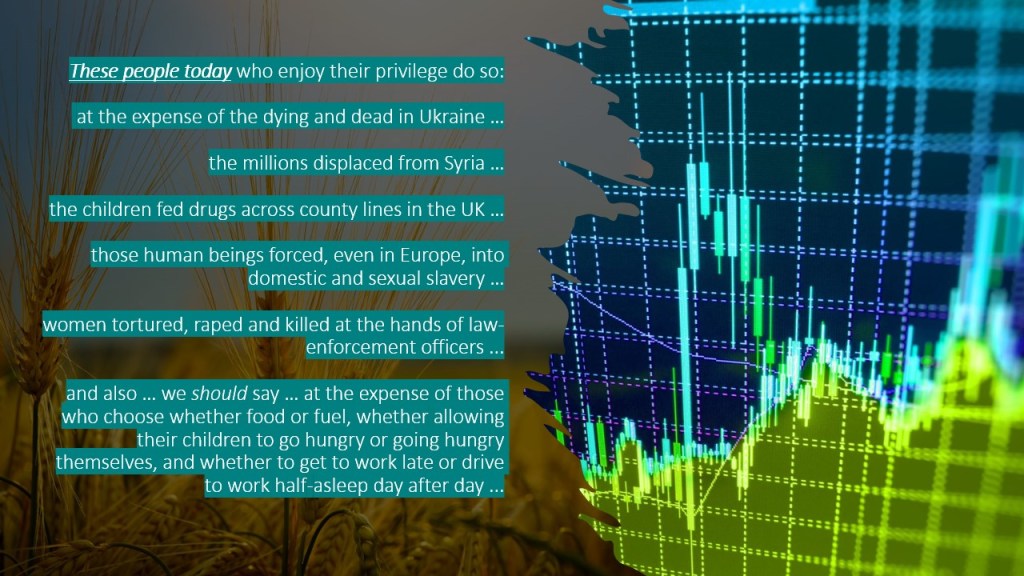
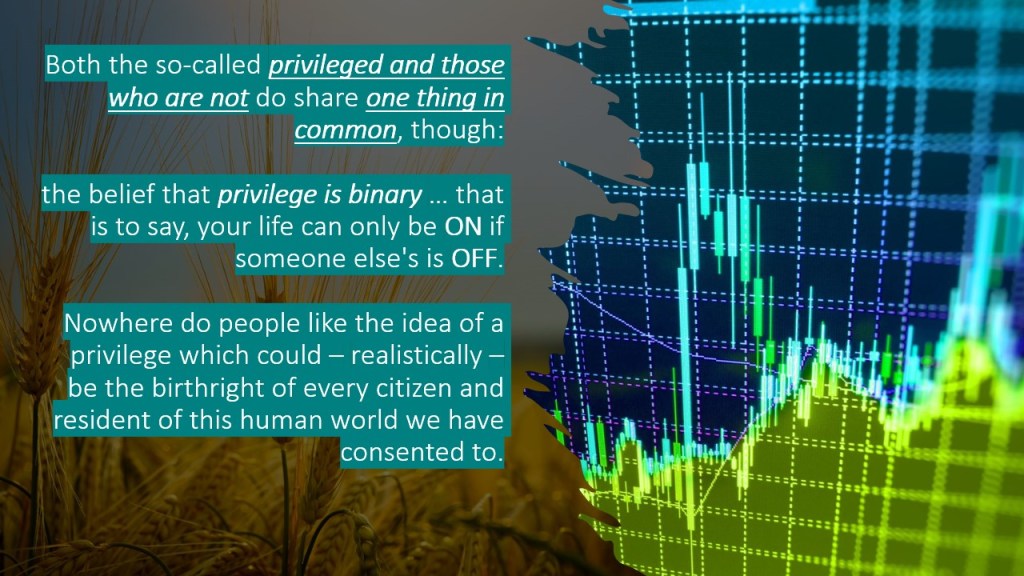
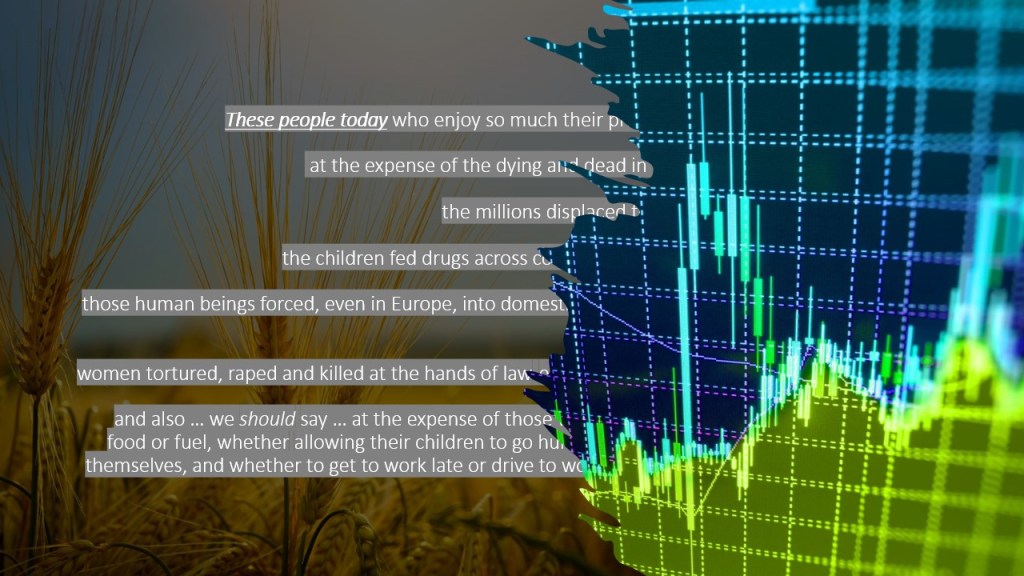
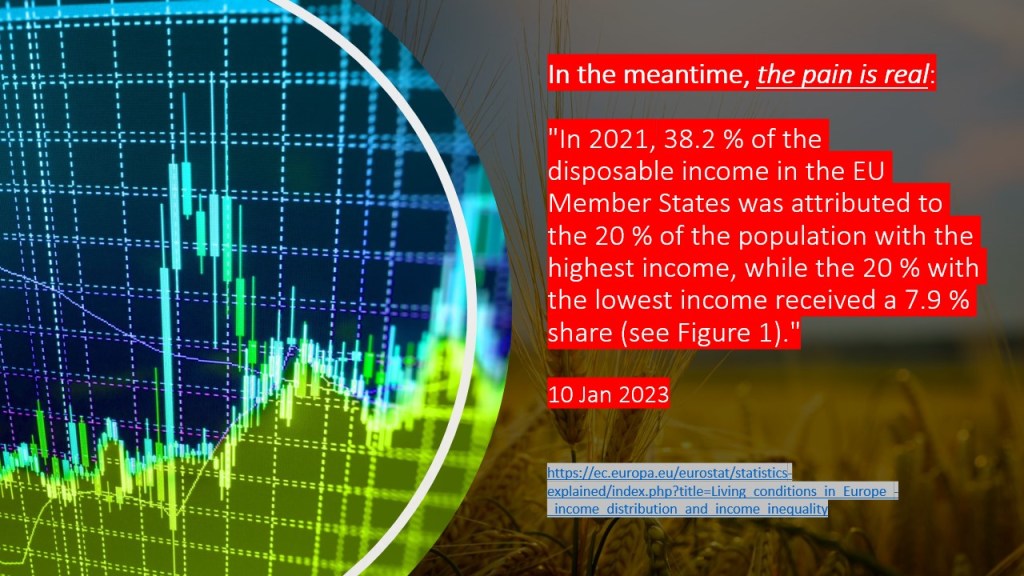
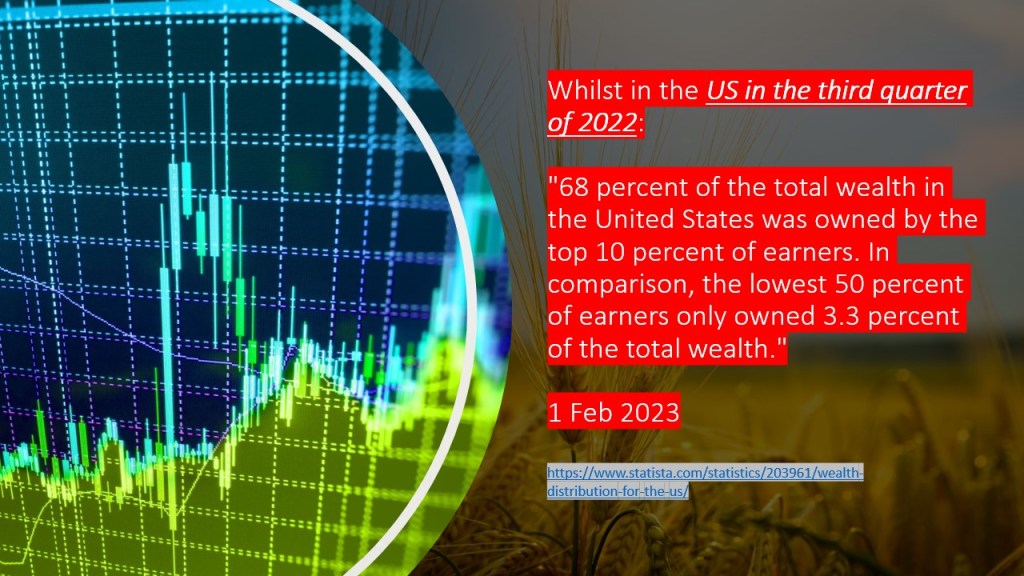
#distributedprivilege: a #nonbinary way of making #wealth

i am wondering this morning if the reason some companies are choosing no longer to embrace #hybridwork is because it may make it easier for their staff to make the #gigeconomy and #sideproject-activities function efficiently and compatibly — but no longer with clear and deep #manager-oversight. the option to buy into new #ip generated by such processes then, of course, wholly escapes them.

previous to this, the #gigeconomy was a control mechanism of quite some power as far as salaries and conditions were concerned. but now #hybrid and #homeworking may actually turn this balance upside down. and some companies may not have the relevant cultures to be able to embrace the advantages that might make it all work for all.
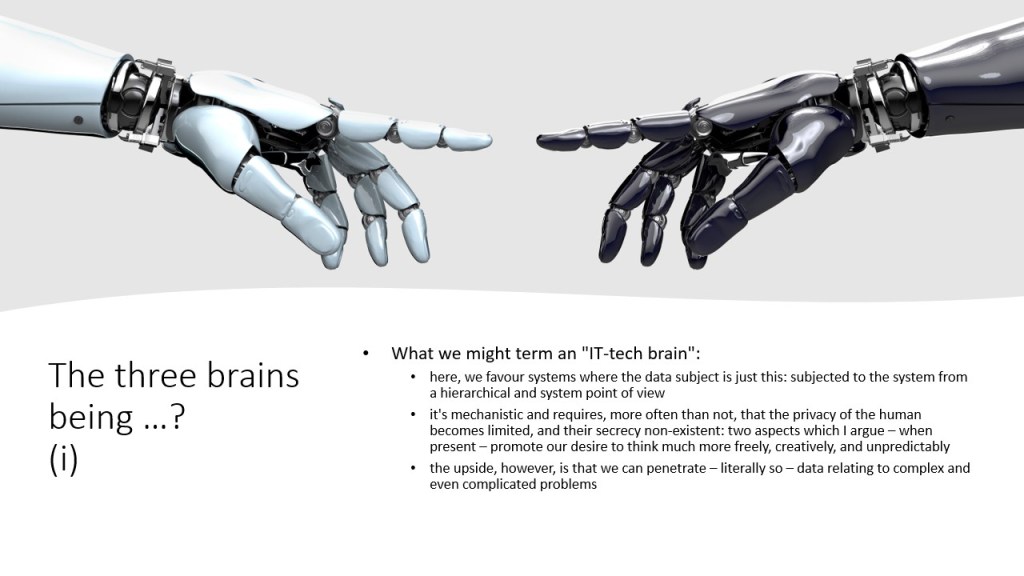
either way, i think the idea of a #nonbinary #distributedprivilege to further the interests of a more efficient socieconomic network of common future-present activity would serve to further the interests, also, of #diversity and #creativity in our western liberal democracies.

wdyt?

is there something worth pursuing here?

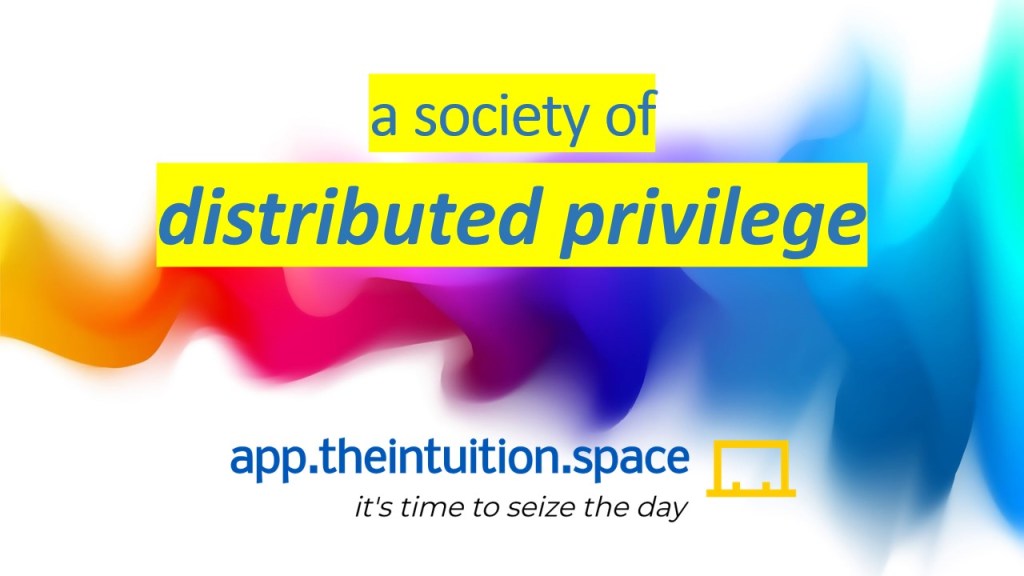
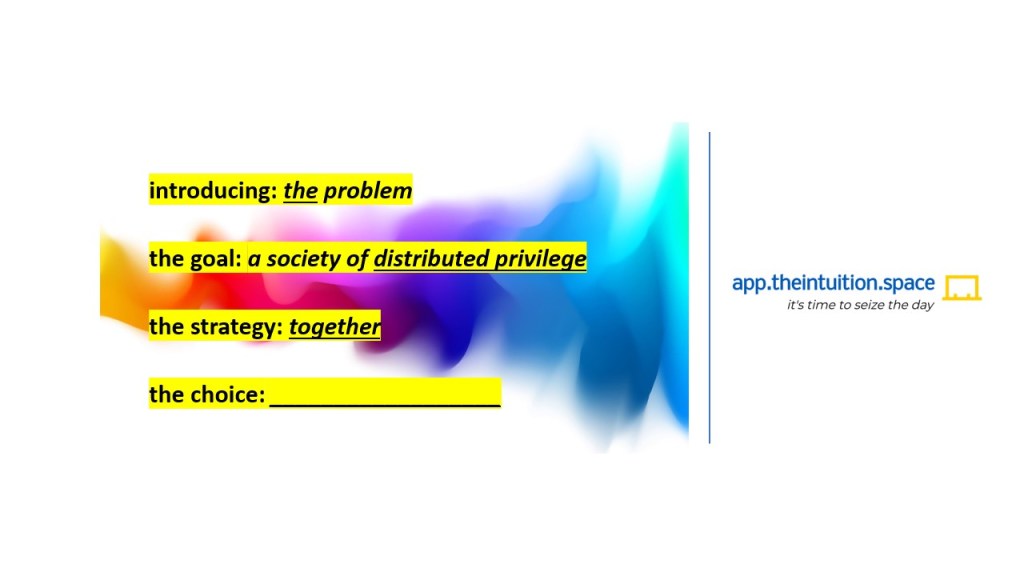
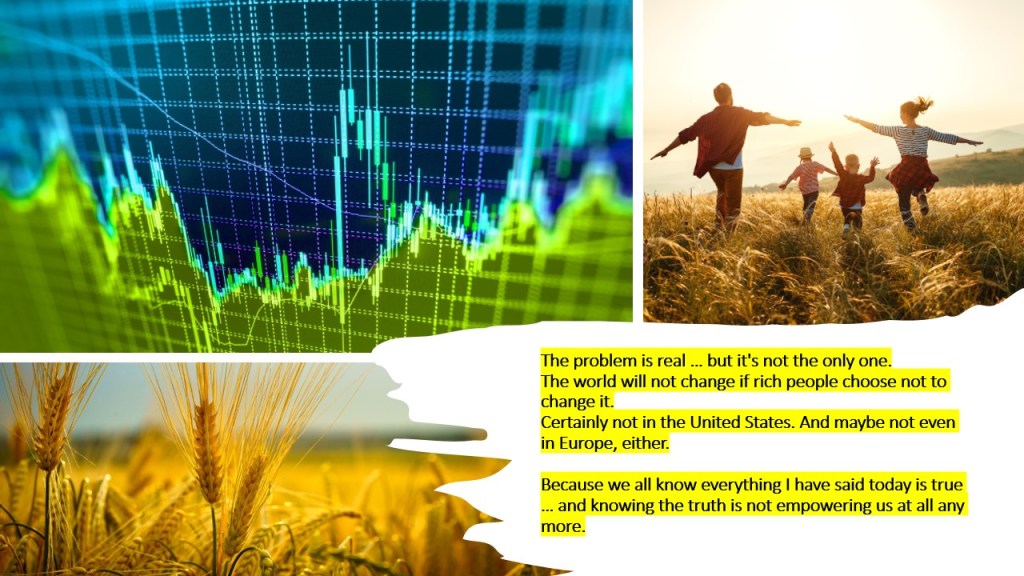
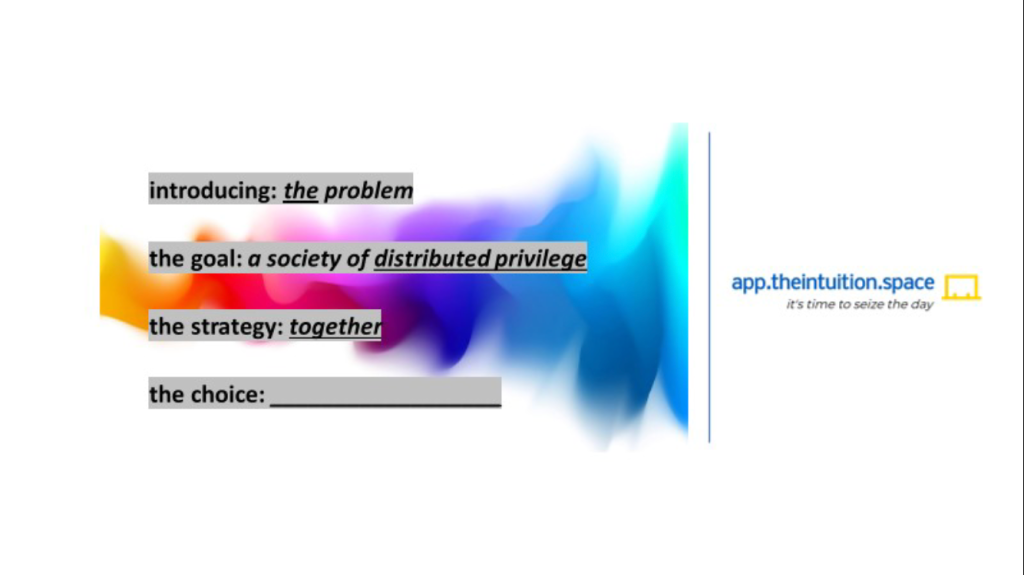
“a society of distributed privilege”

attached, a (big!) little something i’ve been working on yesterday afternoon.

a slide-deck of 33 slides down to about six.

content itself still to do, mind … but you can see where my #roadmap, already.

and i’ll be taking it with me to #sweden next week: a country which has striven so long to truly, actually, sincerely deliver a society of #distributedprivilege.

what i’ve been aiming at all this time i now realise, with ALL my projects around #intuitionvalidation.

and it makes me happy to begin slowly to know how to express it.

mils.page/intuition-day

app.theintuition.space