

introduction
they say we human beings, over and over, stub our toes on the same stones.
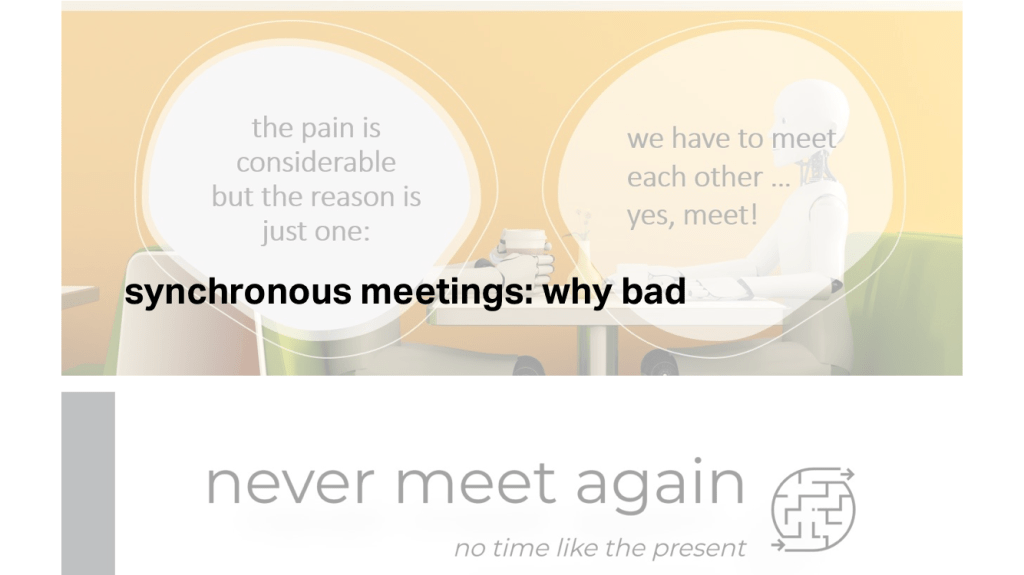
we do it with #meetings, for sure: all the tech that has ever been developed aims to reproduce the weaknesses — even deepen them — of the original beast.
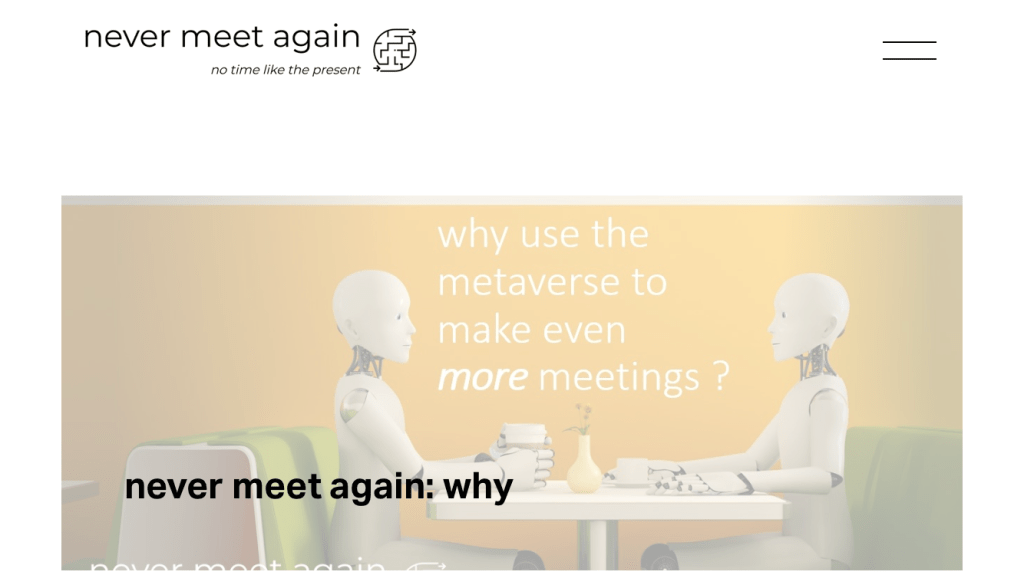
why tech-enabled meetings don’t work right now
three examples:
1. whatever your level of hierarchical importance, you will find it a challenge even to coincide with one person’s calendar … never mind ten or maybe more. then multiply this up over a year: the waste spent negotiating just timings — never mind agenda! — is dreadful.
2. ensuring everyone is duly prepared, and therefore focussed, for a #meeting is a herculean effort in itself. but even when it is achieved, we have the problem which follows, expanded on in point 3: if the structure is strong enough to deliver a reasonable ratio of time versus usable outcomes, it may — equally — be too fierce to enable the potential for tangential leaps of faith that lead to true invention … and so, possibly world-beating innovation.
3. as alluded to in point 2, an developed here now, the inability which current #meeting structures have to ensure that the thoughts and ideas of some of the most significant thinkers a company may employ are ever registered, never mind taken advantage of, is … well … criminal.
whose thought — exactly! — we are criminally wasting
here we are talking about the more reflective thinkers amongst us — and on all teams, everywhere. the ability to freely and vulnerably think up paradigm-shifting ways of running an organisation, and then the ideas such capacity moves us collectively towards in the future to ensure the organisation will thrive always, is wholly dependent on our ability NOT to:
a) talk over the creatives to keep control of our hierarchy;
b) organise the direction of a conversation so the gathered listen to us, instead of us to them;
c) command and never properly enquire.
so why don’t we ask a different question? instead of saying how we might do meetings bigger and better in remote and hybrid ways, why not ask:
“how about we don’t meet again, ever?”
that is, upturn the #meeting paradigm for once in our human history.
it wouldn’t work for everyone: not all company cultures are actually interested in the #truth, and what i am proposing is effectively a company and organisational #truthmachine.
but some companies are: recently pwc published a fabulous workplace survey which shows that forward-looking and forward-acting corporations see the freedoms of, for example, hybrid- and fully remote-working as enhancing almost everything related to company organisations and hierarchies one could possibly imagine. including retaining an evermore picky and supremely skilled digital-savvy workforce.
my call to action: a startup which upturns ALL #meeting paradigms
so here’s the idea:
- add into this perfect and virtuous storm the idea that we might remove — for those organisations intrigued and engaged by verifying and validating the #truth of #business — the hierarchy within the #ideasgeneration #thinkingspaces and nodes that traditional #meetings are sometimes capable of enabling …
- well … you MUST find engaging and intriguing whatever we might be able to achieve …
for sure, no?
no?
further reading:
• the pwc 2022 workplace survey | https://www.pwc.com/gx/en/issues/workforce/hopes-and-fears-2022.html

• edgar h schein’s “humble inquiry” | https://www.google.se/books/edition/Humble_Inquiry_Second_Edition/XpjyDwAAQBAJ?hl=en

• an example “never meet again” implementation | https://www.nevermeetagain.com/gutenberg


 mil's page