Why a data-driven world isn’t everything in life … and why it’s important we understand this much much better

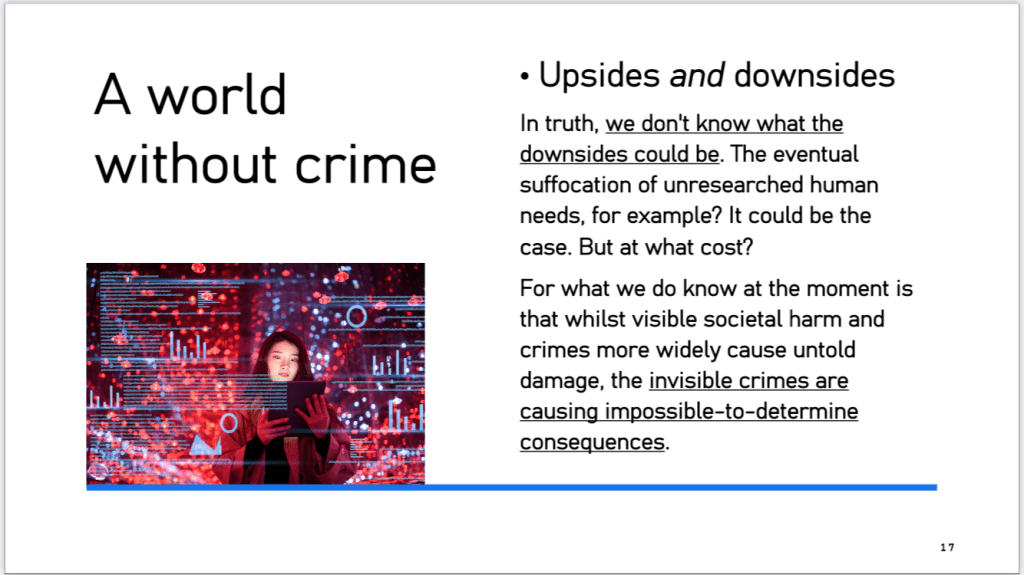
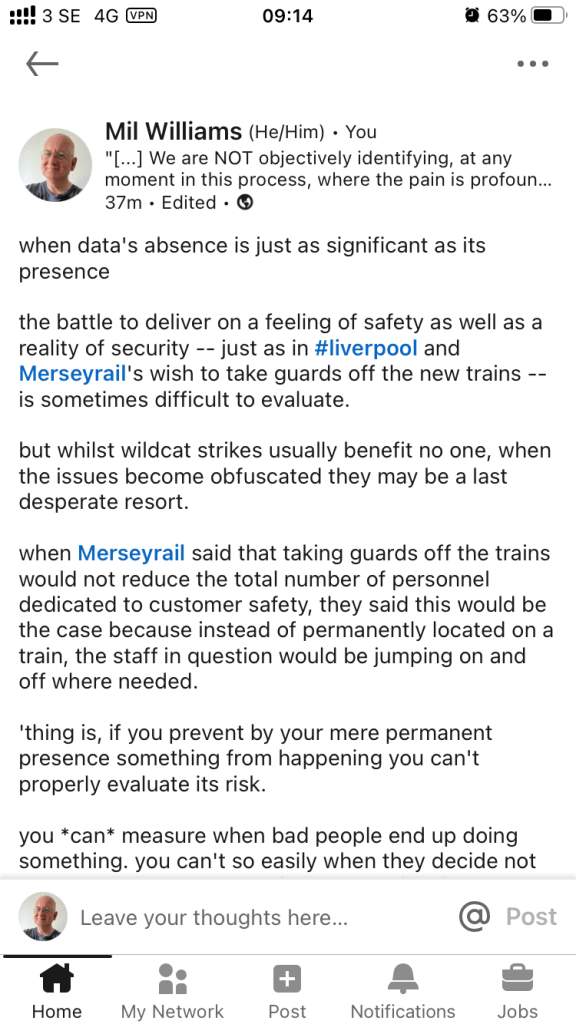
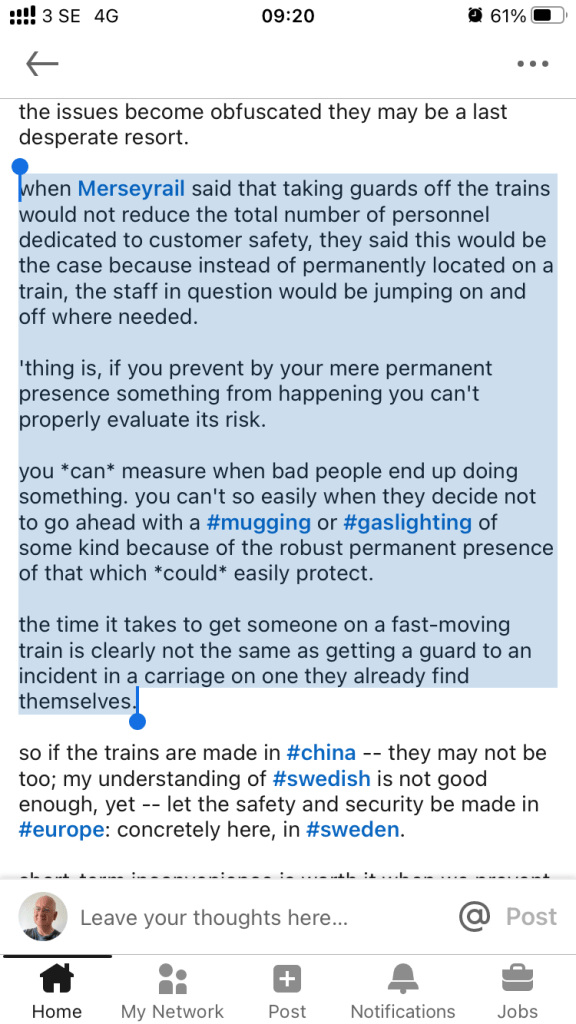
The real nub of the issue is this: in the absence of data, we can only use data that is present. Here, it’s clear when someone commits a crime and we catch them after the event with a certain number of mobile train security personnel on our payroll. That’s measurable: the ratio of events to arrests, for example. What’s not measurable by automated data science and analytics half so easily is when something doesn’t happen because a permanent guard is present to act as deterrent.

Mil Williams, Stockholm Sweden, 21st April 2023

Introduction:

There are strikes on the commuter trains — the otherwise fabulous pendeltågs — here in Sweden: even the occasional wildcat ones. The frustration is patent: more so, because the strikers are right.

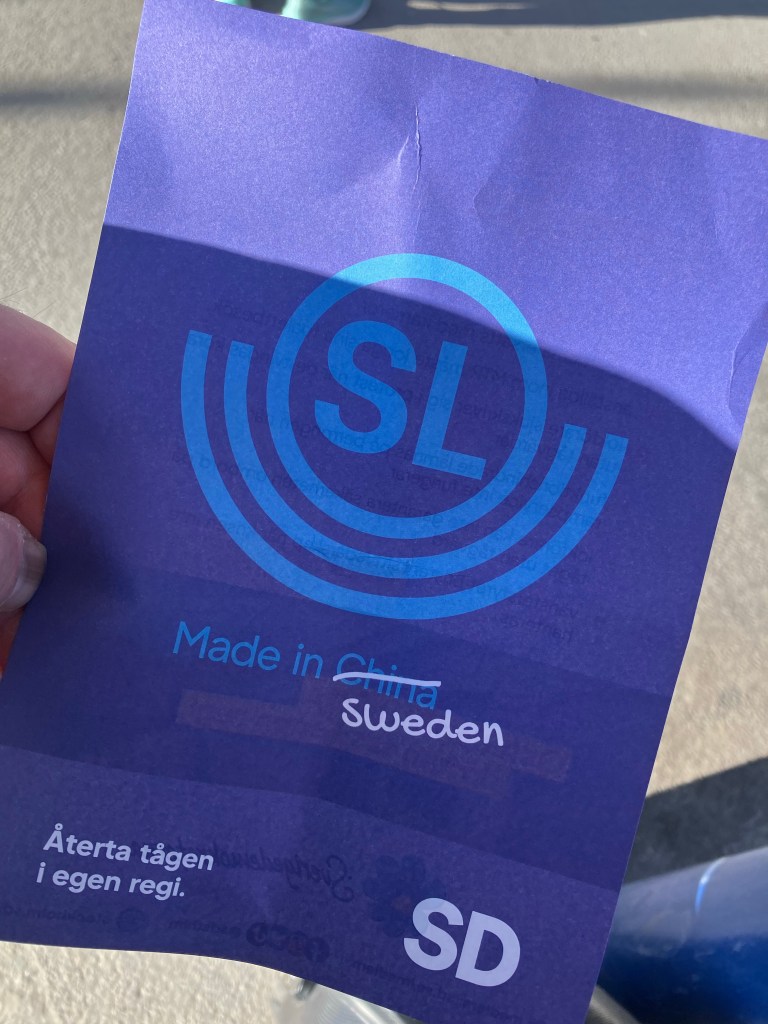
This is why:

An aside:

As a brief by the by before I continue, I think the train companies are able to claim the numbers of security and safety staff would remain the same, and yet still want to go ahead with it all, because they’re changing the type of workforce: you still need to go through with rightful and rigorous measures to vet and upskill non-train guards of all sorts it’s true, but with a train guard it’s less easy to change and chop their working locations, conditions and so forth. Or outsource the workforce, even. Change overnight who employs them and how.

No?

So …

How a data-driven world can deceive:

The thing is, here we have a perfect example of when a “data-driven world” actually needs academia more than it needs an automated data analytics and data science as we usually understand them.

The train companies in Liverpool and Sweden both I am sure will have had long-term strategies to re-engineer the structures of their employees and related re in-house and outsourcing options, and whilst taking guards off the trains in the circumstances described wouldn’t deliver immediate economic advantage, as indeed they underlined in Liverpool for sure, long-term if I’m right it definitely would.

The real nub of the issue is this: in the absence of data, we can only use data that is present. Here, it’s clear when someone commits a crime and we catch them after the event with a certain number of mobile train security personnel on our payroll. That’s measurable: the ratio of events to arrests, for example. What’s not measurable by automated data science and analytics half so easily is when something doesn’t happen because a permanent guard is present to act as deterrent.

And this is the challenge here. It really is a challenge around what we do when the evidence base is incomplete: that is, how it leads us to take quite the wrong decisions.

To the solution:

There is a solution too; I alluded to it above. Straightforward academia gives us tools to codify absences, in for example qualitative data such as an interview transcript or video, so that what isn’t said is as significant as what is.

If we could create an equal set of tools for strategic decision-making when deciding if to take train guards off trains or no, perhaps we would avoid the strikes we’re having everywhere: and at the very least, we could validate, in a less conflictive way, the common sense most users of public services have that a “bobby on the beat” engenders an incomparable feeling of safety even where a car in the neighbourhood can be evidenced to deliver on objective data relating to quantitative crime events.

Summarising:

In crime and public safety, what doesn’t happen is as important as what does: and the “why” of both these matters, too.

So.

Let’s do something after the evidence bases for both aspects of the truth: that which has a visible side and the invisible events as well.

And then let’s achieve delivery of these aspirations sooner rather than later.



Further reading:

https://en.wikipedia.org/wiki/Sweden_Democrats

Another by the by: the promoters of today’s information are a further example of why we should act on the basis of what is not visible, as well as what is.

The Sweden Democrats started out as fascist and redolent of nazism of the very worst sort — at least according to the English version of Wikipedia. They themselves claim to have re-engineered their political DNA, which is not impossible but highly unlikely. Even so, medical professionals claim bespoke DNA of the human kind is very close to becoming a reality now; so we could argue that in politics it’s not unthinkable any more.

Let’s just say, however, for the moment unlikely and hard to do.

So. The risk from relying on present datasets instead of datasets relating to both what’s present and absent too? We allow people to hijack in bad faith what needs to be promoted in good faith.

The train personnel are right. Guards on trains deliver safety and security. This Swedish political party — in the current security conditions which China and Russia together have been stealthily laying out for decades together — are also correct to highlight the dangers of such, separate, narratives.

But they are wrong to a) conflate two issues like this; and b) lever the abuse and violence of both nation-states and their outliers in the fields of geopolitics to then promote an immigration narrative of their own re Sweden which delivers total obfuscation of our all too human reality and a zero confusion around their racist truths. Unless you choose to remain confused.

Sometimes it’s right to be firm: China — not all Chinese people — is a toxic regime. Putin’s Russia, too, has absolutely no redeeming qualities. But firm doesn’t mean we have to give fascism a place at the table of a wider collective progress.

Don’t besmirch the truth of the train staff by taking political shortcuts. And if this is what changing your political DNA leads to, change is what clearly you are NOT delivering.

Just occurs to me, too: even more reason to proceed with #intuitionvalidation.

A roadmap for thinking #complexproblems out of existence in 7 years using #neurodiverse IT-tech

Today I’m posting in full an example 7-year roadmap for ultimately delivering #secrecypositive #neurodiverse-enabling #thinkingspaces I produced the other evening: in this case, specifically focussing on #climatechange but easily lending itself to being repurposed to #security and so forth. Here’s the introduction to the first presentation and online whitepaper of the series I published a few days ago:

why simplifying problems means we have been ignoring the biggest ones

We have a global startup ecosystem which, for decades, has delivered a capability to simplify problems from a complicated journey to a set of easy-to-understand “pain-points”.

It’s solved many problems we needed solving — though sometimes has caused others which have delivered a much less happy set of outcomes.

This presentation, shown in four parts below, has the goal of beginning to stir a debate around whether the concept of incremental progress is useful for us, by itself, any more.

The question I would like you to take away from this online whitepaper is whether you think humanity can incrementally save itself from its past.

Contact details are contained within the presentation itself, as well as in clickable mailto: format at the end.

Otherwise, if you can at least reflect, I’d be really grateful.

complexify.me

complexify.me | sverige2.earth/complexify

complexify.me

I have been working on making the timelines practical, comfortable and safe for all stakeholders — whether #climatechange- or #lawenforcement/#security-focussed.

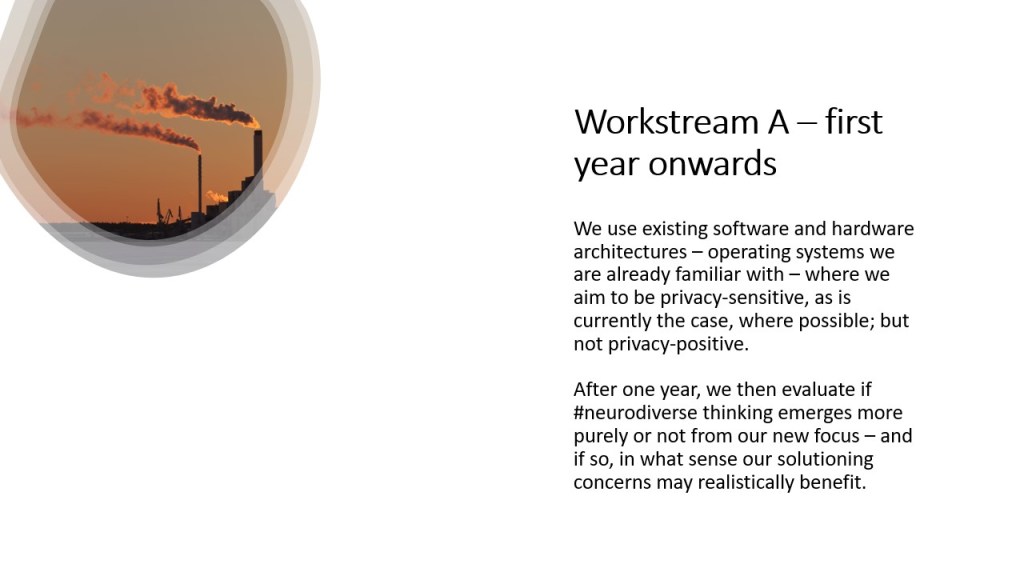
We now take things step-by-step, over the proposed period mentioned, evaluating the results of the four workstreams A-D in turn in firm but responsive ways.

Here’s the second presentation in the series, which offers an initial roadmap for #neurodiverse-solutioning #thinkingspaces to solve #complexproblems such as that which #climatechange now presents humanity on all fronts:


My suggestion is now that:

  • we locate — with #swedish, #us, #irish and #uk stakeholder engagement — the core #complexproblems HQ in #dublin #ireland, in close and permanent collaboration with one large consulting corporation and one preferred tech corporation;
  • that all IP generated by anyone be #govtech only;
  • that the project management and related responsibilities for #security and similar belong freely and entirely to domain owners in each participating country;
  • that tech partnerships and other frameworks for #security etc will also be freely entered into by the respective domain owners in each country (that is, military, agencies, and others);
  • that any of the #govtech thus created belongs in the future only to these stakeholders above-mentioned;
  • and that as everyone who contributes will have access to everything everyone else contributes, we will need to establish contribution KPIs that ensure contributions by all equal the usage we all make of others’ contributions.

I’ll be thinking more on these matters in the next couple of days and may post more here or elsewhere as a result.

Let’s see if by my concentrating on having direct responsibilities only for #complexproblems-solutioning with #neurodiverse approaches, and then acting only in a consultancy capacity in the field of #security etc when and if the separate country projects see the need, we can finally unleash all these projects in a due, proper and deliverable manner.

Comments, as always, welcome.

Email contact here:

milwilliams.sweden@outlook.com


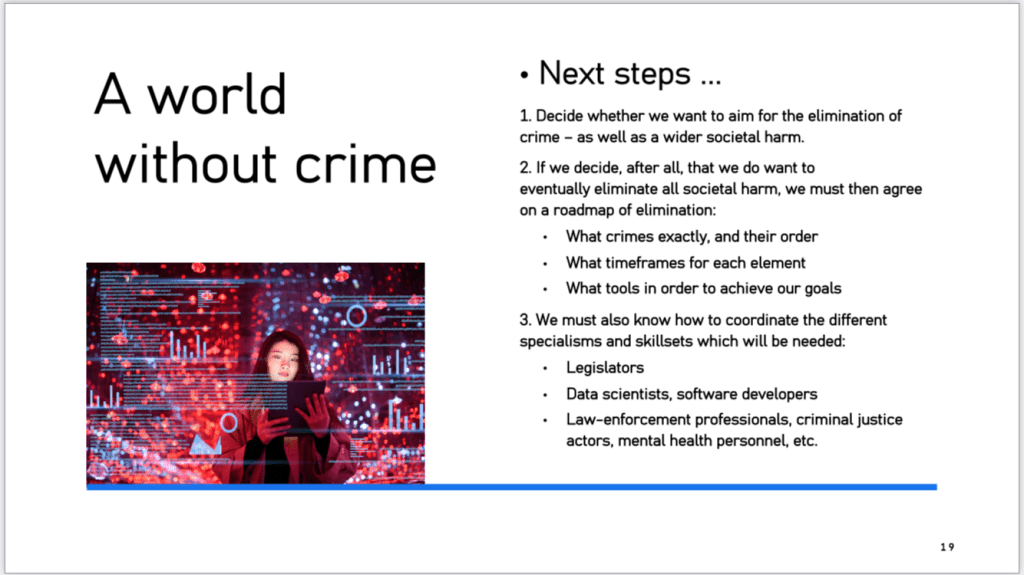
criminals mind …

i said the other day i probably wasn’t suited to the fields of #lawenforcement and #security: i’m a free-thinker, a nonconformist in some serious senses, and almost certainly neurodiverse in others. people who work in the aforementioned fields need to be attached to rules, regulations, procedures and tasks. that makes it hard sometimes for them to appreciate the kind of person i often can be.

generally, not them. which makes me no better than them at all. nor them anything but different from me.

but that doesn’t mean we mightn’t be able to connect the two ways of being to better catch a creative criminality:


it’s my assertion and firm belief that we’re missing out on neurodiverse ways of seeing for understanding better the world of #complexproblems around us. and this is, partly, by using technologies which, perhaps unconsciously, have become firmly neurotypical — but are no less neurotypical for that. technologies which, as a result, reinforce the ways of seeing and doing that most of the world’s professionals need to share, rather than encourage them to have a broader take on that world.

i think we can do much better: i think we can bring the neurodiverse and neurotypical together: not just from the point of view of company inclusion policies and so forth; much more by engineering different #it-#tech architectures.

exactly as what follows, in fact — here, in a separate field, a proposed roadmap for dealing with the #complexproblems of climate change:


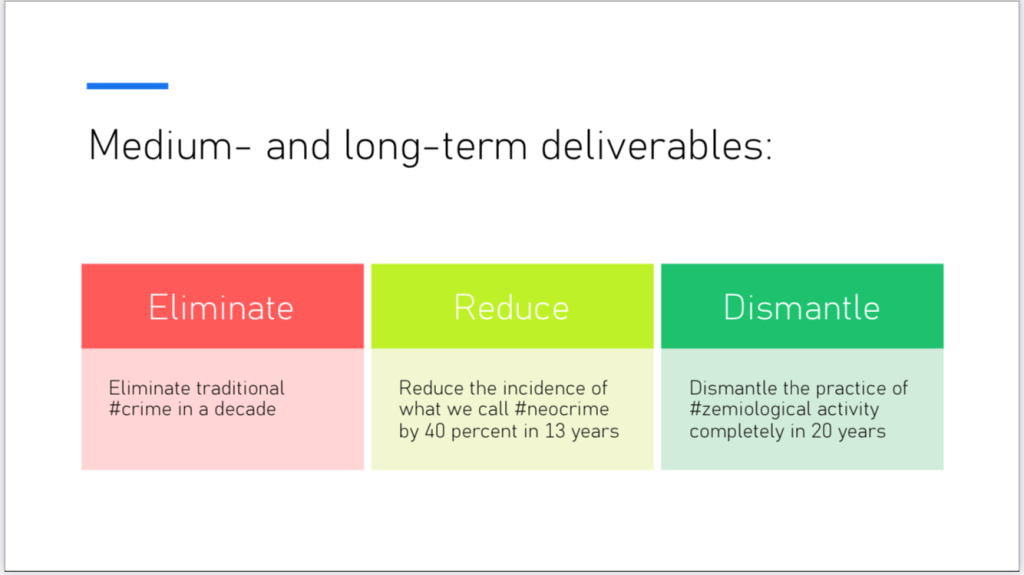
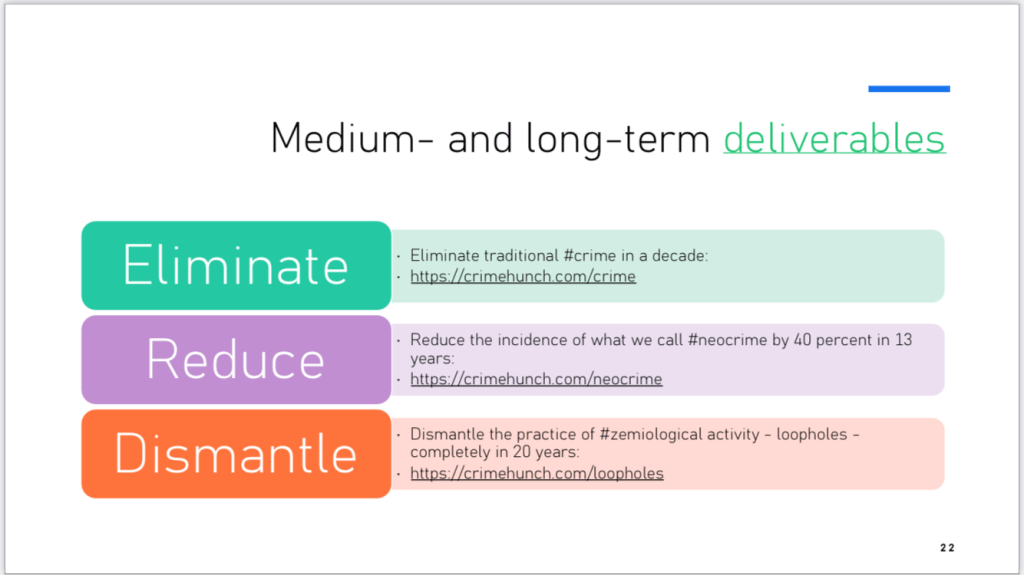
so to finish this post, something that happened to me today just to show i might — as a different kind of thinker from those who usually work in such fields — be able to usefully contribute, in some capacity of due utility even as i remain such a thinker, to the reality that has become deeply creative criminality: what has been called #darkfigure since the 19th century; and which, for a couple of years now, i’ve preferred to call #neocrime.

the anecdote in question:

here’s an example of my intuition in action. and i might be totally wrong. what i want to do is not prove i am right but absolutely clearly be able to share, without anyone being able to disagree, that i am wrong …

“that gangster-looking guy wanted three things at least potentially, when he asked me to use my card in exchange for his cash, for a pizza order he said he wanted to make:

1. get my card number from his mate at the pizza place.

2. give me counterfeit cash so i’d get into trouble when i tried to use it.

3. see if he could identify the name of my iphone with an excuse to approach me (i was tethering to my laptop at the time) in order for him and his mates to be able to sniff when i was using it in the future.

if i am right about him being a gangster, he had already inhibited me (tried to) by standing near the wall and not moving an inch as i tried to get by behind him, when he was looking at his phone in front of the lift on the landing on floor 1 yesterday.”

as i say, i might be wrong totally about him. he might be a humanitarian of the very best.

but what if we could create systems which didn’t prove we were right … but validated whether or not we were wrong! that is, that i was wrong.

and just to frame it better:

• he was at the hotel i am staying at

• i was working for hours at my laptop in a darkened corner: so he had every reason — seeing me wrapt up so intently in my work — not to approach me

• the receptionist (according to the guy) had already refused to take his cash

• no one uses cash in stockholm

and so for all these reasons, i actually think this might have been an example of #darkfigure waiting to happen.”

crimehunch.com/neocrime

of course i could be exhibiting a dreadful prejudice. but this, precisely this, is why i want us, together, to develop systems where we can enter into our deepest thoughts and make it possible for us not prove what we think true — but validate (an utterly different matter altogether) whether true or no.

just this.

complexify.me: an example roadmap

how #neurodiversity can save our humanity

yep!

just that … as i move from considering #lawenforcement and #security to the wider challenge of #complexproblems which may already be affecting our very survival.

which is not to say the first two don’t, but my thinking now assumes that if we can crack #complexproblem-solutioning first, we’ll then be in a position to give those in #security and #lawenforcement the opportunity to access such tools in a freer and more “pick & mix” way, which then may be far more suitable for their specific domains and wider ways of thinking than all my thought-experimenting has been to date.

the presentation itself in image and pdf formats

the presentation itself can be viewed below as a gallery, and can be found in downloadable pdf format here:


creativity and neurodiversity: what do we think?

introduction:

do we agree that creative people have neurotypical brains or neurodiverse ones?

let’s say, without any evidence being presented to hand, that they are more than likely to be tending to neurodiverse.

so.

what about creative criminals?


will they more than likely be neurodiverse — or just plain old simple neurotypical?

will they prefer to conform or disconform? will they keep things ticking over collaboratively and constructively? or do they prefer to break things when doing so serves to reward them with ill-gotten gains?


you know i’ve been right all along. and it’s hurting so much you’d rather leave me in the hell of your denial than accept i am right, in order that then we could do something about it by changing some of the direction of law enforcement and national, regional and global security.

though not necessarily the whole of the process at all. i’m not advocating this; never have either.

more of this in a bit.

neurodiversity, criminality, crimefighting and the real problem

if criminals — like artists — are more often than not neurodiverse, and machines — like #it-#tech more generally — deliver neurotypical environments where rules and regulations aggressively must regulate and rule everything we do when we inhabit and work in them, how on earth will what we do in global, regional and national security and law enforcement ever completely be capable of preventing even a minimum of creatively criminal acts of the highest criminal order?

the ones, i mean, that shake civilisations and their historical development …


traditional it-tech … what do you think?

this is the big question of today’s post:

is traditional it-tech made in the image of the freedoms of neurodiversity or the strictures, rules and regulations of neurotypicality?

mil williams, stockholm sweden, 13th april 2023

if machines are more neurotypical than not, and creative criminality is more neurodiverse than anything else, where’s the judiciousness we will have demonstrated to be operating here when we choose to use machines plus more than likely neurotypical humans — that is agency operatives who are focussed on applying rules and laws (and quite rightly, too)?

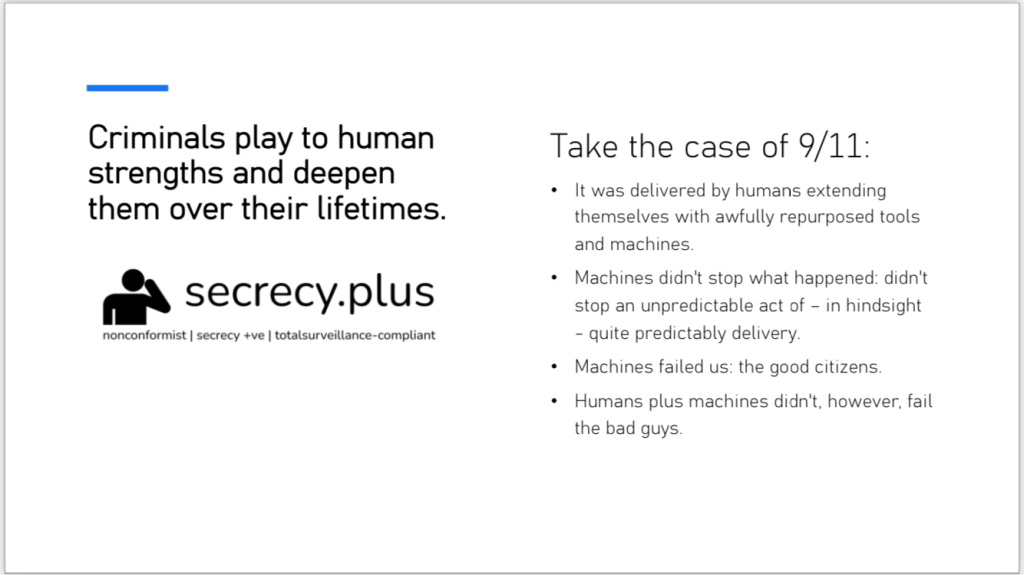
how will we be ever able to fight neurodiverse creative criminality of the 9/11 sort — especially when now applied to the deepest digital cyberspace, to dark figure, and to neocrime — if we don’t use newly neurodiverse crimefighting humans enabled by the radically neurodiverse software and hardware architectures i am now advocating in the complexify.me workstream?


and to be delivered in the following order — humans (maybe neurotypical and neurodiverse) first in the workflow, supported by machines in second place; not in the traditional order — machines which spot and spit out largely neurotypical (even when obviously mega-) insights to support equally neurotypical humans …

look.

don’t get me wrong, please. we need neurotypical: we need conformists more than any time in our history. we need people who just love to pursue those who don’t follow the rules and laws that provide the best foundations for civilisations and societies we’d all wish to be proud of again. people who love to apply these legal figures with due and appropriate process. people you’d trust with your youngest children. people you’d trust with your life.
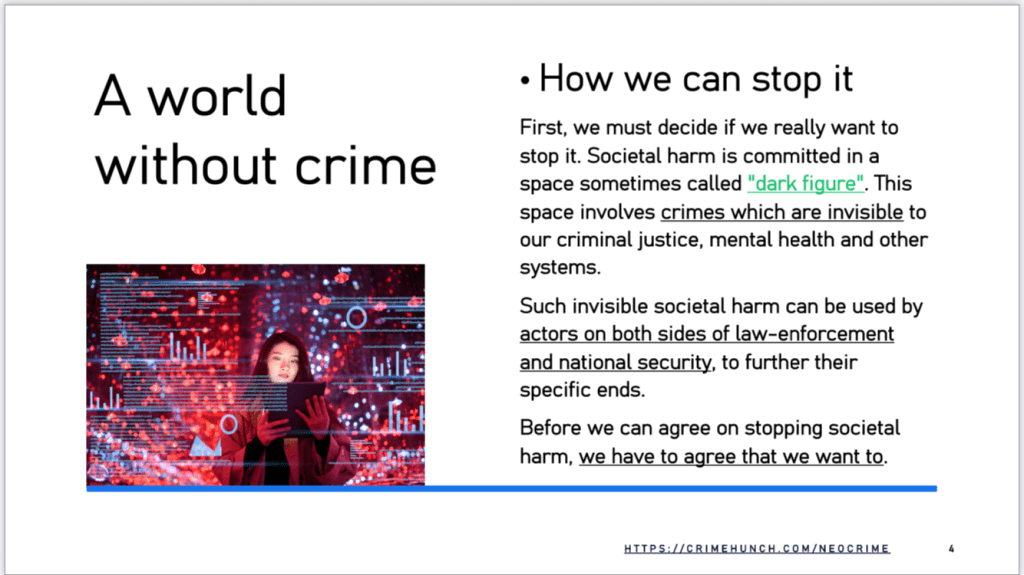
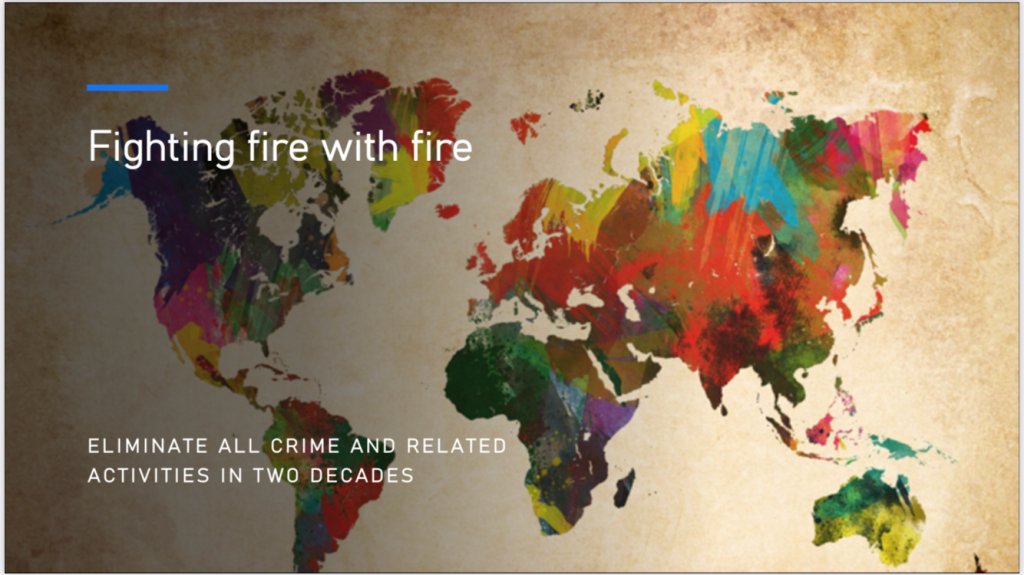
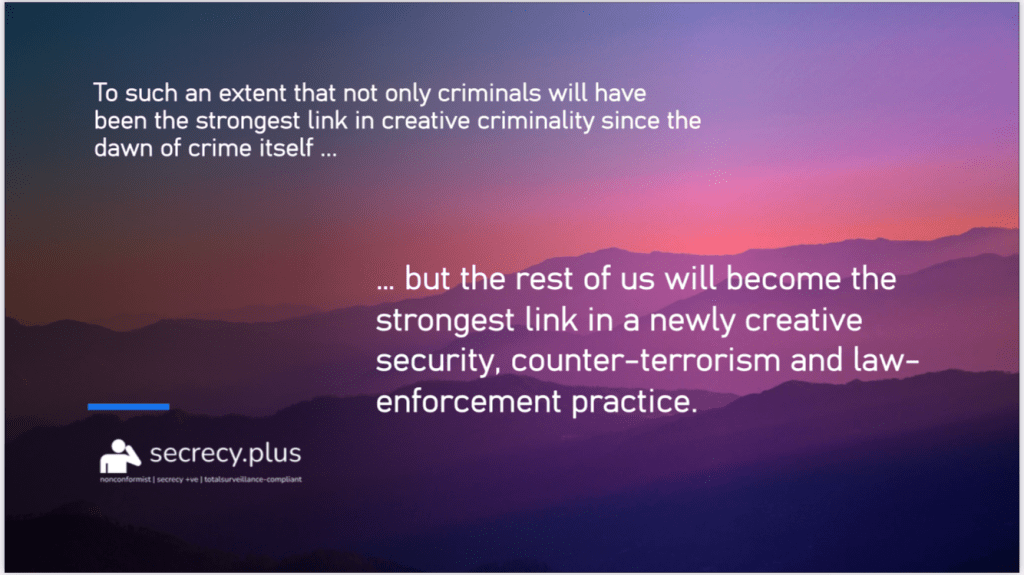
but we need neurodiverse colleagues; so much, too. nonconformists in every breath we draw, so we may all become better able to pursue bad actors imaginatively, and therefore finally — on equal terms and learning how to properly fight fire with fire — we properly police this space we call digital: a space which has become almost infinitely malleable … and so intimately present in our lives now that we are not even safe when we drink a coffee in our local coffee shop …