
2. How can you make out you’re predicting a person’s future when you’re not? By dismantling their agency: that is, their ability to exercise free will. If we agree with my hypothesis around nudge theory and the picture superiority effect … that is, by using tools and strategies borrowed from traditional espionage and spycraft, and then technifying them with a data network of private development, we can make it possible to know what someone is going to do in almost every key decision of their professional and personal life both … but NOT by foreseeing their actions at all … simply by persuading, shaping, nudging and if necessary provoking the target into actions they always consider will be their own choices.
Mil Williams, 3rd September 2023, Chester UK
When in fact, if truth be told, they are self-fulfilling prophecies gaslit into being by the blurring of lines between digital and the real world.
3. Why would you want to do this? Frankly, what’s the business model? And so this is the easiest of the three questions I’ve posed for me to explain. Control. Authoritarianism. Disembowelling Western and related democracies from within. Setting up the conditions for a multitude of future Ukraines. Seeding distrust amongst those who’d otherwise be capable of coming together, and making of this broken world a much better place for everyone. Because when you can get a doctor to incarcerate a citizen who tells uncomfortable truths to power, and the doctor — a truly honest man or woman — sincerely believes no one has influenced the processes relating to that incarceration, then the crime committed is literally a perfect one which Hitchcock couldn’t have bettered if he’d tried to.
And done once it’s a horror film you’d eat popcorn to.
But done, as I suggest firmly now is the case, maybe thousands and then again maybe hundreds of thousands of times, throughout an ever more brittle and fracturing Western democracy, and with the support of a deepening private-sector tech developing its own hidden data models which make prediction completely unnecessary now whilst the proscription of inconvenient minds becomes much easier and cheaper to deliver on, then motivations are really not difficult to perceive.
Control. Authoritarianism. Organised crime. Criminal revenues. Ukraines galore. Dislocated Western economic and sociocultural activities. Permanent war. And unending profit. For those, I mean, who have learnt how to control both the public and the private.
Welcome to an AI which predicts nothing and shapes everything. Where human agency no longer effectively exists. And where data is what you literally become an extension of.
Definitions:
A prediction (Latin præ-, “before,” and dicere, “to say”), or forecast, is a statement about a future event or data. They are often, but not always, based upon experience or knowledge.
https://en.wikipedia.org/wiki/Prediction
Proscription (Latin: proscriptio) is, in current usage, a ‘decree of condemnation to death or banishment’ (Oxford English Dictionary) […]. Its usage has been significantly widened to describe governmental and political sanctions of varying severity on individuals and classes of people who have fallen into disfavor, from the en masse suppression of adherents of unorthodox ideologies to the suppression of political rivals or personal enemies.
https://en.wikipedia.org/wiki/Proscription
The background to today’s post …
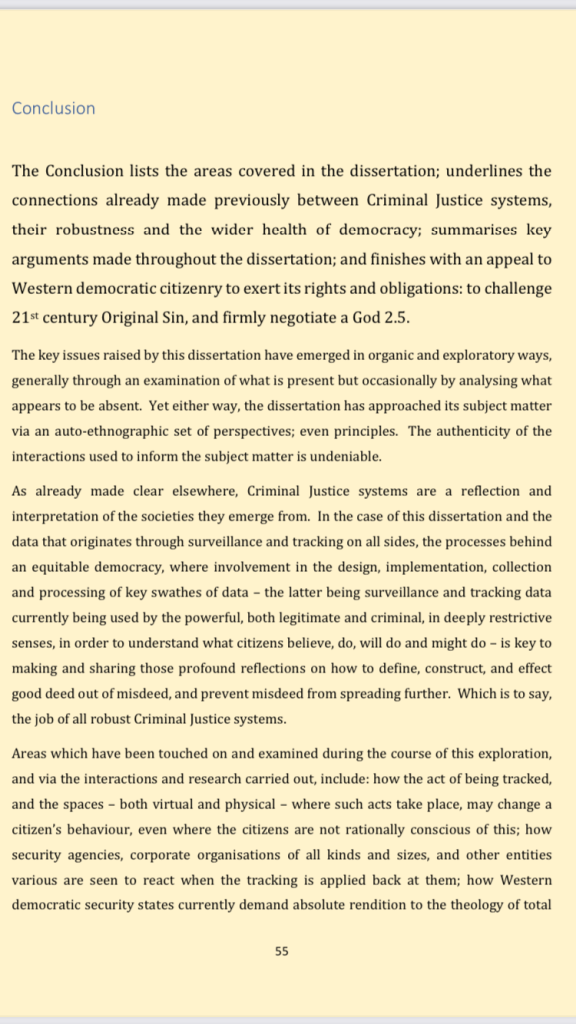
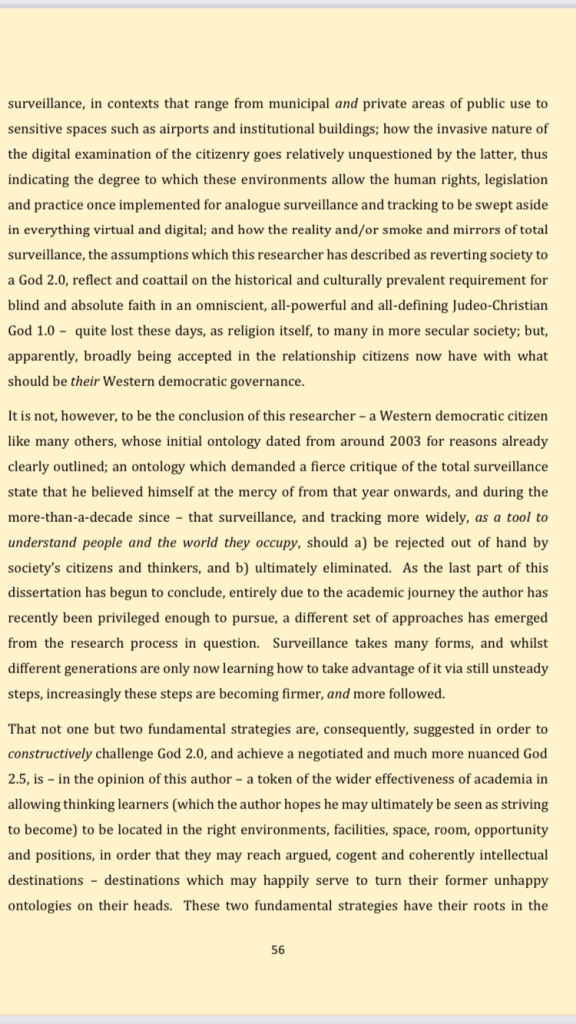
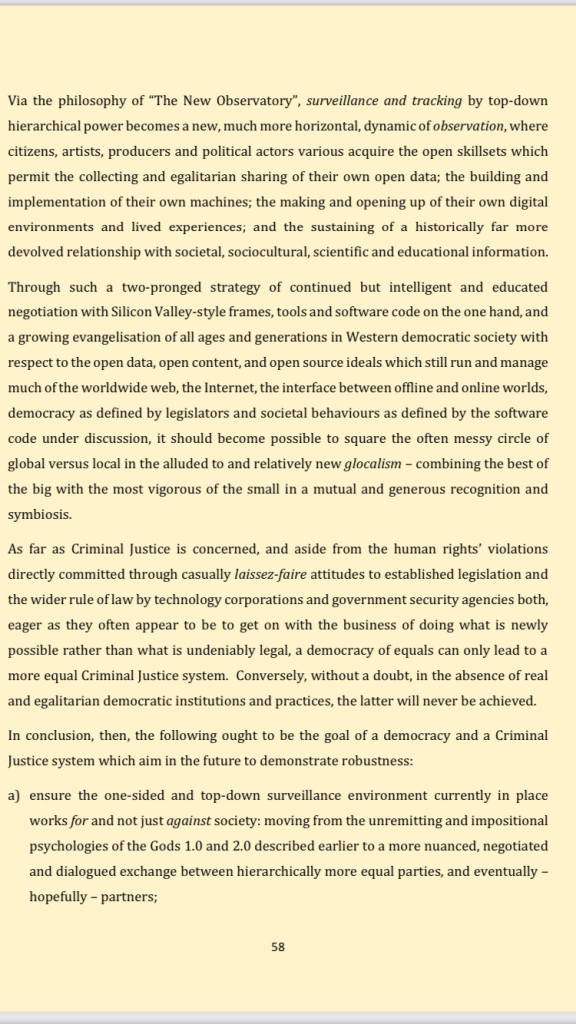
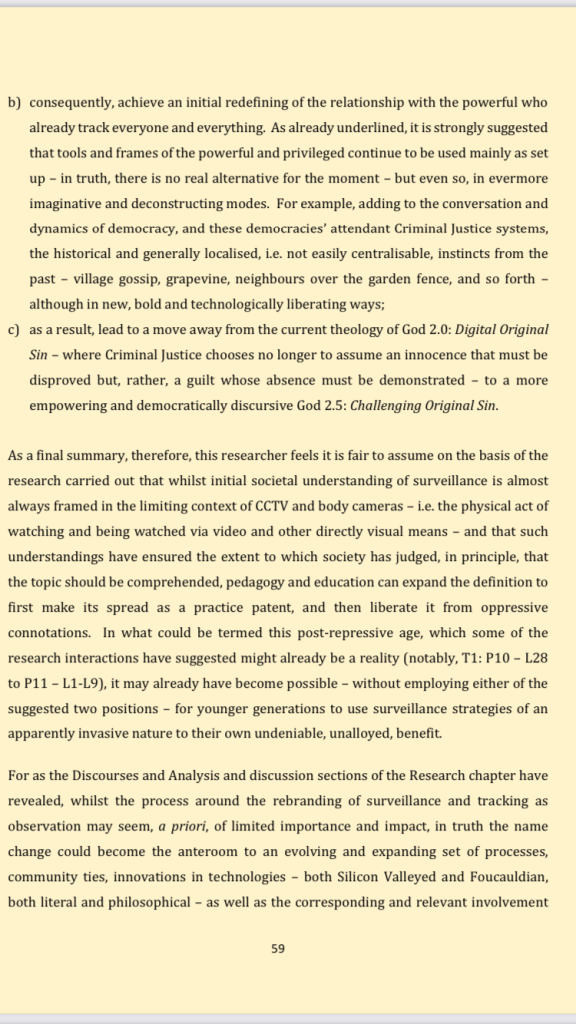
By the last quarter of 2017 I had completed my MA dissertation on digital and other surveillance.
This was the title and abstract:


And here is a selection of the Conclusion’s pages:



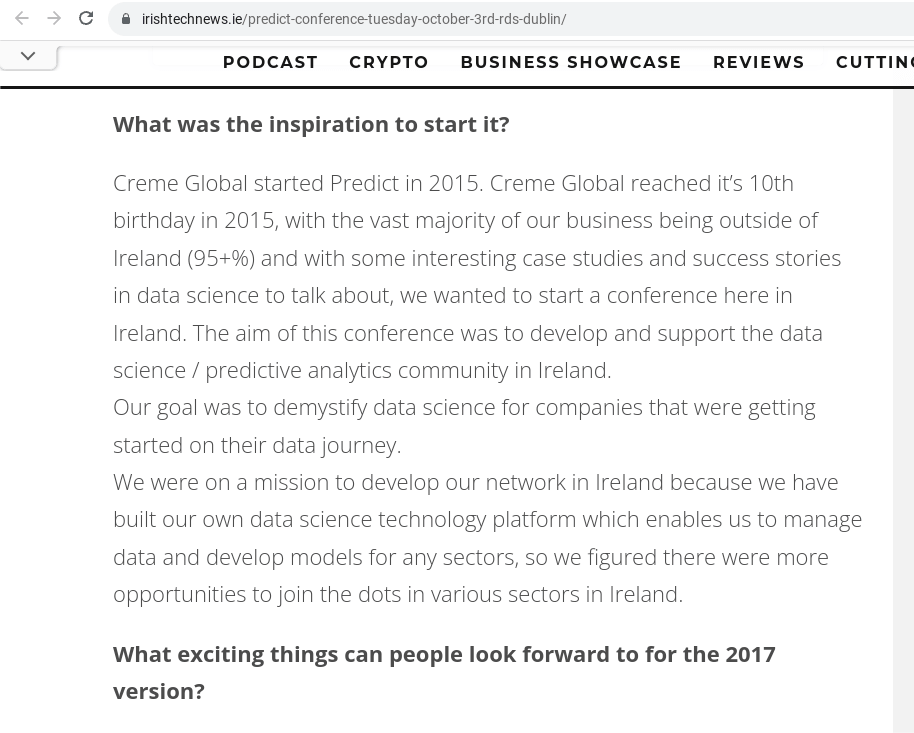
In late September of 2017, after completing the dissertation in question, though I can’t recall how or why what happened actually did, I was given two complementary tickets — if I remember rightly, the face value being more than €200 each — to the Predict conference of that same year, held at the Dublin Ireland RDS conference centre:

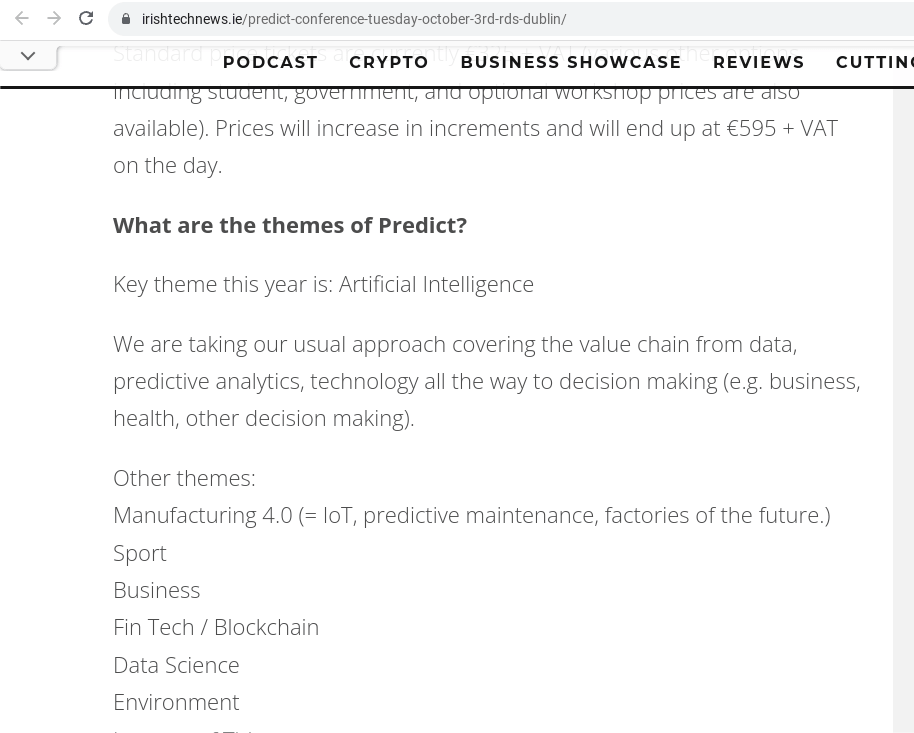
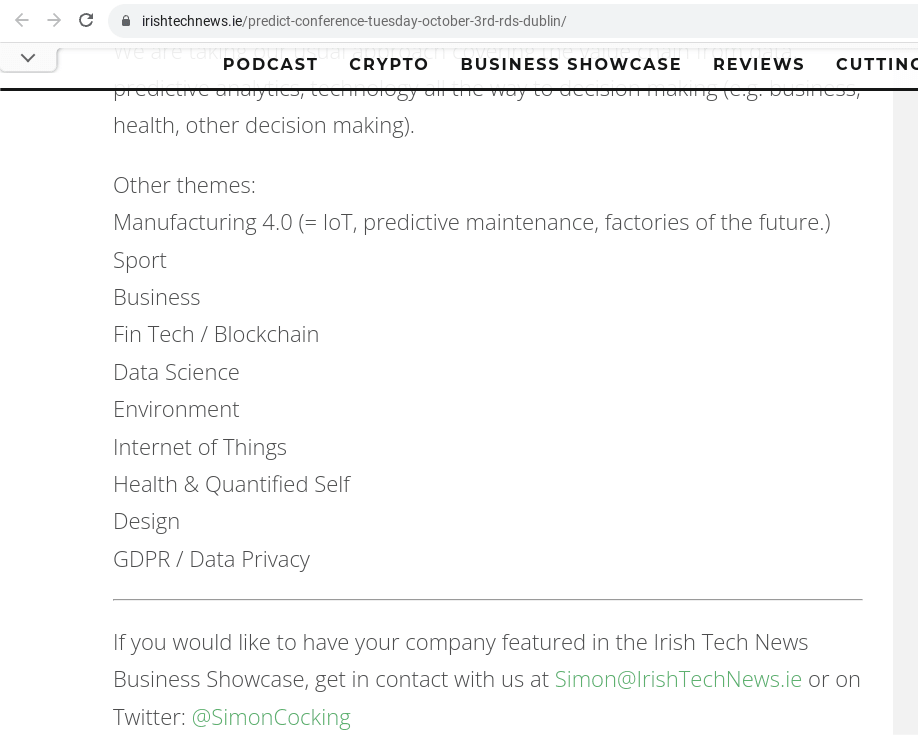
This was how it presented itself to the media that year:

Now. Before I continue, much more than the detail I am posting here today I already communicated to a country’s security agencies back at the beginning of this year, as well as, separately, directly to a major global investigative newspaper.
Three people representing private-sector interests in Ireland, one grouping in particular being those behind the Predict conference of that year, remain front-of-mind. These actually talk in the preamble to the 2017 conference about having built their own platform which can “develop models for any sector”:

Alongside at least one British security agency, I firmly suspect them now of having worked together over the years in bad faith re my person. But in the case of British security, whilst earlier this year I had come to the conclusion that these were choosing quite deliberately to cause me real grief, specifically whilst I was in Sweden on and off over the past eight or nine months, I now believe the British had become the unwitting dupes of the real actors in this story.
Because at the conference in question there was, I remember, much talk around how AI could predict the future. I don’t believe now that those deeply driving this association of interests had any intention of predicting the future at all: mainly because it’s too costly a task. What would be much easier is what I believe they were testing on me: a series of systems they designed then, and continue to operate now, which has demonstrated it can shape the future — and therefore is able to give the impression of predicting what people do when in reality it is nudging them into doing what benefits these actors aforementioned. Not governments either, primarily, but private-sector interests of potentially the murkiest kind. Just keep in mind how the Russians embedded themselves over the years in the British establishment and financial systems, as they set up their revenue streams to fund Ukraine and a couple of other wars in the past fifteen years.
Because there’s a lot of organised Eastern European criminality in Ireland: it connects well with the criminality of certain big tech business models which headquarter there too; criminality that has also helped Trump and others massage their messaging into privileged places from which to springboard long-term political aspirations..
So not a prediction machine, nor ever intended to be, but a self-fulfilling prophecy machine: just that.
Let’s call the three of them Michael, David and Sean …
I met a close friend of Michael’s in 2016. It wasn’t, however, until early January 2019 in Dublin itself, just after a quiet Christmas I had spent there, that I got to meet Michael. The encounter was disagreeable for me, but I can’t say how he saw it. The meeting lasted for a brief 45 minutes or even less; and I didn’t then return to Ireland for more than a year as a consequence of how unpleasant he had managed to be.
Over the years since I started going to Dublin, I have met David often, and without exception the relationship at the time seemed genial enough. He’s a genial man too, with an easy smile, and well-manicured and dapper appearance. He seemed, however, in hindsight, often to play to some degree the environmental and touchy-feely fool. This is why on one occasion early on in our relationship, two things he said remained incomprehensibly out of place to me:
- “We’re clear you are of value; but we’re just not sure about you yet.”
- “I have a good friend at the heart of British intelligence and government.”
And it wasn’t even what he said that stuck out as unusual to me later on: it was the fact that its thrust was totally unlike most of what we ever discussed. These topics being my then love of all things Irish, the Irish character and cultural achievements, drinking Guinness, the good food you could find in his country, and stuff of a fairly general nature like that.
Finally to Sean. As with David, I had met him first in the breakout sessions of Predict 2017. Sean has an astonishing capacity for recalling the history of all kinds of tech: most usefully, its failures and dead-ends when promise seemed all that it might deliver.
I met him quite regularly after that: we discussed the Rail Tap app’s toolbox gamification in Terminal 2 of Dublin Airport once; a summer in between we had a good and lively discussion at a Liverpool macro-business conference; and most recently, in Limerick during late autumn 2022, he helped me discover the very real promise and joys of asynchronous metaverse implementations, after inviting me to a handover meetup, again in Dublin, sponsored by Facebook, and which their public policy representative attended as one of the main speakers.
I hasten to add that the handover wasn’t to me! But I don’t think you needed me to say this.
🙂
After attending the conference Predict in 2017, where David approached me in a breakout session in his always amiable way, I struck up what I considered for a long time was a relationship of equals with little to suspect.
Sean, meanwhile, seemed sharp but not wrong-headed nor deceitful in any way. As I say, he had — still does, as far as I know — a fabulous capacity to rewind recent and current tech praxis into the corners of its history: a matter and ability most tech people who prefer to hype the new which actually isn’t prefer to avoid, ignore, or positively eschew in themselves and, indeed, any others who “try it on”.
Now you may wonder why I consider them necessary to this story. I was uncertain myself, and didn’t continue to write this post first started whilst in the Moderna Museet in Stockholm itself, until returning recently to the UK. But I don’t think in the event I was uncertain about whether to include them. More, it was that I wasn’t sure about the UK side of things: MI5 and related, I mean. Sufficient unpleasantness of a street psychology sort had happened on quite a few occasions whilst in Sweden: one specifically involved well-dressed London voices on the Stockholm commuter train as they attempted to surround and hijack me. I only escaped because of local support. As on quite a few other occasions.
But in truth, I don’t think it was London. I think it was Michael, David and Sean paying someone to press my buttons. The usual ones follow the KGB strategy of getting people to sit down near you and speak loudly, but only just a little loudly, in a clearly foreign language that upsets you for historical reasons. It happens once, and you say random. It happens twice, and you say coincidence. It happens every day … that’s a different matter.
Above all, therefore, if we accept this version of events, I was to be made to consider that those to blame were anyone but Michael, David and Sean, and their crowd.
So what’s the tool? What’s the platform exactly? How can you make out you’re predicting a person’s future when you’re not? And why would you want to? I mean frankly, where’s the business model?
Because these people only ever do think of business … why we never really were ever going to get along.
Let’s take each question one by one:
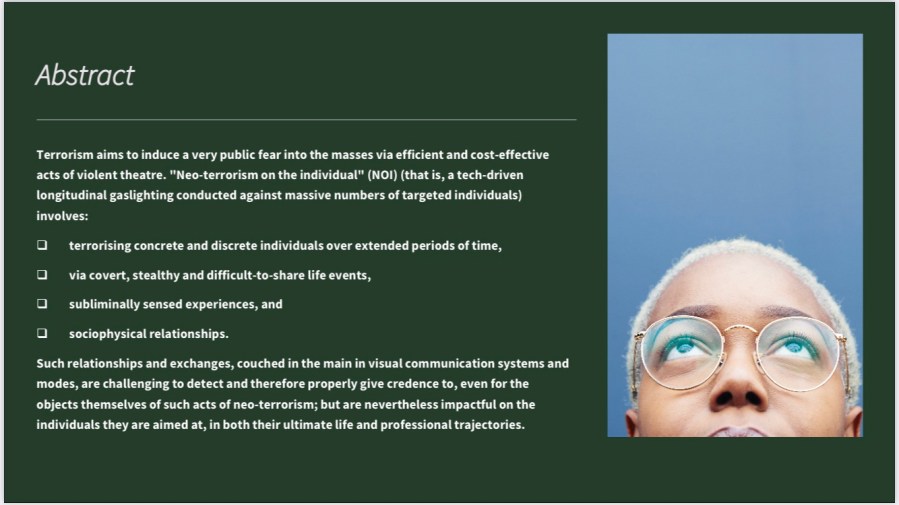
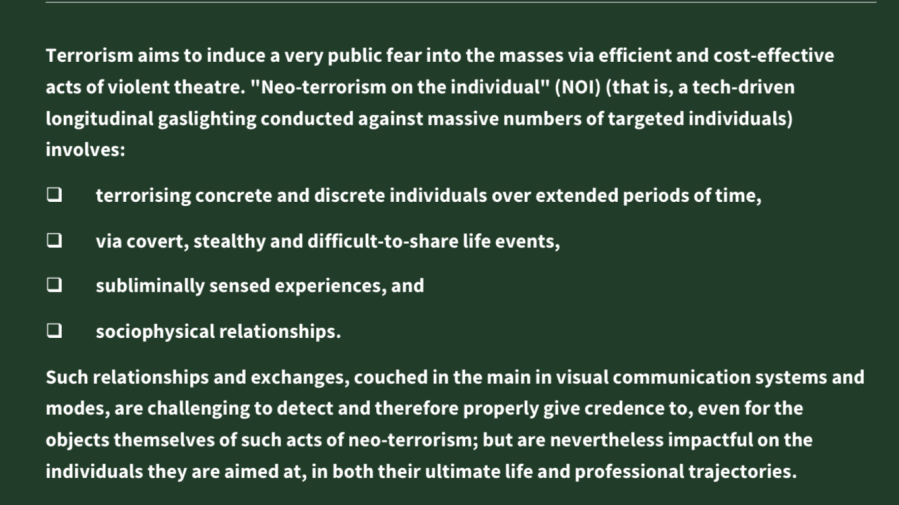
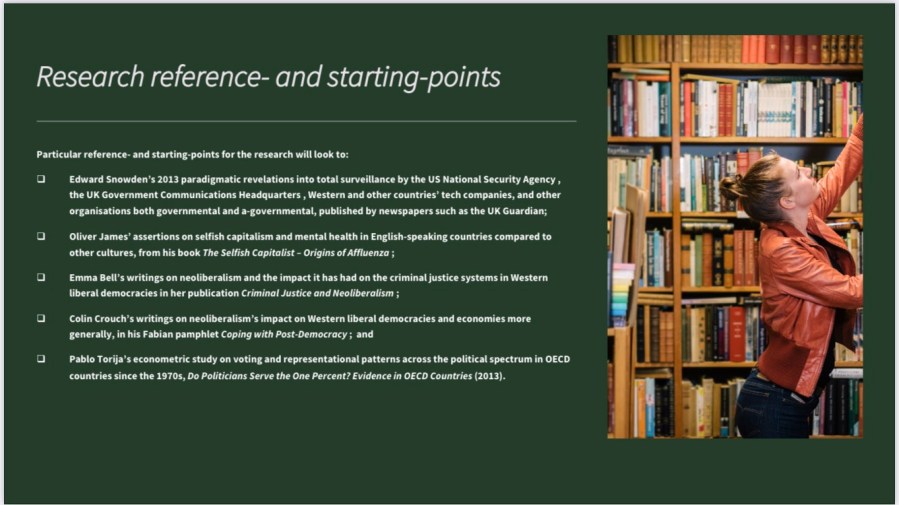
1. What’s the platform exactly? The tool and/or platform is what I later realised was happening to me. As a result, I constructed these observations — from lived experience and auto-ethnography — into a PhD proposal that described a tech-driven long-term form of gaslighting, conducted simultaneously, but discretely even so, on thousands and maybe hundreds of thousands of people, simply because certain organisations might consider them to be threats to their ongoing business models. Useful possibly to sell onto governments at some point as well, but surely best to keep the latest versions within a secretive private-sector space of common political and socioeconomic interests. Just like the space and network described previously, in fact.
my first #phd proposal: #neoterrorismontheindividual: my first delivery of a #phd proposal (document); #neoterrorismontheindividual: my first delivery of a #phd proposal (slide-deck)
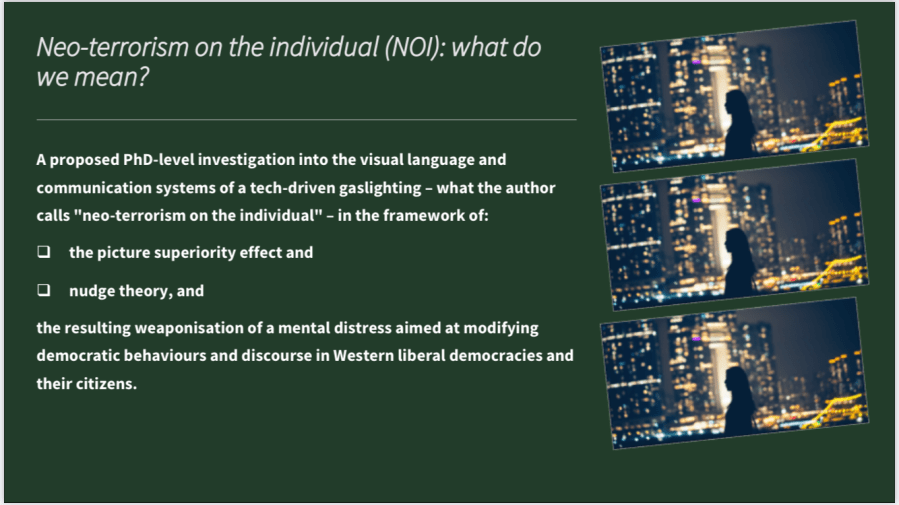

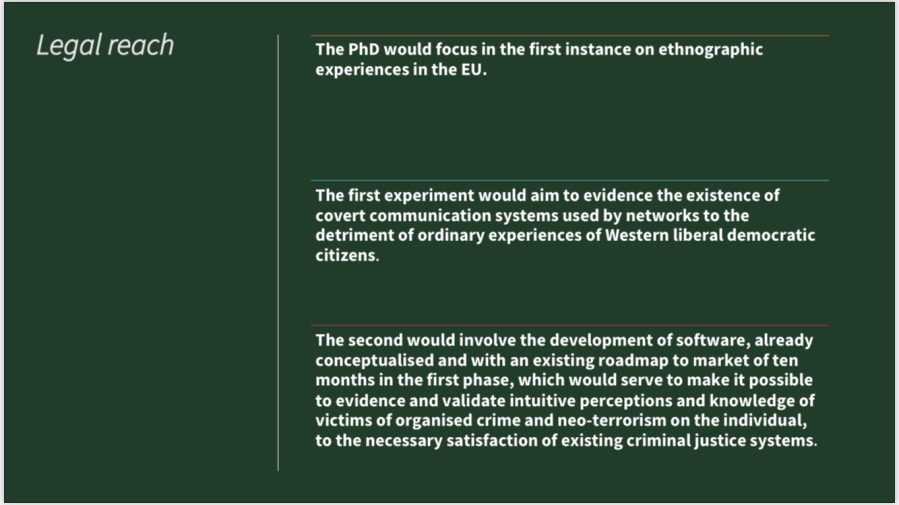
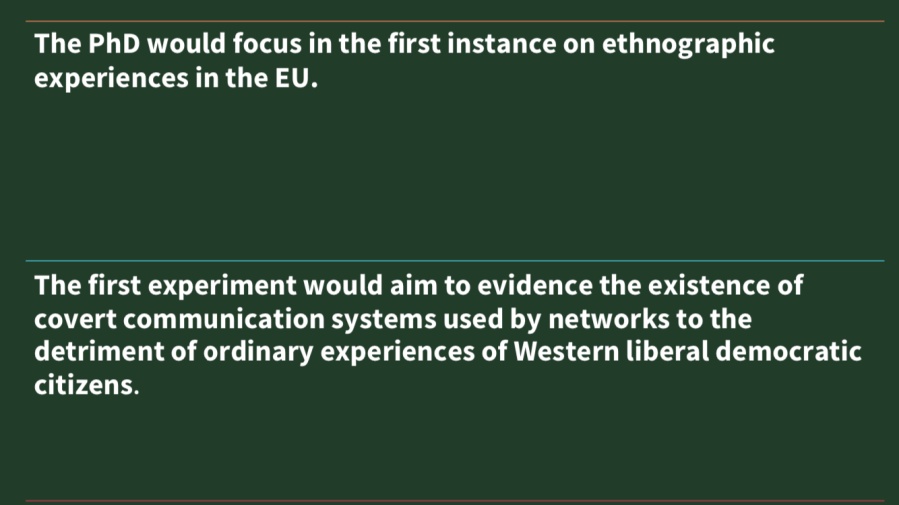

2. How can you make out you’re predicting a person’s future when you’re not? By dismantling their agency: that is, their ability to exercise free will. If we agree with my hypothesis around nudge theory and the picture superiority effect … that is, by using tools and strategies borrowed from traditional espionage and spycraft, and then technifying them with a data network of private development, we can make it possible to know what someone is going to do in almost every key decision of their professional and personal life both … but NOT by foreseeing their actions at all … simply by persuading, shaping, nudging and if necessary provoking the target into actions they always consider will be their own choices.
When in fact, if truth be told, they are self-fulfilling prophecies gaslit into being by the blurring of lines between digital and the real world.
3. Why would you want to do this? Frankly, what’s the business model? And so this is the easiest of the three questions I’ve posed for me to explain. Control. Authoritarianism. Disembowelling Western and related democracies from within. Setting up the conditions for a multitude of future Ukraines. Seeding distrust amongst those who’d otherwise be capable of coming together, and making of this broken world a much better place for everyone. Because when you can get a doctor to incarcerate a citizen who tells uncomfortable truths to power, and the doctor — a truly honest man or woman — sincerely believes no one has influenced the processes relating to that incarceration, then the crime committed is literally a perfect one which Hitchcock couldn’t have bettered if he’d tried to.
And done once it’s a horror film you’d eat popcorn to.
But done, as I suggest firmly now is the case, maybe thousands and then again maybe hundreds of thousands of times, throughout an ever more brittle and fracturing Western democracy, and with the support of a deepening private-sector tech developing its own hidden data models which make prediction completely unnecessary now whilst the proscription of inconvenient minds becomes much easier and cheaper to deliver on, then motivations are really not difficult to perceive.
Control. Authoritarianism. Organised crime. Criminal revenues. Ukraines galore. Dislocated Western economic and sociocultural activities. Permanent war. And unending profit. For those, I mean, who have learnt how to control both the public and the private.
Welcome to an AI which predicts nothing and shapes everything. Where human agency no longer effectively exists. And where data is what you literally become an extension of.
And in my case, it’s Michael, David and Sean’s business and sociopolitical interests which in my judgement have shaped my life and my reactions since at least 2016; and maybe, in collaboration with possibly unwitting others, for many years prior to that.
If true, it’s selfish, cruel, intolerable, and practically nothing more nor less than a psychopathy delivered with the highest levels of aggression from the most secretive of undemocratic spaces, in order to remove any remaining semblance of citizen intimacy and privacy for what I can only consider a financial gain of the most utterly unacceptable.
Anything to be done, then …?
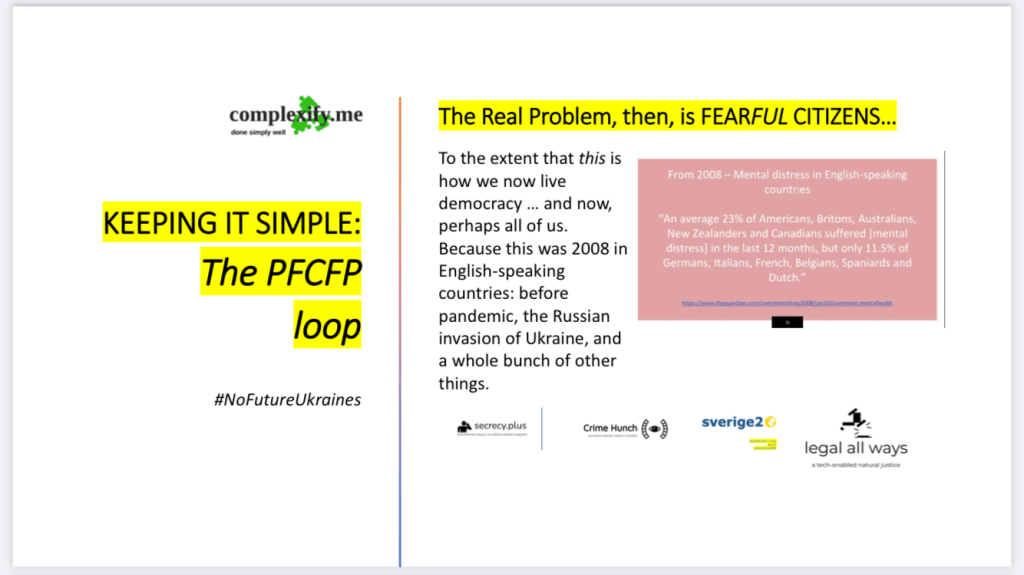
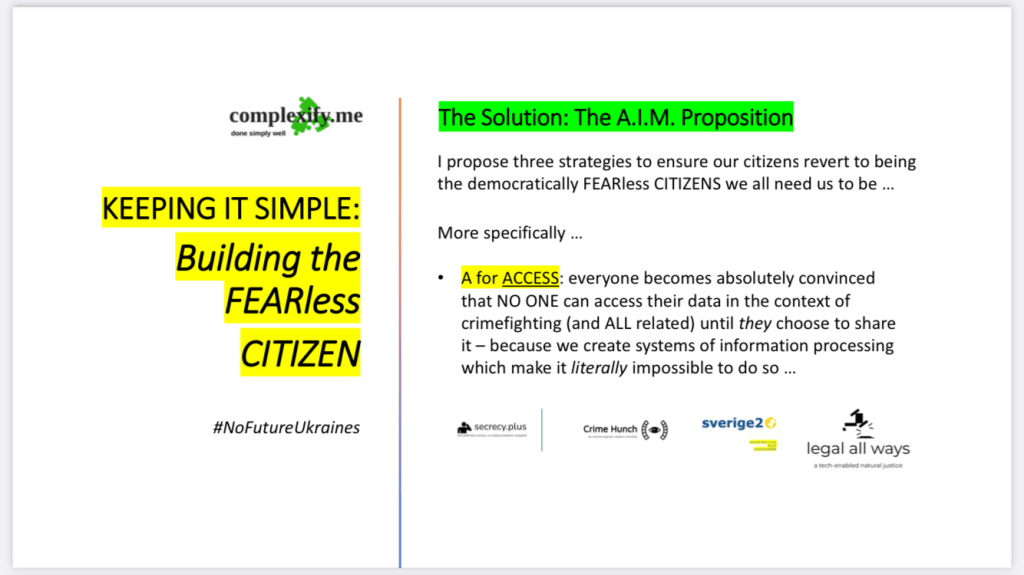
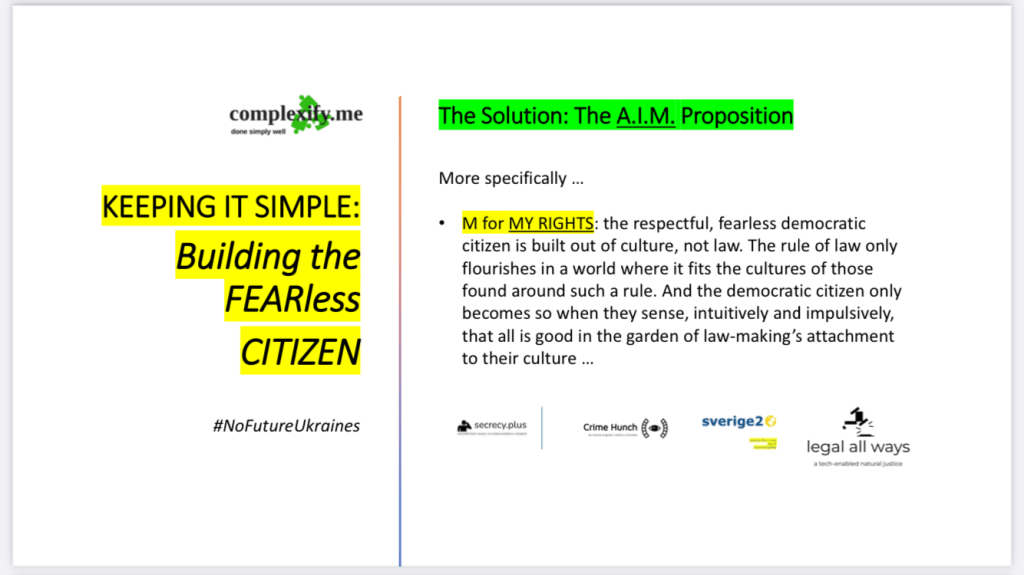
Surprisingly, I think there is. Below, a few slides from a slide-deck I created in July whilst in Stockholm, Sweden. The third of three intimately connected, it argues for a tech, legal and sociocultural response I have called “The A.I.M. Proposition”.
You can download the full slide-deck here. | You can find the online whitepaper here.
And so thinking back along the timeline of my own life in the past decade, and maybe since my undue incarceration in 2003, committed perhaps, yes and after all, by unwitting accomplices subjected even then to a primitive form of neo-terrorism on the individual, where as a professional in some transaction you consider every decision of weight you’ve been taking over the years has been yours, and where, in truth, absolutely none of them were … or worse than this perhaps, it’s impossible for you now to establish to what extent they weren’t then, nor will be in the future … well … that timeline of mine does make me think. And more than that, it makes me determined to act.
Doesn’t it you, too?
Doesn’t it?






 mil's page