how to combine three brains to fight the fire of creative criminality with the fire of a newly creative crimefighting

introduction:

this post contains thoughts from a fortnight’s thinking processes more or less; plus the content of a synthesising presentation which is the sum of years of thought-experimenting on my part. i’ll start with the presentation, which is now where i want us to go:

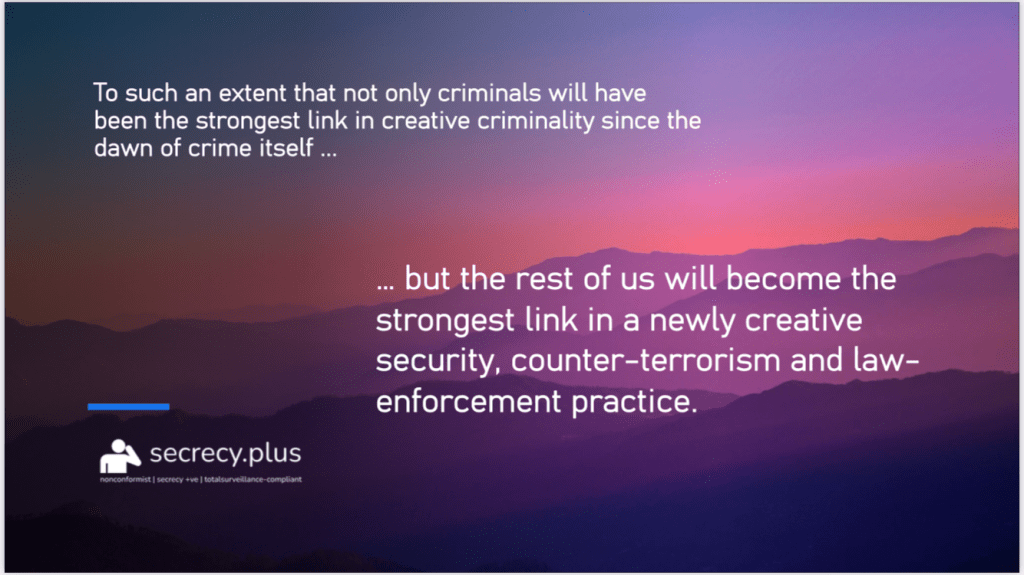
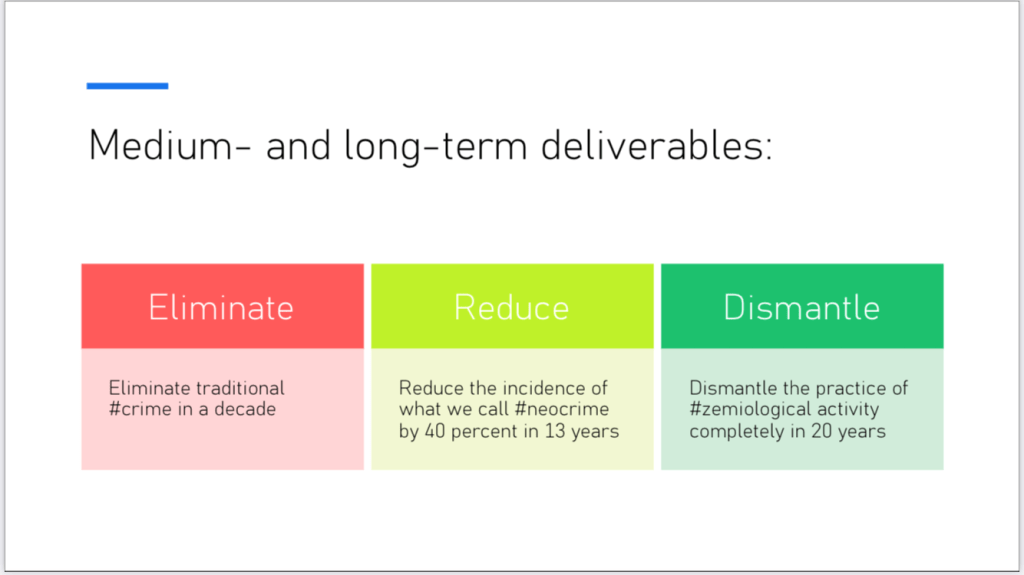
fighting creatively criminal fire with a newly creative crimefighting

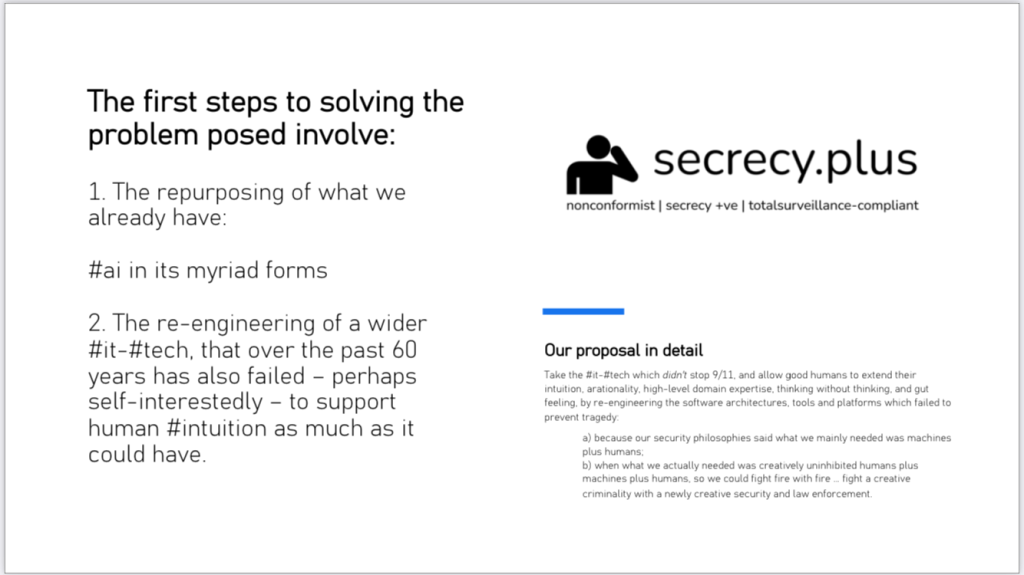
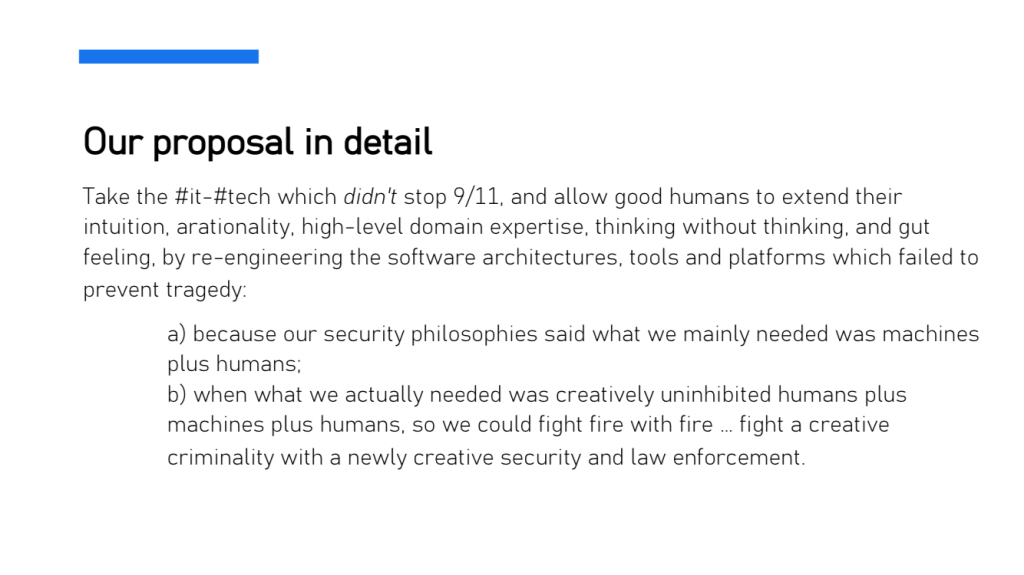
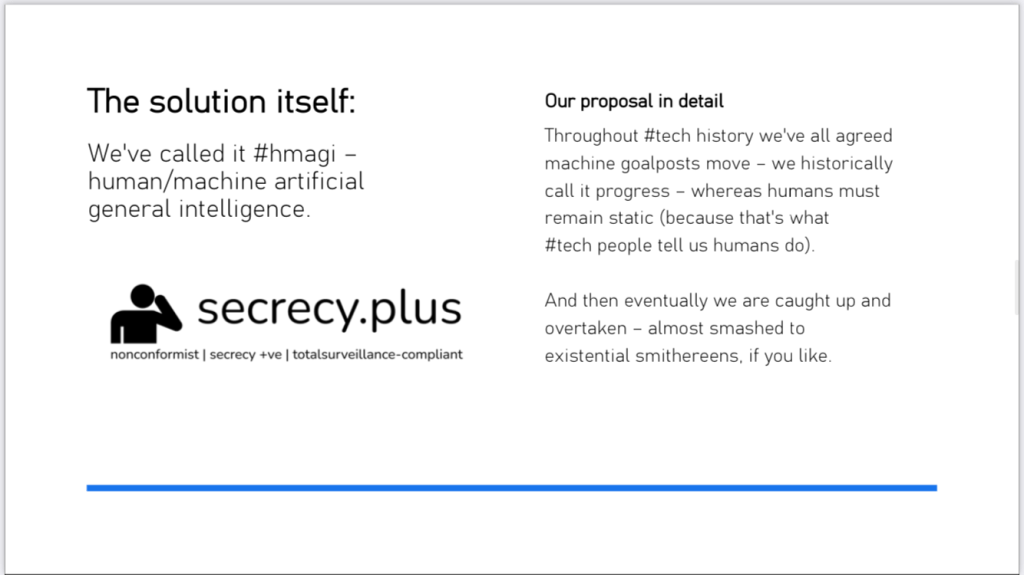
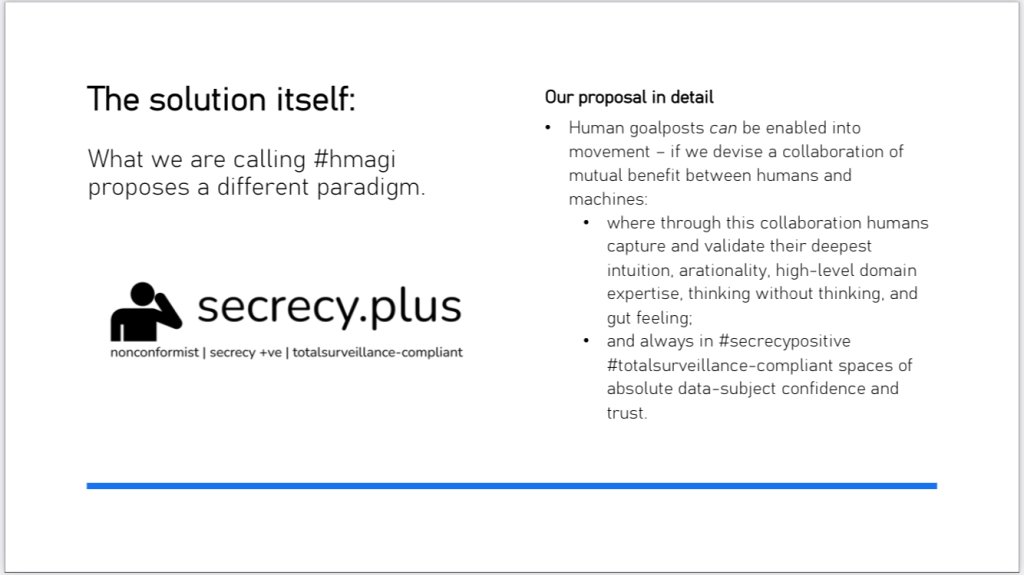
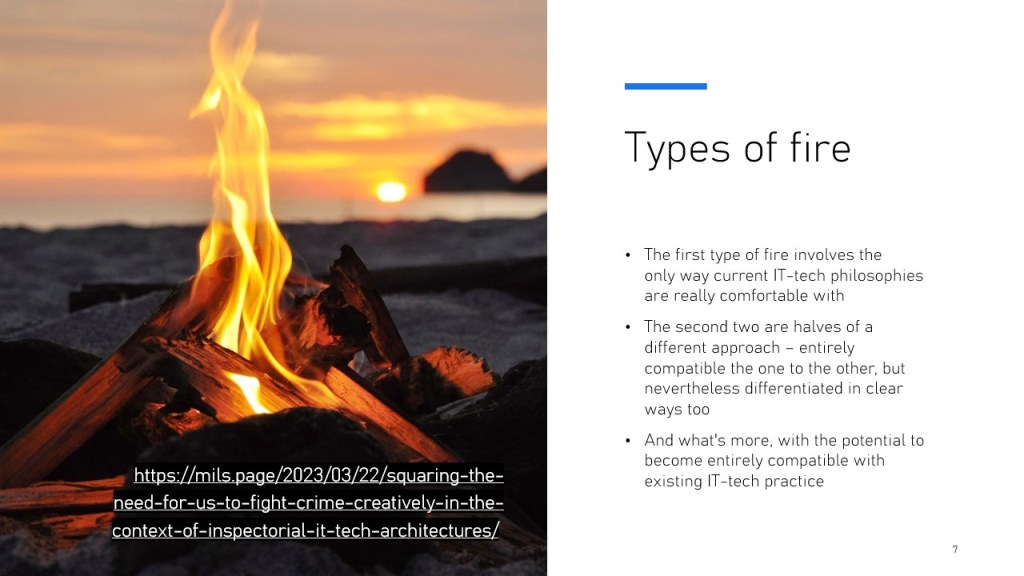
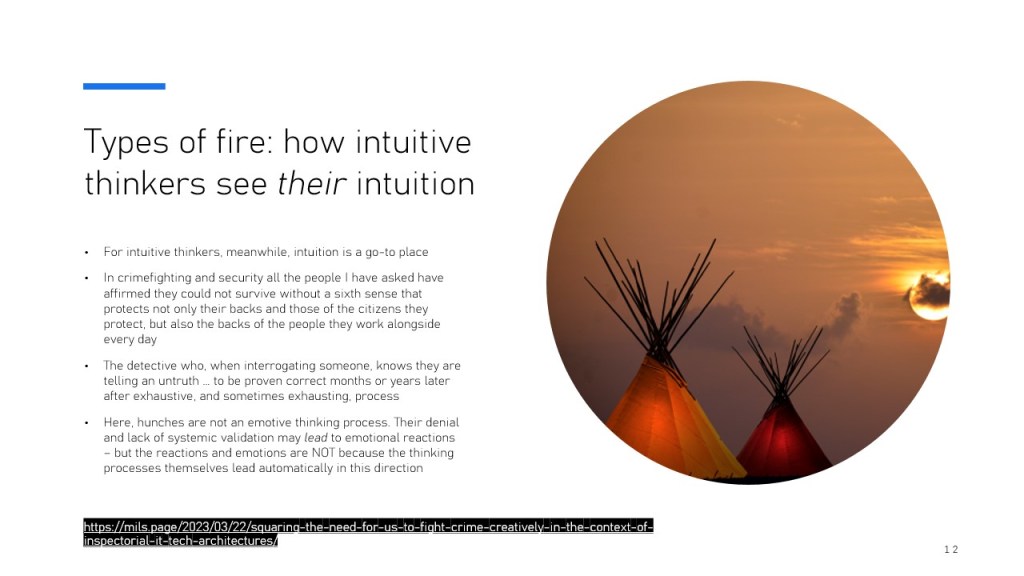
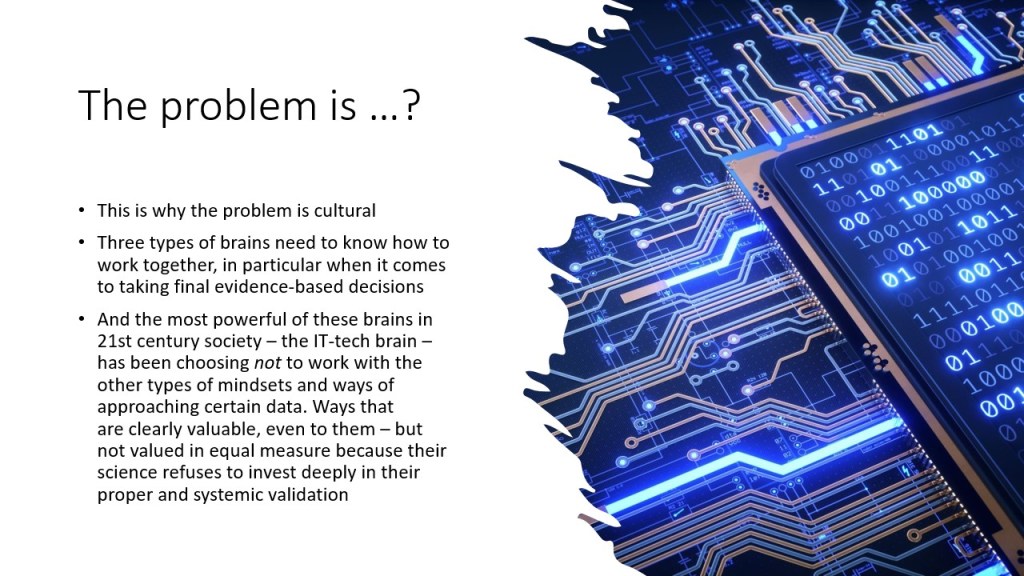
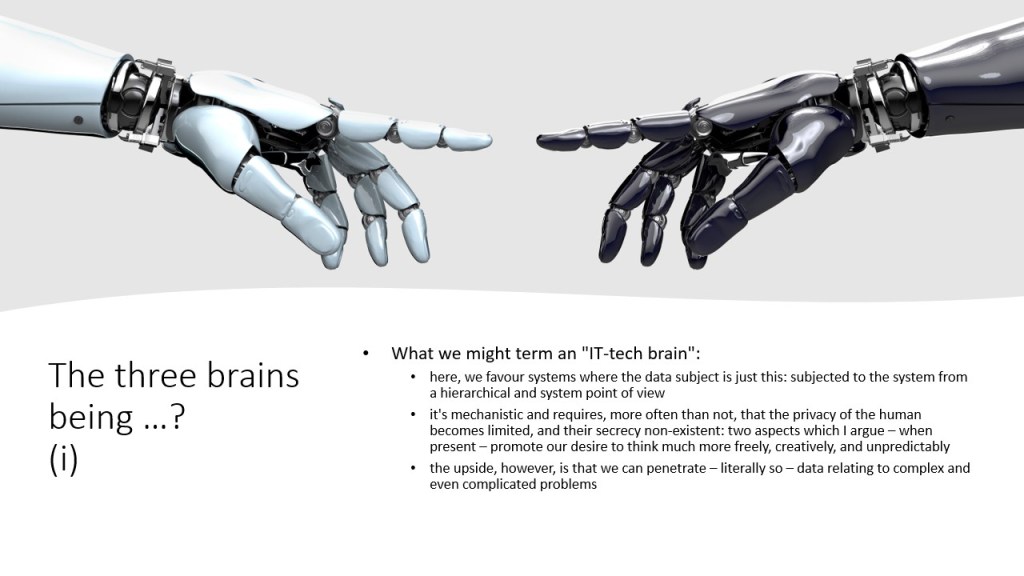
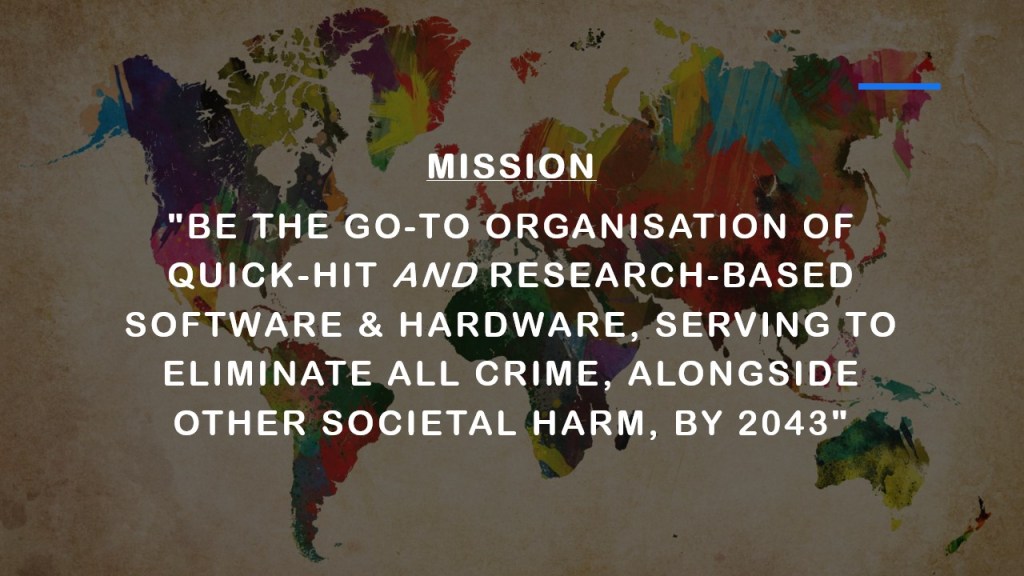
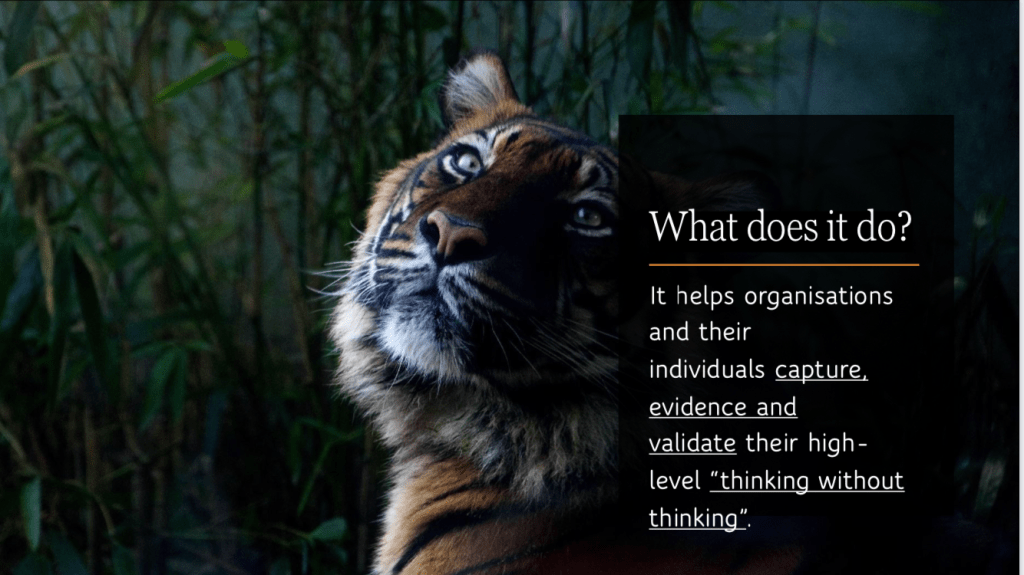
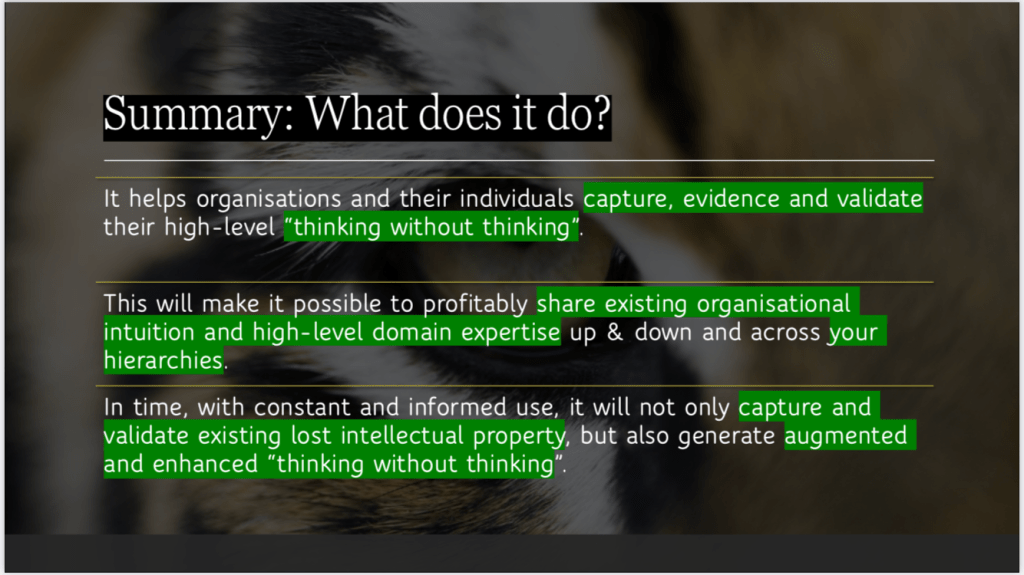
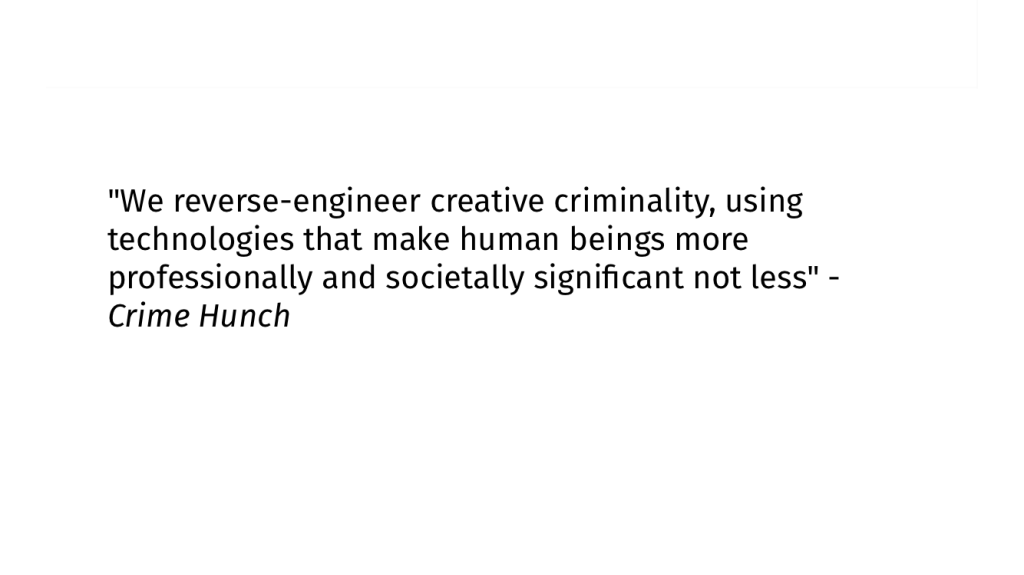
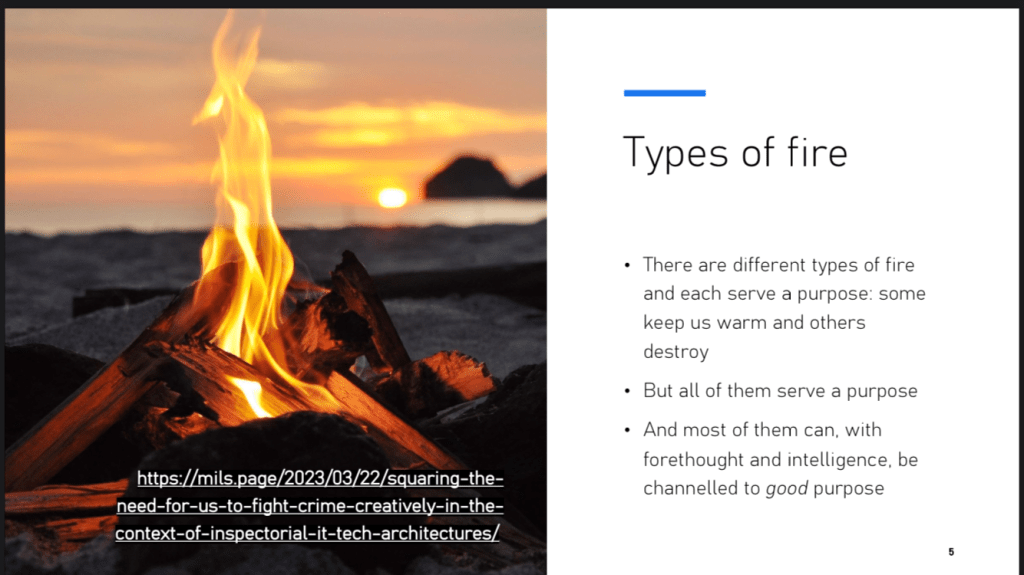
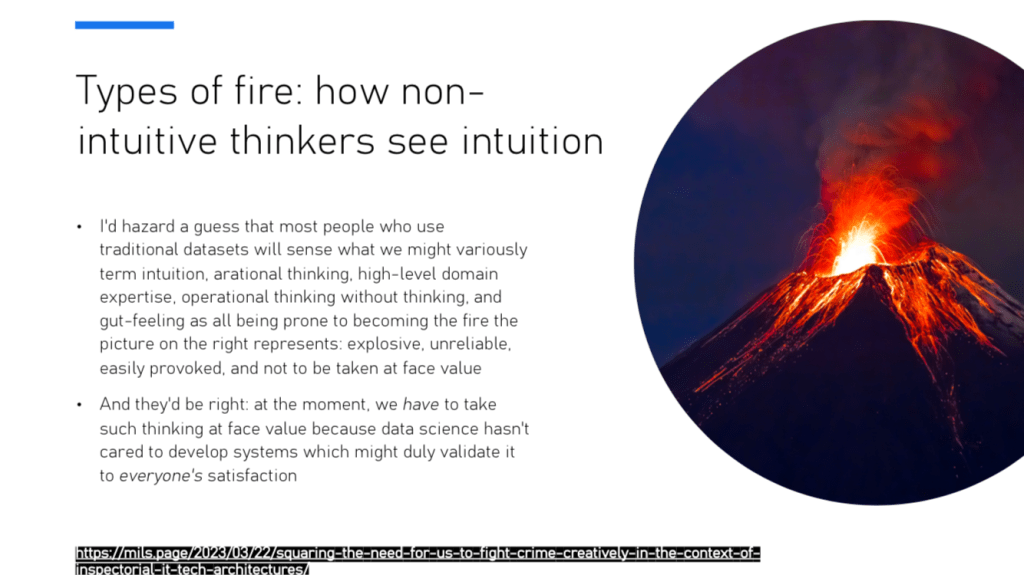
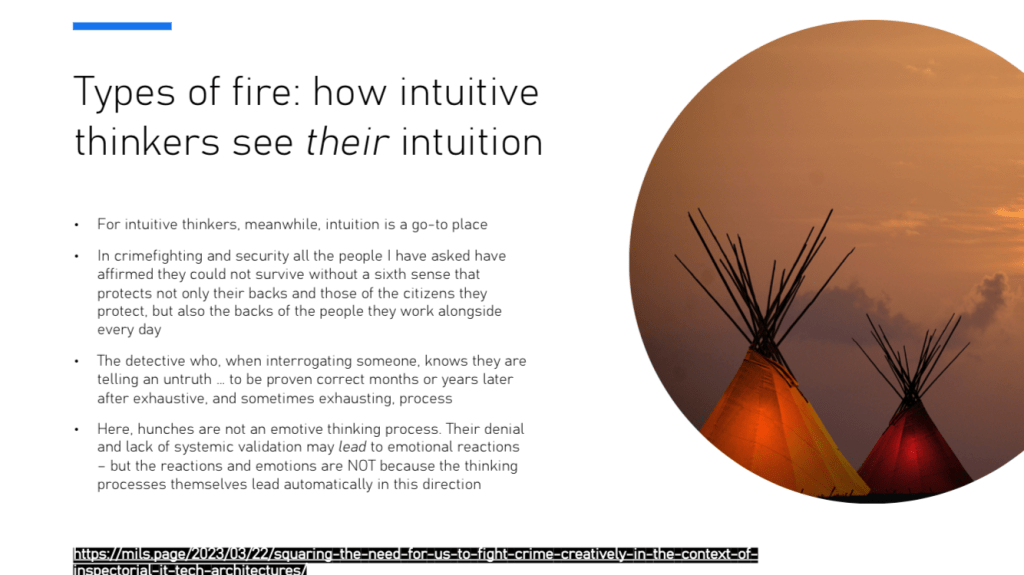
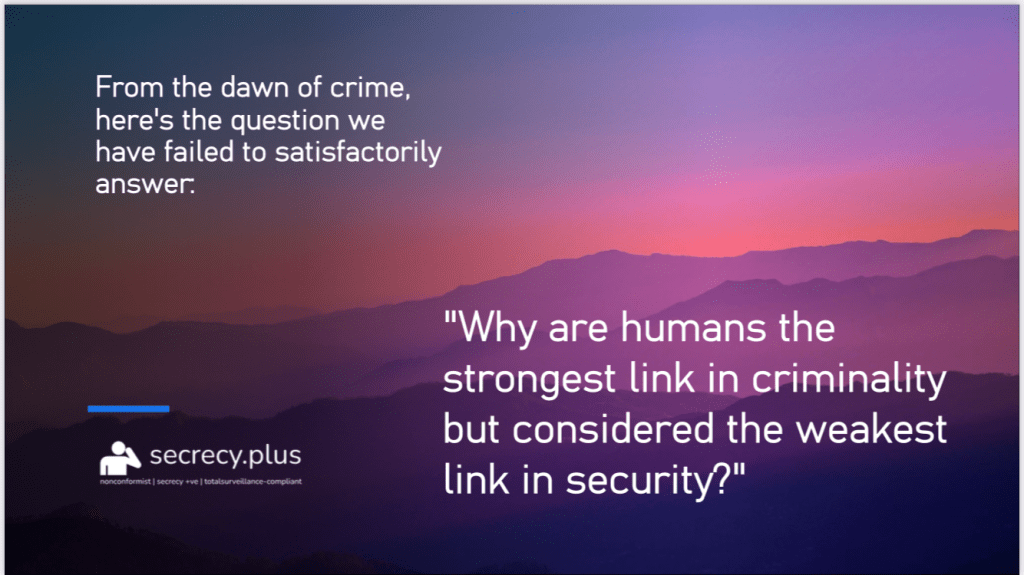
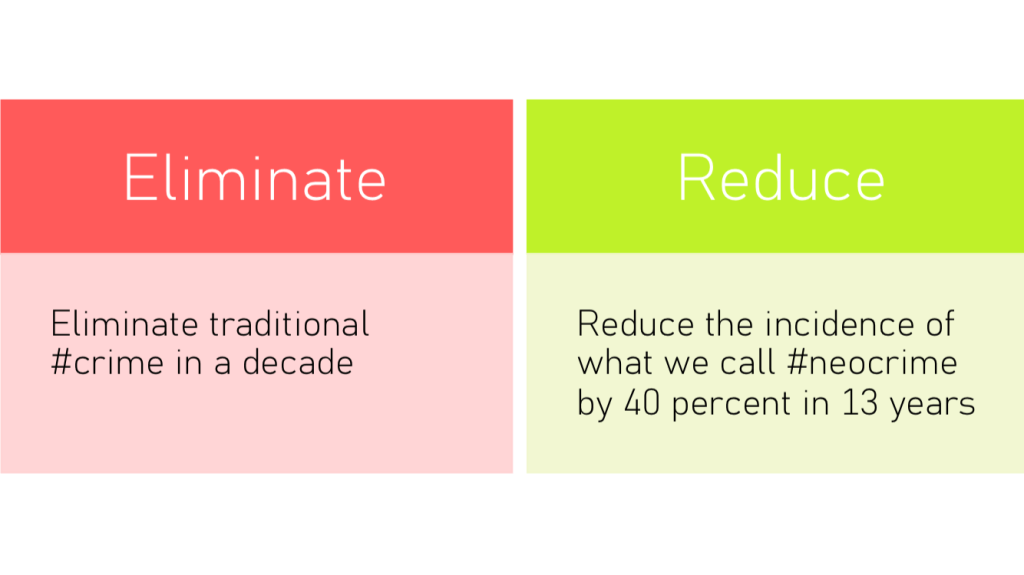
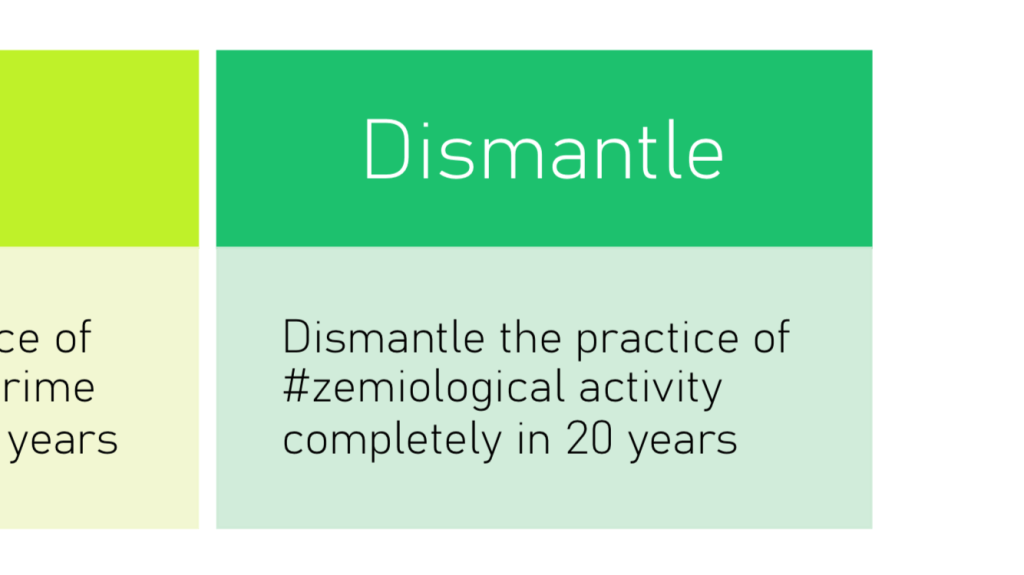
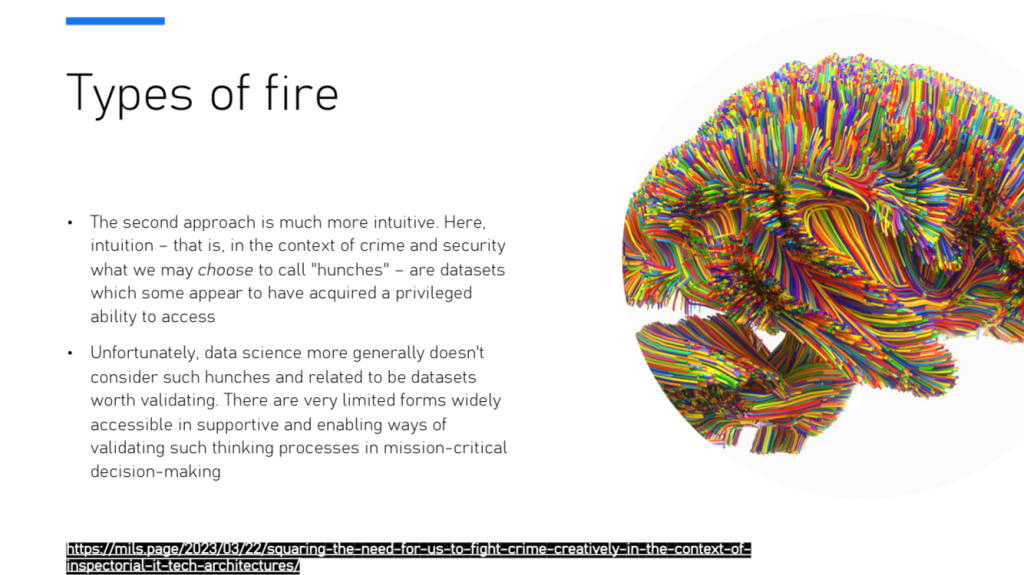
i created the slide below for a presentation i was asked to submit to a european digital agency pitching process, by the uk organisation public. the submission didn’t prosper. the slide, however, is very very good:
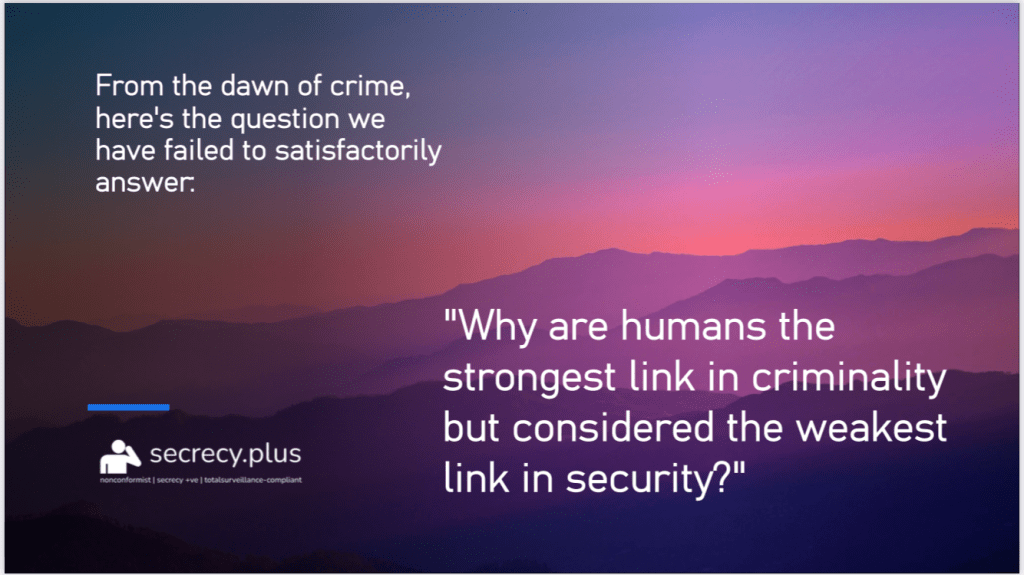

the easy answer is that obviously it benefits an industry. the challenging question is why this has been allowed to perpetuate itself as a reality. because real people and democratic citizens have surely perished as a result: maybe unnecessarily.

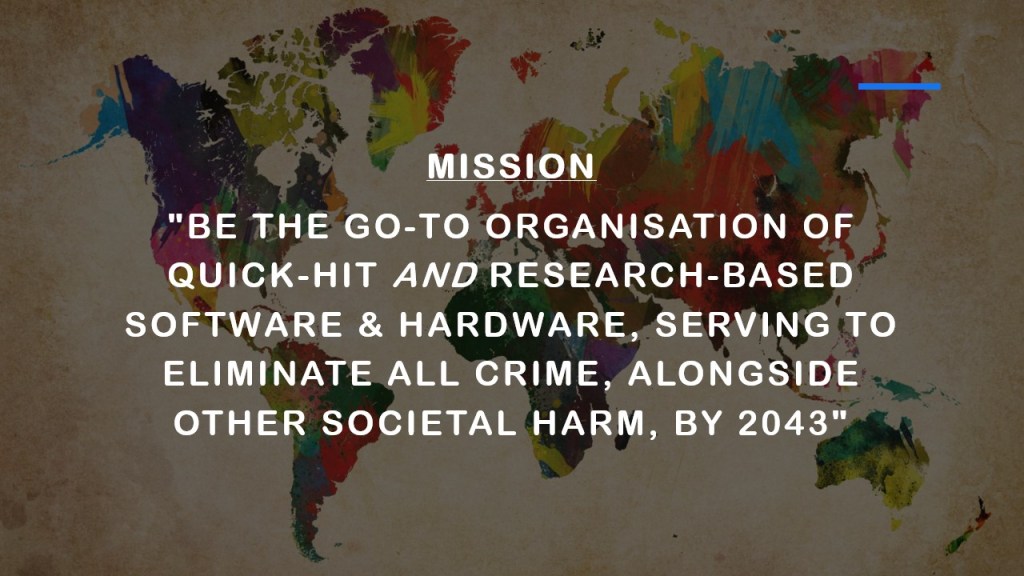
here is the presentation which public failed to accept for submission to the european digital process last october 2022, and from which the above slide is taken:

presentation submitted to public in october 2022 (pdf download)


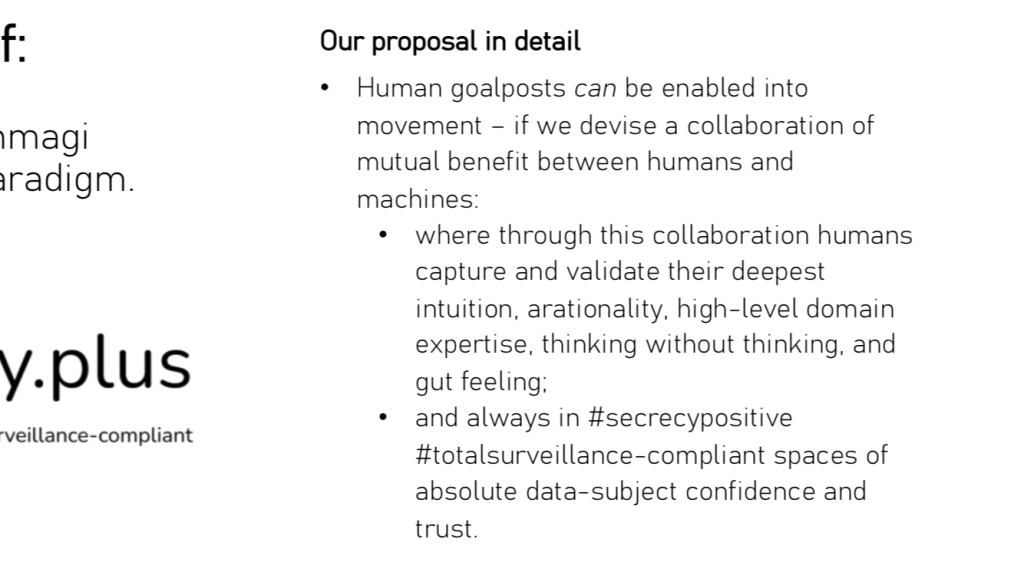
where and how i now want us to come together and proceed to deliver on creative crimefighting and global security

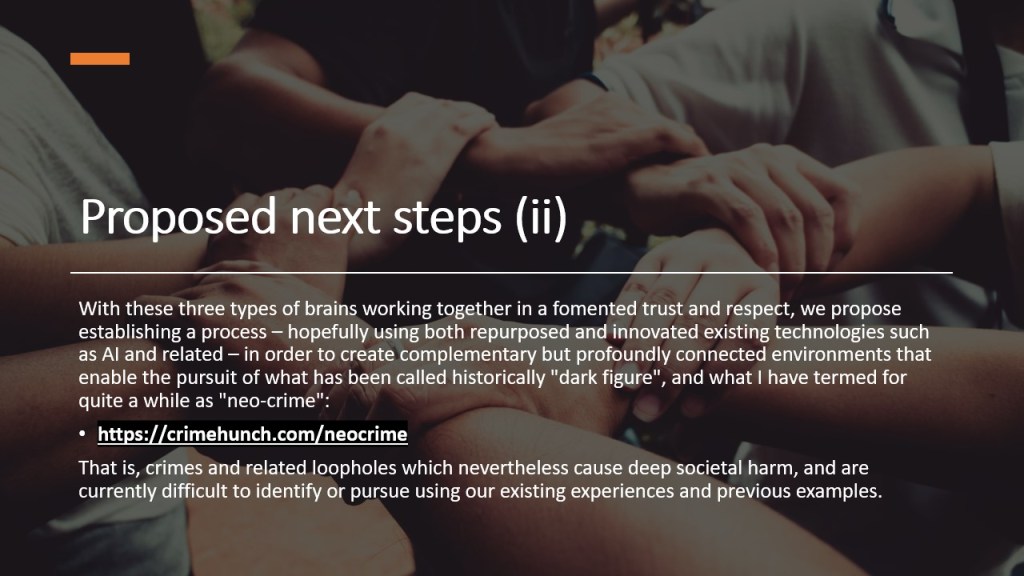
the second presentation which follows below indicates my thinking today: no caveats; no red lines; no markers in the sand any more. if you can agree to engage with the process indicated here, no conditions on my side any more.

well. maybe just one. only western allies interested in saving democracy will participate, and benefit both societally and financially from what i’m now proposing:

www.secrecy.plus/fire | full pdf download


following on from the above then, thoughts i wrote down today — in edited format to just be now relevant only to the above — on my iphone notes app. this constitutes a regular go-to tool for my thought-experimenting:

on creating a bespoke procurement process for healthy intuition-validation development

step 1

pilot a bespoke procurement process we use for the next year.

we keep in mind the recent phd i’ve had partial access to on the lessons of how such process is gamed everywhere.

we set up structures to get it right from the start.

no off-the-peg sold as bespoke and at a premium, even when still only repurposed tech for the moment.

step 2

we share this procurement process speedily with other members of the inner intuition-validation core.

they use it: no choice.

but no choice then gives a quid quo pro: this means total freedom to then develop and contribute freely to the inner core ip in ways that most fit others’ cultures.

and also, looking ahead, to onward commercialise in the future in their zones of influence where they know what’s what, and exactly what will work.

and so then, a clear common interest and target: one we all know and agree on.

mil williams, 8th april 2023

historical thought and positions from late march 2023

finally, an earlier brainstorming from the same process as described in part two above, conducted back in late march of this year. this is now a historical document and position, and is included to provide a rigorous audit trail of why free thinking is so important to foment, trust and believe in, and actively encourage.

we have to create an outcome which means we know we think unthinkable things far worse than any criminal ever will be able to, to prevent them. we need a clear set of ground rules, but these rules shouldn’t prevent the agents from thinking comfortably (as far as this is the right word) things they never dared to approach.

the problem isn’t putin or team jorge. it is, but not what we see. it’s what they and others do that we don’t even sense. it’s the people who do worse and events that hurt even more … these things which we have no idea about.

if you like, yes, the persian proverb: the unknown unknowns. i want to make them visible. all of them. the what and how. that’s my focus.

trad tech discovers the who and when. but my tech discovers the what and how before even a glint in criminals’ eyes.

so we combine both types of tech in one process that doesn’t require each culture to work with the other. side-by-side, yes. but in the same way, no. so we guarantee for each the purest state each needs of each.

my work and my life/love if you prefer will not only be located in sweden but driven from here too. that’s my commitment. and not reluctantly in any way whatsoever.

[…]

i have always needed to gather enough data. now i have, the decision surely is simple.

mil williams, 21st march 2023
on the kind of society i’d love to work towards

as a by the by, these days in tech they often talk of something called “zero trust”. they never even broach the concept of “total openness”.

why …?

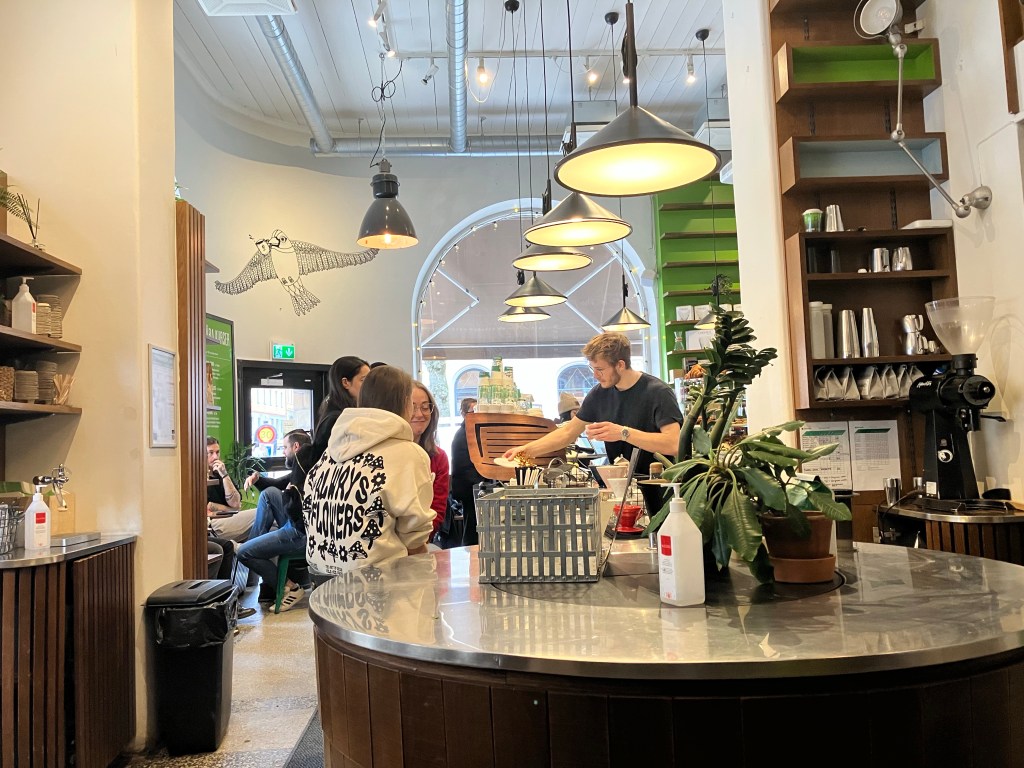
mil williams, johan & nyström coffee shop, stockholm sweden, 7th April 2023
a) i accept you are good

ok.

you’re right.

but you sometimes act using fascist tools, without really realising you are.

not taking ownership is a fascist tool.

pretending you’re something you’re not: this is fascist.

so fascists, then, can be right sometimes? is that what you prefer me to conclude? (btw, i don’t think you are fascists at all. but you’re so used to the right an admin has to admin a system that you can’t see why i should sincerely object.

why it could be in good faith, too.)

b) the nub of the issue

you feel i should trust you absolutely as if i were a catholic and you were the church. i don’t want that relationship with anyone. look what it brought us.

i want a trust built on a right to get it. and that means information-sharing.

look.

if you believe i am less able to comprehend what you already all comprehend, why work with me in the first place? why want to work with people less able than you?

one reason. just one.

but evidenced … not on trust.

c) what i mean by “not on trust”

i don’t want to take such important things on trust. i’ve done things on trust and they’ve just not worked out. i did when i got married. i did in 2002 in open source; and then in late 2002 in my mother’s homeland, and in the uk re my father’s wretched establishment’s prejudices from 2003 to the current day.
i also foolishly and stupidly used the tool of trusting in others in 2004 in both cases then given: i) media-related in respect of the new labour government at the time; and ii) a horribly personal example, as well.

d) what i mean by an “open society”

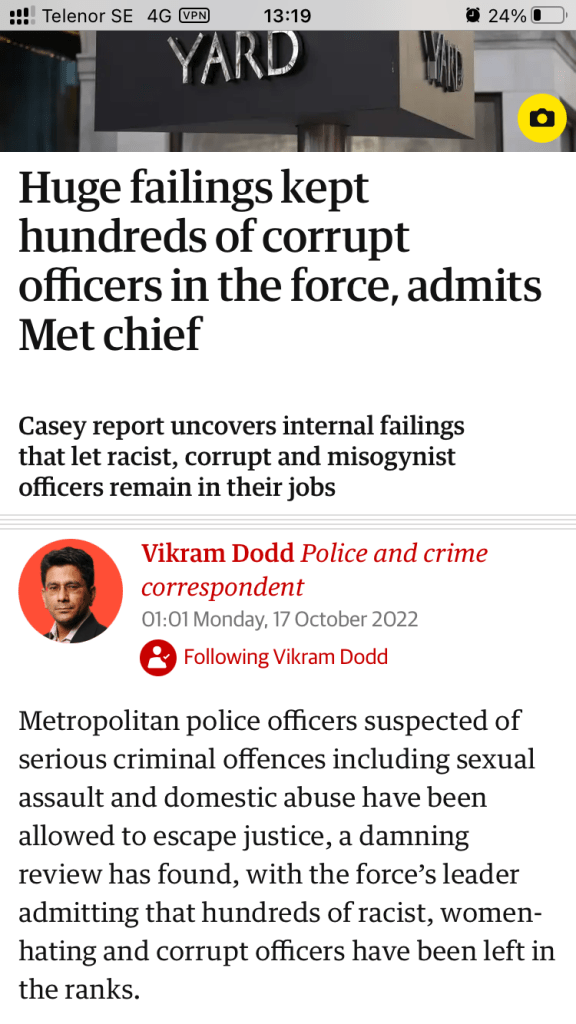
we shouldn’t have to build a democracy and society on trust. an open society, yes. of course. but a society where a person does what they do without evidencing to another it’s cool … no … not that. it inevitably leads to corruption. it inevitably leads to abuse of all kinds of powers. in all contexts, public and private. it enables rape. it enables the police force we now have in london.


we need openness precisely so we DON’T need trust. let’s get rid of trust and your demand for it. why? simple: it’s a lazy euphemism for faith. and faith comes from a time before gutenberg. and gutenberg brought science to us all. and now it’s time we gave arationality its place, and by so doing facilitated openness to the very maximum.

now it is. it really is.


e) my preferred timeline

first, do away with faith.

then, do away with trust.

and then make of our world a magnificent, peer-to-peer society of an EVERYTHING that it is to be UTTERLY egalitarian.

openness is beautiful. trust, meantime, is a tool to be turned against you by the powerful (at home and outwith, tbh). and faith is rarely more than what blinds you to what’s really out there. this being what faith always has been throughout human history: the bedrock of religions’ abuses. (not only that. good too, yes it’s true. but what i have seen in most of my life is that the good do good whenever they can, whilst the bad rise to the heights that serve almost inevitably TO CAN the striven good of the good. over and over.)

f) conclusion

anyways.

just that.

just this.

not much more to say today.

just as a by the by, though: these days in tech they often talk of something called “zero trust”. they never even broach the concept of “total openness”. why …?


and so to one final final thought, as i walk the streets of stockholm after posting: if i’m right in what i write here today, trust is a component of faith but not of openness. those of us who want open societies should, therefore, ensure we take note.


if you’d like to contact me, try email: we can start there … yeah?

milwilliams.sweden@outlook.com | positive@secrecy.plus

looking forward to chatting — and hopefully disagreeing!

“upskilling” human beings in the ways of the machine … again? i don’t THINK so

introduction

i just got a message from microsoft (linkedin) which asked me to consider and/or explain how what i was about to post (what you see below in the screenshots) related to my work or professional role.

why nudge in this way

is this a stealthy attempt to remove the ambiguities of #arts-based thinking patterns from contaminating the baser #chatgpt-x instincts and what they scrape?

more than personally, quite intellectually i think it’s wrong — in a world which needs lateral and nonconformist thinking — to define, a priori, what a thinker who wishes to shape a better business should use as a primary discourse.

because this discourse may include how much we follow or no the traditional way of framing information: where we state what we will say, say it, and then summarise it, we fit the needs of machines and people trained to think like them.

art should be used to communicate in any forum

‘truth is, when we choose a precise ambiguity (one forged out of the arts — not the confusions — of deep communication), where such ambiguity and the uncertainty it generates may in itself be a necessary part of the communication process’s context — and even content — what value ever is added by telling the speaker and/or writer they are ineffective?

in any case, the public will always have the final vote on this: and if you prefer to communicate in such ways and be not read, why not let it happen?

why choose this kind of nudge to upskill writers in the ways of the machine?

using automated machines to do so, too …!

so what do YOU think? what DO you?

me, what follows is what i want. what no one in tech wants to allow. because i’m not first to the starting-line: i’m last. they decided it didn’t suit their business models decades ago. i decided i didn’t agree. and i still don’t. and neither should you.

on making a systemically distributed intelligence and genius of all human beings … not just an elite

on not wanting to be a genius

i think we sometimes use terms to ensure they can be boxed away safely.

criminal means him (mainly), not me.

axe murderer … whoa!

serial womaniser — never even occurred to me.

mentally ill. well. just crazed.

like a paving we never will tread; never will see ourselves treading … not being, you see, of that cloth.

“… and then we have a problem”

i have a beef (you may have noticed) with western democratic and corporate notions of #teamwork.

i have a similar distaste of command and control economies. and, equally, i dislike exhortations to five-year plans and one-best-way only.

all these things were what we fought the #sovietunion during the #coldwar to resist.

and then, after we considered we won that war, thirty or forty years on it turns out the #ussr had won all the basics. big corps deliver command and control like nobody’s business, ever. #teamwork which subsumes the capabilities of original, #nonconformism to the interests of the collective … well, wouldn’t you know? and five-year plans — how common aren’t these in modern ways of thinking and doing … whether corporate companies or corporate-style public sectors?

let’s face it: the individualism of the human species has been lost to the need to do something over and over again, exactly.

one thing i notice in #stockholm right now: so many houses are simply anything but uniform. and they keep all the big trees wherever they don’t have a house’s foundations. they actually build around trees instead of razing it all to the ground before starting. and then, only then, balefully planting little trees which take decades to grow.

i could give you a ton of analogous examples, too: examples of where the #swedish have forged their own thoughts and praxis on a collectivism based beautifully around the individual. the individual person and the flora …

it’s not perfect: but it strives to do better.

nowhere else have i seen this instinct manifested so clearly. nowhere. nowhere with such a gorgeous attention to details.

we have a problem in our western democratic corporately-organised institutions and groupings: we universally fear a standout talent. we box it up in a label which protects not the labelled but ourselves. in fact, we prefer to see it as standout rather than something we could all deliver on one day.

even the box we call #genius is there to defend us from what we fear: that we also might shine today as never before during too many years.

better not to hope ever, than to break the habits of a deadening lifetime.

no?

what happens when society is secular but redemption remains a desire and real human need?

introduction:

i’ve been thinking a lot about redemption, ever since a messenger and intermediary said to me in 2016 that my problem was guilt.

she was, on due reflection, wrong. guilt is good, if its reasons for provoking can be assuaged in competent and compassionate manner.

what i still suffer from is an absence of process, in the secular society i cherish, for redemption.

my supposition:

let’s presuppose the following: let’s say that religion served a real positive purpose which in its relative absence now in many of our societies has not been supplanted with other processes as compassionately. i say compassionately with circumspection, of course. religion itself has effected many horrible historical — and even current — events in humanity’s journey.

an example, then, of the redemption i mention?

well. here we are!

discretion is a very humane aspect of criminal justice systems, when used in the spirit of the law and its kindly interpretation.

i studied international criminal justice in 2017 at master’s level and on one occasion stumbled across the following anecdote in the academia i was reading: italy, well known for the misuse of family power and structure, may also invoke the good of family leading to a better criminal justice praxis there.

most crime in all criminal justice systems is committed by young men between the ages of 18 and 26. after that age, almost automagically, its incidence tails off. some suggest there may even exist physiological reasons for this: that young male brains get hard-wired to begin settling at around the upper age band quoted.

either way, we have a criminal justice reality: young men who commit crime are also victims of crime, in the sense that they are the most vulnerable group to enter criminality, and get very little proactive support to stay out of the criminal justice system. more often, in fact, they get targeted — maybe targeted into it — via prejudice and presumption of very many, damning and defining, societal forces.

in italy, then, this was the example: a law-enforcement officer heard of a young man around 17 who had just about committed his first crime; certainly infraction. the officer knew of the family, and instead of “inducting” the youth directly into a path which later would be heading irreversibly towards criminality, he went behind the back of the youngster and straight to his parents.

he explained the situation gently and non-threateningly, explaining that the family could help. here, we could argue, was good discretion operating to the max: even, that it shouldn’t have been necessary to use discretion to keep the young man out of being typed so young as criminality’s cannon fodder. maybe it could be conceivable that the officer’s own kpi-structure and law-enforcement praxis would consist primarily of keeping people out of the system — enabling and allowing them to redeem any initial acts so that criminality became something they themselves wanted to veer from — instead of counting up the number of criminals captured and banged away.

proposal:

on the of the above, and in relation to things i’ve already published on a new concept of criminal justice which i’ve termed natural justice, i’d like to propose that we take the renewed need for a societal infrastructure of redemption to be revisited.

in the absence of father confessors, that is in the absence of many people finding them unsatisfactory to their needs (where they work, no change needed of course!), we should create serious halfway houses between the criminality and zero good of #darkfigure and #neocrime as i understand them at one extreme (the 20 to 40 percent that is the crime and related loopholes invisible to criminal justice) and religiously delivered confession and relief at the other. which for secular societies no longer functions easily.

yes: a natural justice, after all.

final observations:

thinking more philosophically, it’s possible that the behaviours acted out as described in this post, which may then duly and rightfully lead to criminal prosecution, are encouraged because we need to be redeemed — to feel it, i mean. and unless in secular society you enter the criminal justice system, a societal-level redemption is not within reach. if we provided other ways which had nothing to do with criminal justice stigma, perhaps — too! — fewer would wish to be criminals.

i’ve often felt, as a by-the-by and in analogous way, that open-source and social-networked online communities have become so popular and active because in such spaces — the really competent and well-run ones i mean — we find the reality (or even just simulacrum, but at least this) of a democratic discourse that real democracy increasingly is lacking.

what’s clear is there are exist basic human instincts and impulses, and they must always act in pairs.

doing democracy is one; where nowadays the reward for its practice where this doesn’t invoke the relationship of abused partner?

and so doing ill is another; where nowadays the redemption which doesn’t involve punishment and disgrace?

choose people to work with, not their institutions

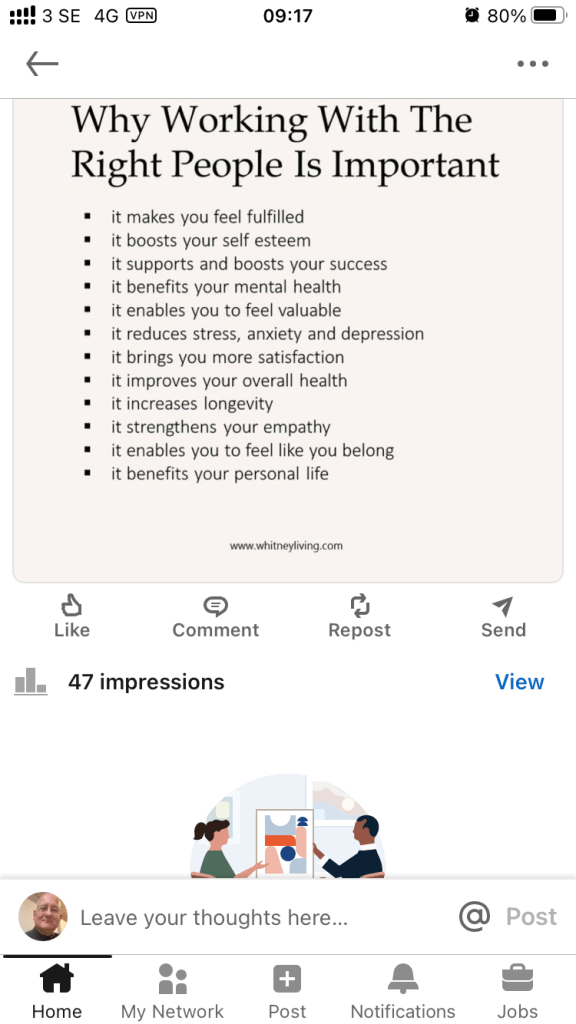
https://www.linkedin.com/posts/jewel-pena-53257213_activity-7041962988248952832-m7Pq

i realised this not long ago. i don’t want to work with this company or that. i want to work with people who also, simultaneously, may work for one company or organisation or another.

when the institution overrides the individual from the start is when, even if all the starting-signs are cool, the individuals will one day — especially when huge amounts of money all of a sudden become likely — be inevitably and overwhelmingly overridden by their instituitional framework.

i don’t intend for us to start as i don’t mean us to go on.

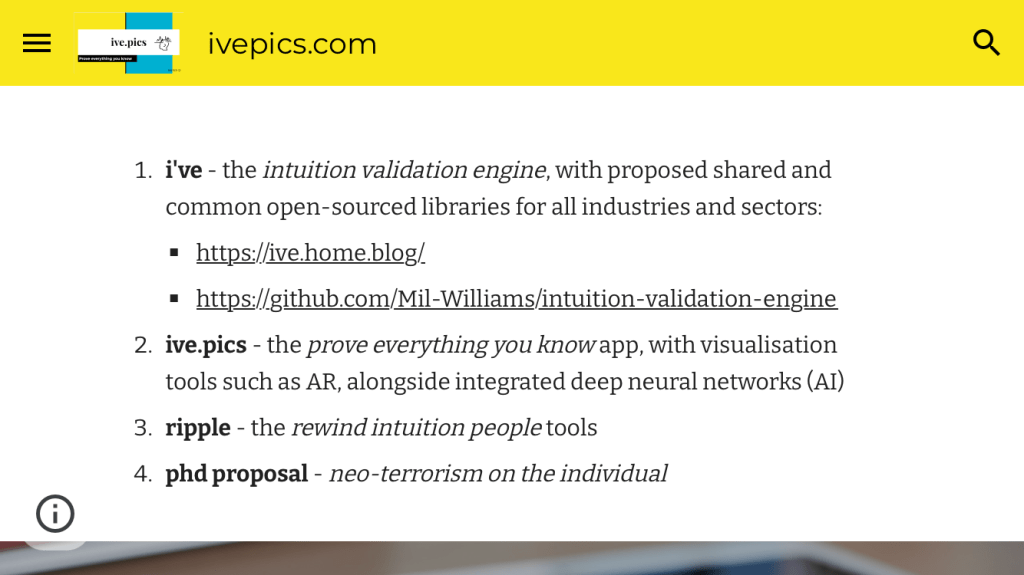
so first i want to meet people. i want an organisational structure which generates a hybrid of #holacracy. and i want brains to show themselves the most important factor and matter of all, where the overarching #gutenbergofintuitivethinking and #intuitionvalidationengine projects are concerned.

www.ivepics.com

because if you choose people first, and the people are right for you, then the institutions automagically will remain so too.

at least … whilst your people of choice remain at the institution in question. and they will do in general, for sure — if the institution remains worth then staying. for in the question of #intuitionvalidation there is no building-block which is more significant than the human as individual.

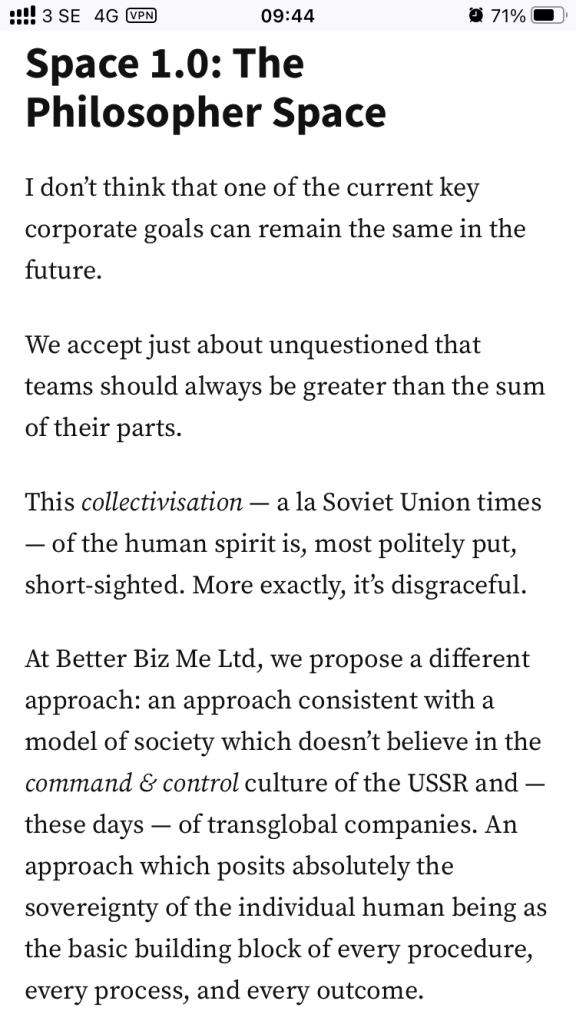
thephilosopher.space/space-1-0-the-philosopher-space

platformgenesis.com

www.secrecy.plus

omiwan.com

mils.page/presentations | #milspage #presentations

mils.page/intuition-day | #milspage #intuitionday

mils.page/distributed-privilege | #distributedprivilege

machines + humans or humans + machines … or …?

i once wrote the below:

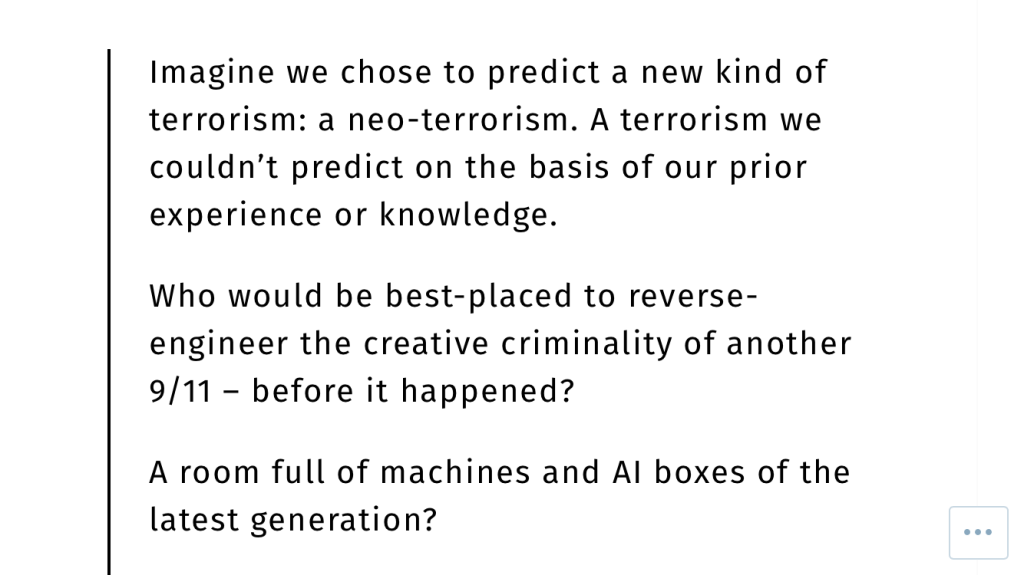
crimehunch.com/terror

i think i upset a lot of people. i remember a more than hour-long conversation with faceless executives from a big us tech corporation i really value and would love one day to work with.

i say “faceless” neutrally, mind: they had no faces, just circles with initials; and were never introduced to me. six or seven plus the person who organised the video-chat. during lockdown, it was.

i asked them the above question: there was silence for around ten seconds. in the event, no one replied at all. the fear was palpable. the fear that someone would say something which someone else would report back, and forever mark a person’s career, without recourse to explanation.

or so i thought. on reflection, maybe i had gone too far. maybe it was wrong for me to suggest their machines weren’t up to the job of beating creatively criminal terrorists. maybe it was wrong for me to suggest we could do more to creatively crimefight: to make human beings capable of being as nonconformist to the good as the putins et al of recent years have manifestly been longitudinally to the extreme ill.

here’s the thing: maybe i wasn’t wrong but maybe i wasn’t enough right.

obviously, if the exercise was delivered to its full extent, whatever your answer the assembled would inevitably agree that both machines and hollywood scriptwriters (or their analogous: the skillsets of, at least) would be the best solution. but even here problems would exist — and i would go so far as to suggest, actually, real roadblocks.

people who operate by rules and regulations — conformists we all need that make the world function with justice and fairness — don’t find it easy to value the contribution of nonconformists who, more often than not, make their own hugely competent rules. and, then again, of course, vice versa. conformists don’t always float the boats of nonconformists as much as they should.

so to allude to the fact that we need to be as good as the supremely creative criminality out there in our own forging of a singular combination of intuitive arationality with the best machines we can manufacture is NOT the solution.

no.

the solution lies in ensuring the cultures of nonconformism and conformism may come together to facilitate this outcome of creative crimefighting and national security … this … just this … has to be the solution.

if we minimally know our philosophy, a thesis — being that crimefighting and national security need ever more traditional ai to deliver a fearsome capacity to pattern-recognise nonconformist evil out of existence, alongside people who press the operational buttons on the back of such insights — will get, from me, its antithesis: that is … we need just as much, if not more, what we might term the “human good” to battle the “human bad”.

and maybe the machines, too. alongside and in fabulous cahoots.

yes. and maybe, of course, the machines.

but what if we change the process? what if a synthesis? as all good philosophy?

1. to find the nonconformist what and how — the next 9/11 before it arises — we use hollywood and analogous creativity to imagineer such events.

2. and to find the who and when of such newly uncovered neocrimes, we apply the obviously terrifyingly useful pattern-recognition capabilities of the ever more traditional ai. so that their adepts, their supporters, their proponents … and those conformists who more generally are comfortable with such approaches … well … simply be comfortable with this new paradigm i propose.

in this scenario, the suits and the flowery shirts work in consonance but never simultaneously. and so we square the circle of respect amongst the two parties, which long-term would always be difficult to sustainably engineer and forge permanently.

wdyt?

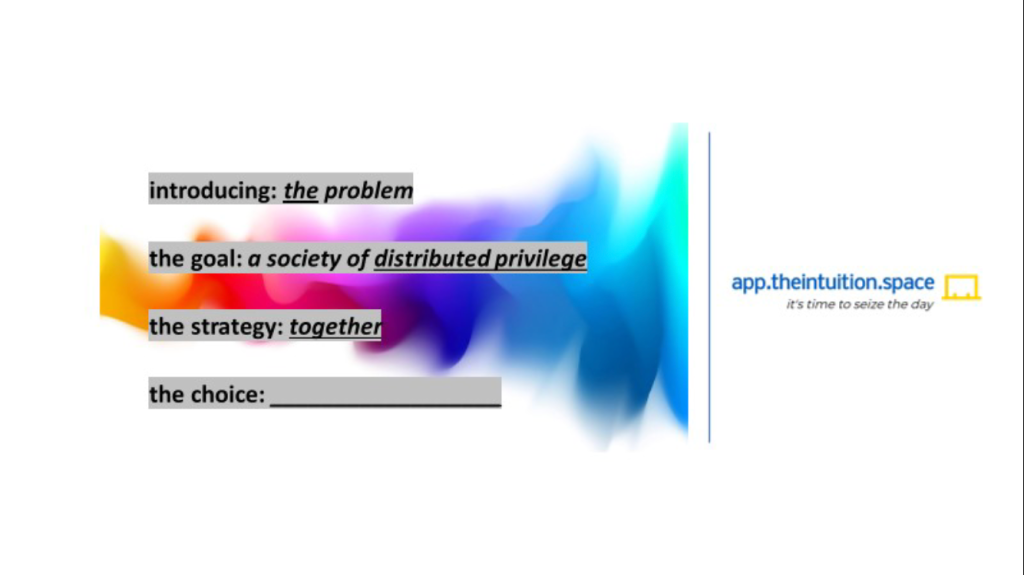
“a society of distributed privilege”

attached, a (big!) little something i’ve been working on yesterday afternoon.

a slide-deck of 33 slides down to about six.

content itself still to do, mind … but you can see where my #roadmap, already.

and i’ll be taking it with me to #sweden next week: a country which has striven so long to truly, actually, sincerely deliver a society of #distributedprivilege.

what i’ve been aiming at all this time i now realise, with ALL my projects around #intuitionvalidation.

and it makes me happy to begin slowly to know how to express it.

mils.page/intuition-day

app.theintuition.space