Next steps for #complexproblems …

“Because there is nothing that stops us more from achieving the impossible than by asking ‘how’. And nothing better to enable that impossible than focussing on the societal harm being committed over and over and over again … and then agreeing, of course, it’s now inconceivable to ignore it any more.”

Mil Williams, 6th August 2023, Stockholm Sweden

I’ve been meditating on next steps.

Background:

Usually in innovation circles, the person with the idea spends years trying to convince someone to fund its making, so then a client can be convinced it should be bought as solution which, actually, may not find a problem that needs it.

Better practice is to work closely with a potential client in these years, in order to bring to the table finally idea+client for funding to be arrived at: a problem identified first before a technology is made tangible.

This is why all my incessant thought-experimenting since 2016 …

I’m engaged these days in stopping the #putins of this world from ever getting a stranglehold over the countries and peoples I treasure, ever again. I want us to have more confidence, little by little, that there will exist a collective and shared future-present we can look forward to: in all aspects.

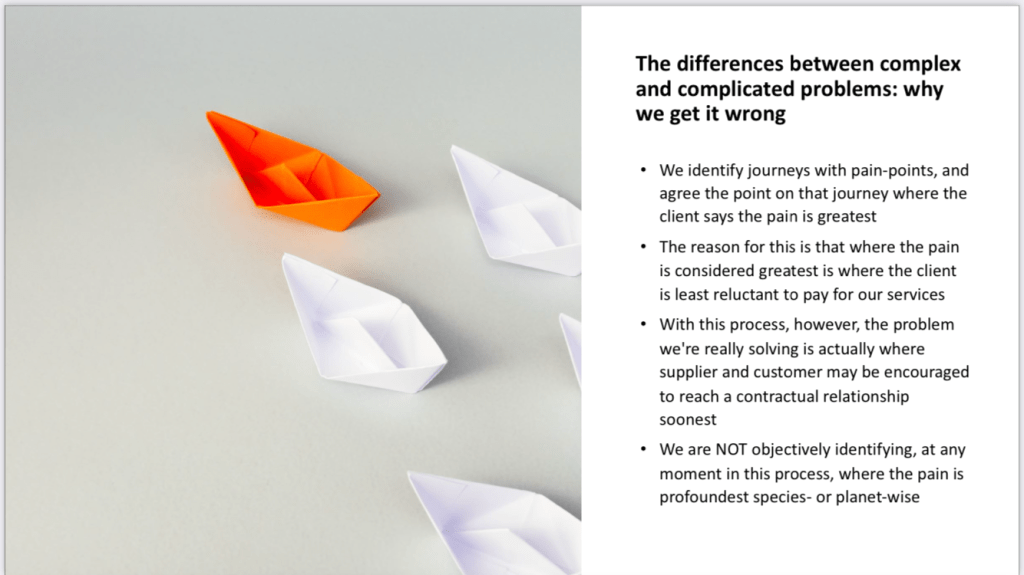
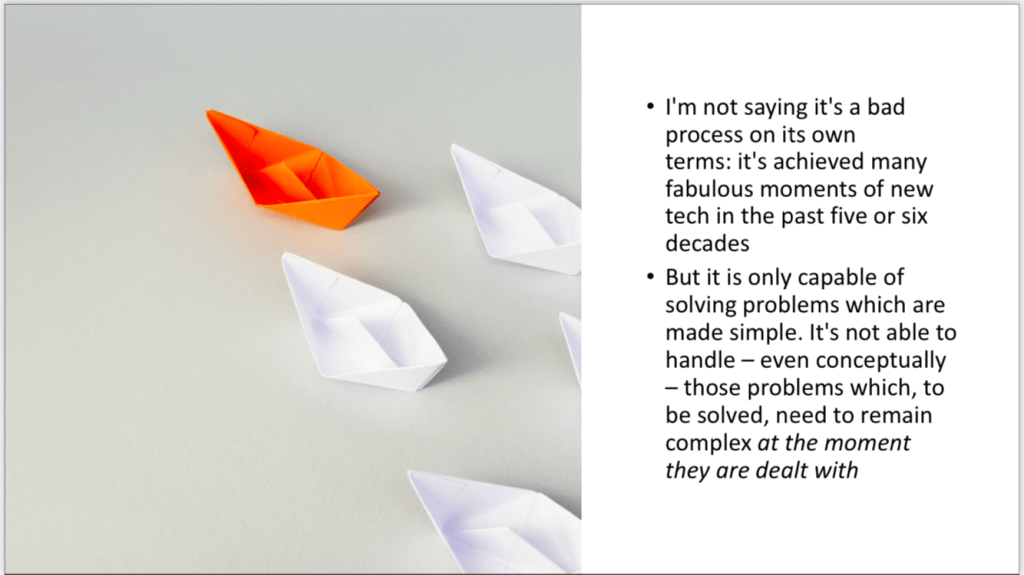
But I want us to solve a complex problem with complex thinking and outcomes. I don’t want us to use traditional startup tools which insist we must simplify before we can solve, and which then mean we inevitably lose sight of this complex problem’s essence:

complexify.me


And:

www.sverige2.earth/complexify-roadmap

I’m aiming high, it’s clear: it’s the only way. The stakes are just this: babies bleeding to death from shrapnel that punctures their apartment walls as they sleep. Not the rain of drops of beautiful nature but the rain of death of horrible men.

My objectives … which I’d like you to buy into also

This is what I want:
1. I want us to have tech architectures that enable us to prevent history repeating itself.

omiwan.com/the-foundations

thephilosopher.space

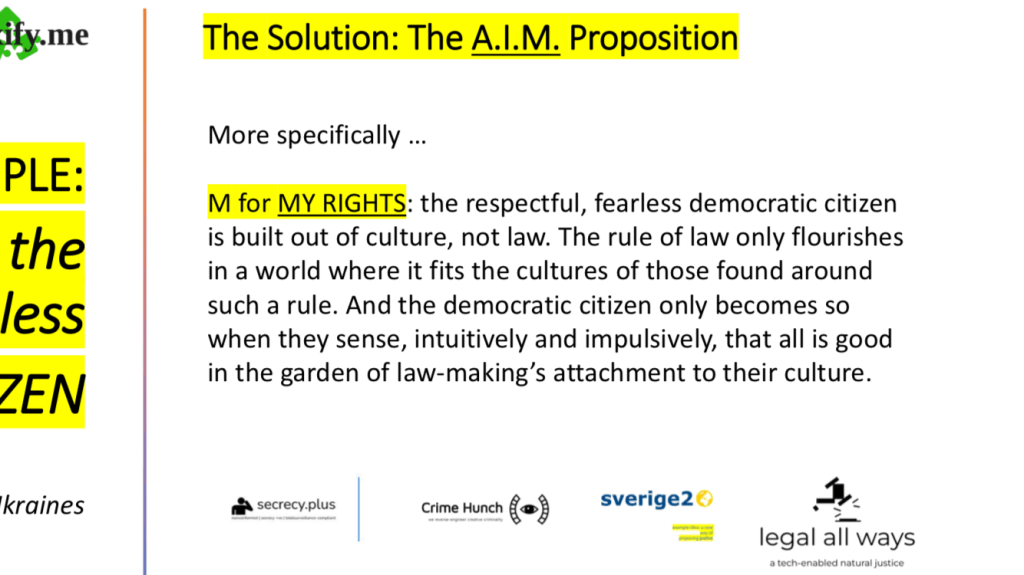
2. I want all citizens to become FEARless CITIZENS: it’s these sorts of citizens I want us to build.

mils.page/phd

3. I want a security which believes also in a very human sense of safety too.

4. And I want ALL our law-enforcement and security agencies to become rigorously legal in all their actions … in everything they do, even when covertly:

legalallways.com | www.secrecy.plus/law
What I believe in, then …

I believe in narrating inconvenient truths. It is my one foundation stone: the truth. I don’t believe in the relativism of post-modernism at all. The appalling and alleged “he says, she says” journalistic objectivity of organisations like the UK BBC leads to the fake news trumpeted by the likes of Trump, Farage, Johnson et al, as they achieve a ridiculous prominence with their ridiculous lies, via their being awarded equal dollops of public- and private-service airtime, whatever they assert.

How I want us to approach this “making it real” challenge

In the light of all the previous thought-experimenting, done precisely so as to avoid us building solutions for problems that don’t exist, I propose a different order to reach the goals I want us to deliver on one day:

Step 1: We start with the client, yes. But understood in their widest sense. We don’t ask what hurts them most and benefits us financially the easiest, with the quickest-to-invoice path we can think up. No. In the world the client inhabits, which is our world too when dealing with the complex problems I am asking us to debate, I want us to define and focus on what should’ve been solved generations ago. And most importantly, when we do:

“Kick into the grass ALL thoughts of HOW we might achieve such solutions. First, ONLY, consider ONLY whether the problems are hurting us all as badly as, for example, #ukraine is hurting everyone too.”

“Why?” you may ask.

“Because there is nothing that stops us more from achieving the impossible than by asking ‘how’. And nothing better to enable that impossible than focussing on the societal harm being committed over and over and over again … and then agreeing, of course, it’s now inconceivable to ignore it any more.”

Mil Williams, 6th August 2023, Stockholm Sweden

And it’s the client that provides the funding, not private investors.

Step 2: then we move to the research institutions, which will adapt to the requirements of a client that is not constituted out of their direct interests as money-generating institutions, amongst other important matters, but, rather, from the framework of the existent client that has emerged from Step 1, already agreed upon.

Step 3: if the client defined in Step 1 considers it safe for the overarching security and citizen-safety projects and workstreams under discussion to be opened up to wider investment, then we do so. However, big money has no national loyalties, as a general rule. So I suggest that the real due diligence that needs to be conducted will be on the provenance of the interested investors and their funding-pots, as well as their historical relationships — which will need to be audited closely, at start and on continuation throughout the projects and related workstreams — with countries and private interests that could easily be prejudiced by both the research I have already conducted to date as well as the work I would like for us to begin to deliver on together.

On societal forces which are actively destroying the agency of good human beings

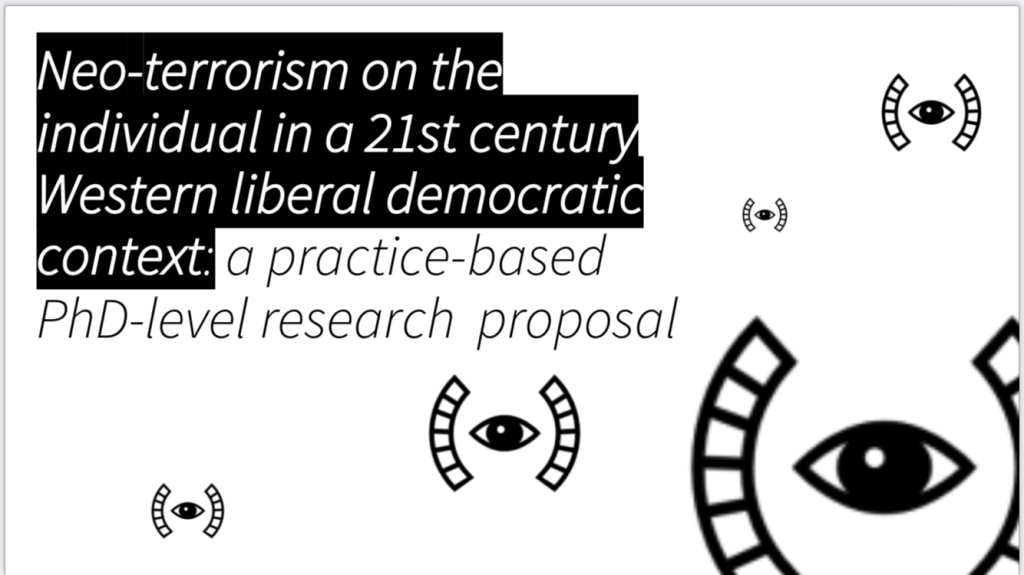
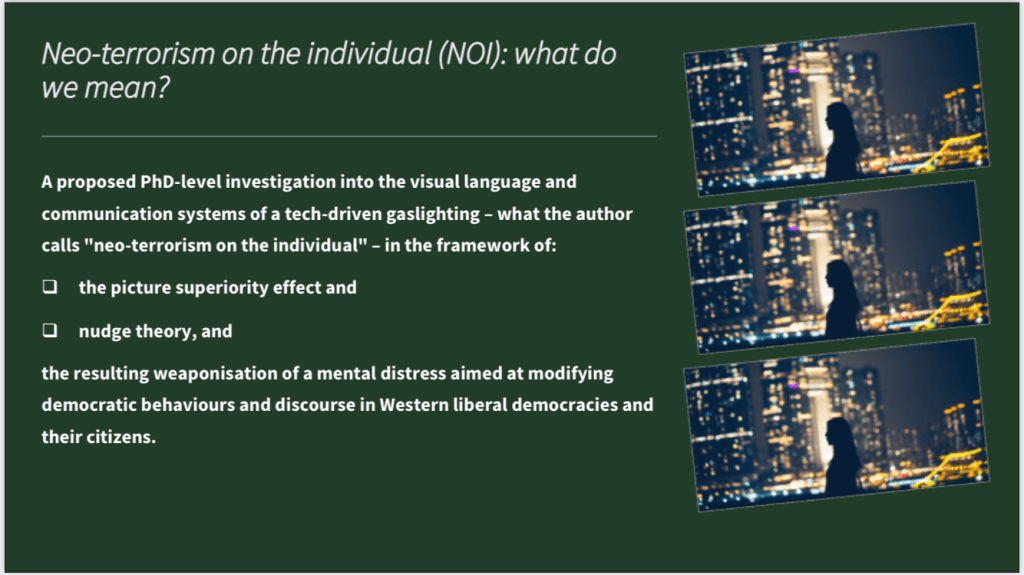
In all this, there’s the impact of #neoterrorismontheindividual (#NoI)– a #tech-driven longitudinal #gaslighting which I suggest firmly by now is being used in really bad faith by the parties I want to exclude from our work, so they can shape and structure our societies in ways that benefit them deeply and prejudice democracy — that is, ourselves — profoundly:
omiwan.com/the-humans


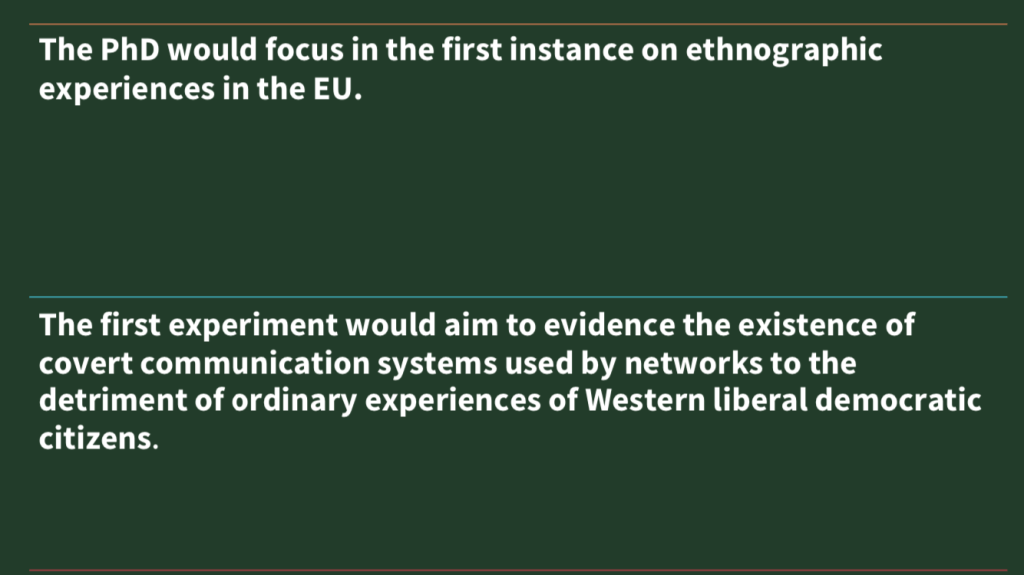
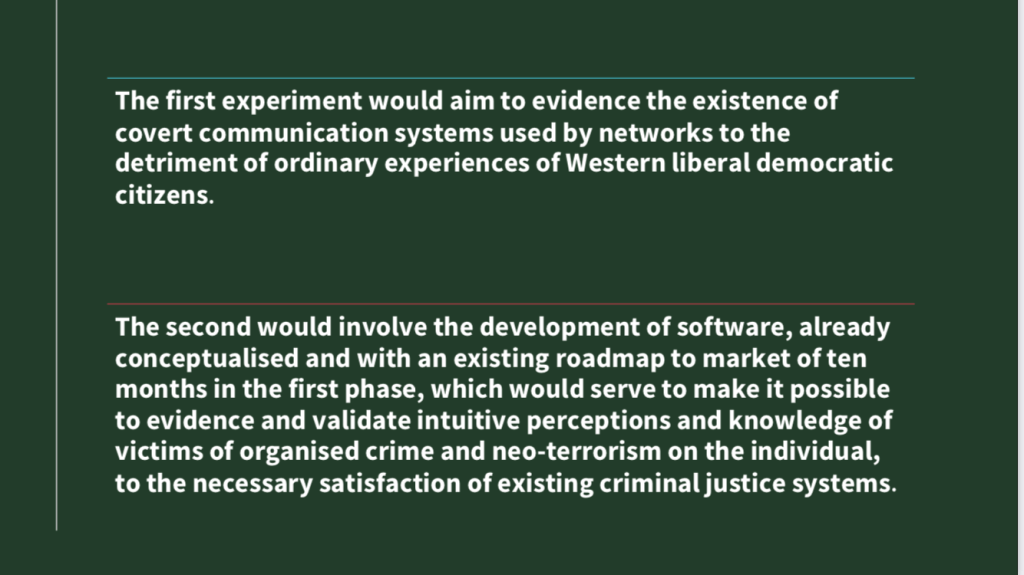
Linked to, then, from a few years ago, my draft #phd proposal in text form, and in respect of #NoI.

It’s not a project which needs doing now as a piece of research, but it should become — in a more developed form — an instruction manual whose lessons need to remain front-of-mind for anyone who works with us from now on in.

Because to destroy human agency — to give the impression one is predicting the random future when in truth one is scoping and delivering an artificially designed and beneficial future for limited and very private interests (NOT the same as prediction at all) — is actually evil: and it leads to #ukraine and a whole bunch more of actions we could all do well without.

Conclusion:

Meditating as I have been today, this is what I have come up with.

And I’m open to discussion now, of course. In the real world, that is, of compromise and even fudge. It’s better to do something good even if it enables, still, some evil — when it didn’t need to enable any. Because we can’t always do as well as we ought to: we don’t always do as well as we should.

Yet this shouldn’t stop us from trying, now should it?

Let’s shoot high. Can we?

Let’s …

www.sverige2.earth/overview

smotherland? how DARE you …

i have been racking my brains: what’s so different here in stockholm? why does the concrete feel so human? why do the humans feel so different? why is there such a sense of purpose — even when the purpose is not to be all that purposeful?

what does make it happen, after all? something tangible, i ask myself. something i can point to and show you how.

and so i realise, just now, two things which become quite clear for me. one i experienced one summer, decades ago in the northern spanish city of burgos: a continental climate and hot even 800 metres up. at least during the day. so everyone left the city in summer: to climes where you didn’t survive the weather but could thrive instead. the seaside, maybe. yep. there for example.

but i had to stay behind for work that july. and suddenly i had this sense of being at one with my environment. what was it? what was different? what had changed?

it was easy once i tumbled to it: everyone had taken their cars with them. not just that they weren’t there to drive them around: the cars themselves weren’t there to intervene in the visual landscape, and distract and divert and impact on your psyche, even when only subliminally; and then again, even hurt some of us because of a still undiscussed neurodiversity … and all as a result of their deliberately engineered capacity to attract our attention inescapably with covert ingenuity.

here, today, then, in central stockholm, there are two things which tangibly make me feel at home. the first is an absence; the second being a presence.

the absence, first:

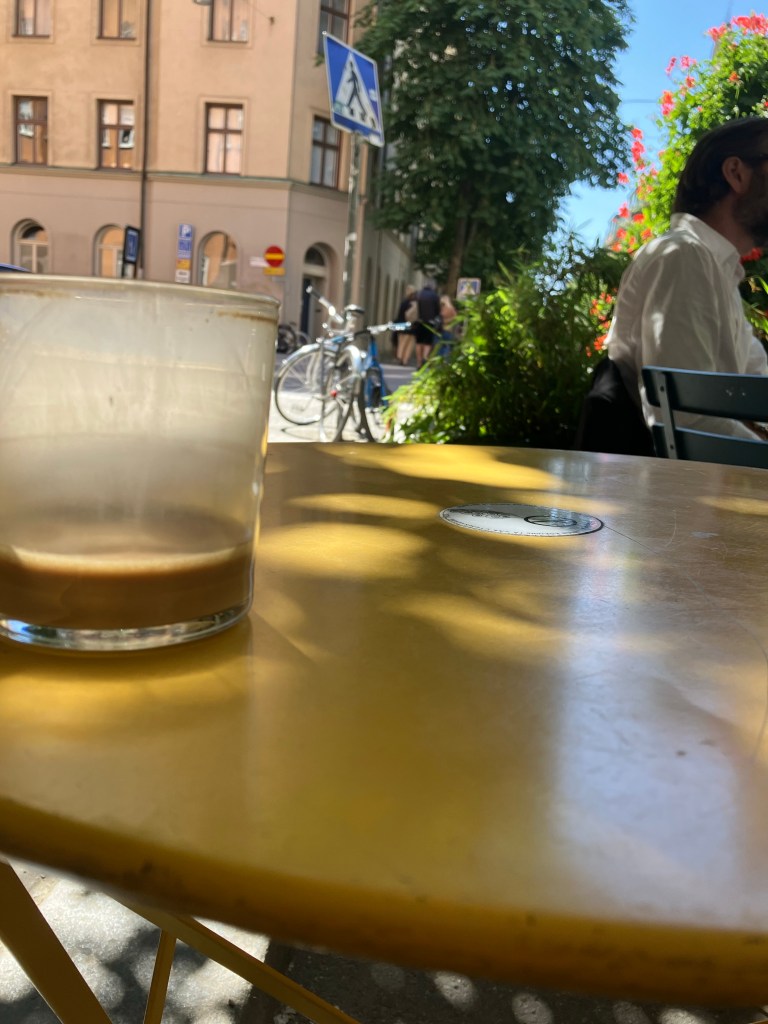
  • no cars. very few anyways. no need for cars. just people using their legs. do you remember legs? remember what that was about? no. not the clutch and the accelerator. the pavement and the kerb and walking the line … and the dance.

the presence, second:

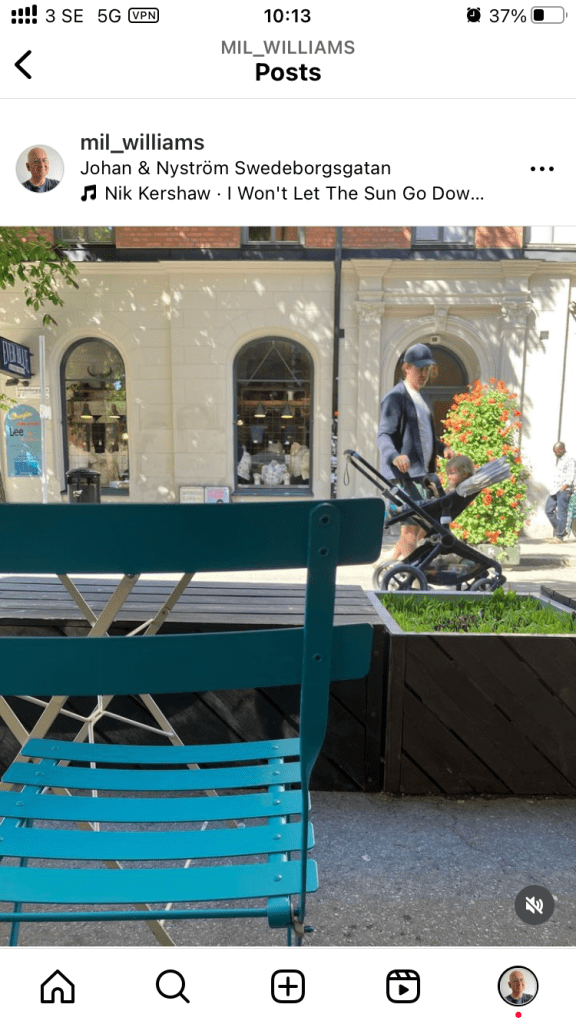
  • so many young people and children and elderly and other. and a young man with a boom-box, and then the coffee-drinkers on the terrace across the road smiling in recognition of their own youth, perhaps; and smiling, all the same.
  • and then bikes galore and bio-diesel buses, and trams and stuff, and within five minutes walk an underground and a commuter-train network.

so: this is purposeful living which liberates not suffocates. and don’t believe the anglo-saxon right-wing when they say sweden equals “smotherland”. what they say when they do … it’s utter bollocks.

more than any country i’ve been to, this is an intellectually, emotionally and socioeconomically free society. even today. even after everything we’ve all been through. even after what they think they have lost to a better past.

imperfections? for sure.

on the scale of other countries flaws and injustices? no way, josé.

just one example from the uk to illustrate. many years ago, foodbanks arrived to ameliorate real pain. a conservative minister even praised the fact: community coming together. she (i think she was a she but she only voiced what all her party, mainly men, also preferred to assert) … well … she could’ve said how terrible that they were needed in the first place. but she didn’t.

last year in the uk of johnson & co, it was warm-banks for those who couldn’t afford both food and central-heating.

and so this year, gordon brown, the ex-british prime minister, informs us of hygiene-banks: for those in the uk who already share toothbrushes, can’t buy toothpaste, and who find that sanitary products for women just ain’t something they can contemplate:


so DON’T tell me “smotherland” EVER again, when you discuss the fact of sweden and its ways of seeing and doing stuff. because if you do, if you dare to, you just really have no idea what you’re saying … no idea whatsoever.

and that’s a tangible fact for sure.

as tangible as the weekly death tolls that add up year after year, at the hands of the gun-holders who terrorise good american citizens in the name of spurious constitutional rights.

On the “Complexify Me” and “Complexify Me Holding & Lab” proposals

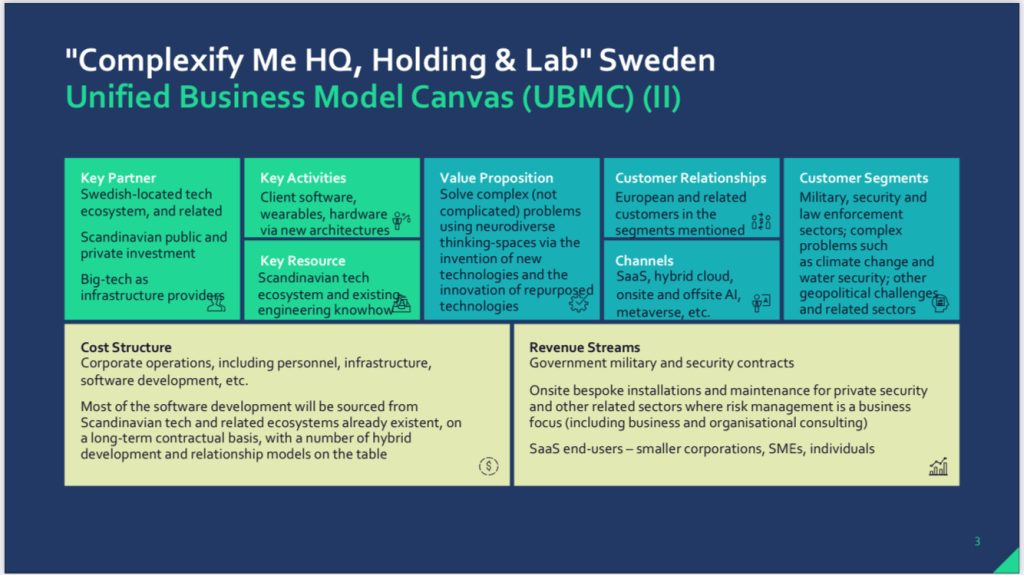
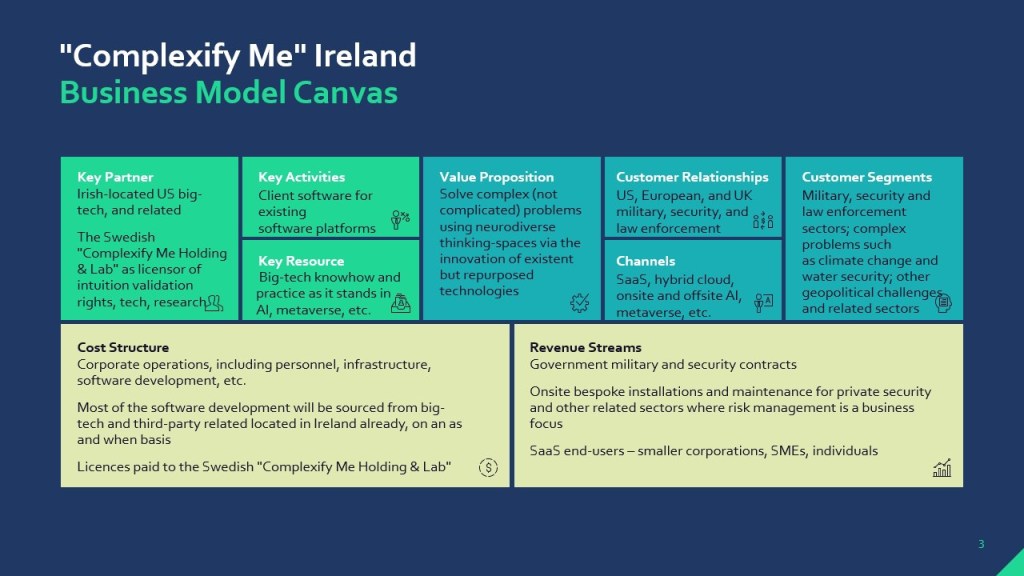
I’ve been progressing my projects recently quite a bit. See the two “business model canvas” drafts below as one example:

One observation I need to add as per the following updated sverige2.earth homepage — Ireland and Liverpool UK may now form a co-location for Workstream A with its associated AI innovation (though not invention) processes:

As you can see, Irish-located big-tech would provide circular-economy hardware lifecycle delivery and management, whilst the cloud that would sit behind an agnostic cloud management services dashboard, also located in Ireland, would itself be located in the Nordic versions of US big-tech cloud services.

Finally, in this first corporate relationship, the responsibility for AI innovation (though not, as already observed, invention) would be that of existent Liverpool AI organisations and institutions.

*

Meantime, I’ve finally been on the serious hunt for a funding flexible enough to allow me to locate in two or three countries without being imperiously tied to one. The latter has always been my objection to the UK-based government funding streams I’ve been offered: zero intention to promote ties with other countries that don’t purely involve selling to them, with no collaboration contemplated at deep levels; no transfers of technology, knowhow, or business models; and nothing, really, that talks to me of open doors, whether intellectual, technological, or even simply business-related. And this was before Brexit.

As a result of all this, I’ve now found a funding-pot foreign to UK government and agency approaches which will, if awarded, allow me to capitalise on my existing UK-based ltd company structure, establishing myself in Ireland simultaneously for what I mentioned above already that I call Workstream A, alongside a filtered Workstream B; and then taking the next step to set up a Swedish AB as Holding and driver of the Intuition and Neurodiverse Thinking Lab I want to be my direct responsibility and end-of-life work, covering off the pure research and invention that will form the basis of Workstream C and Workstream D.

This funding stream I have applied for just yesterday would enable all of the above to be kickstarted into the life it should’ve had already years ago. And I now exclude no one: simply include everyone with starting-conditions I will be firm about, it is true; but that once agreed I have no intention of us changing, ever.

Below, then, as a flavour of the tenor of my thinking, the video I was asked to make for the funding submission described above:

“Complexify Me” and “Complexify Lab” funding submission video

This video now forms part of this submission for funding, the initial decision on which will be taken by the organisation in question in June 2023.

*

Useful further reading:

Enjoy!

🙂

Oh, and have a safe Sunday … yeah?

Why a data-driven world isn’t everything in life … and why it’s important we understand this much much better

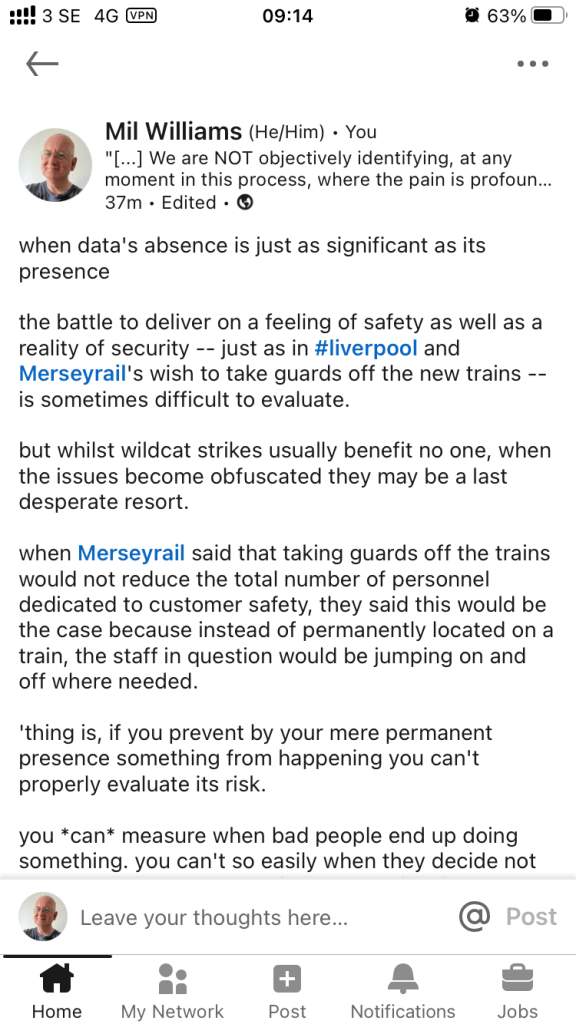
The real nub of the issue is this: in the absence of data, we can only use data that is present. Here, it’s clear when someone commits a crime and we catch them after the event with a certain number of mobile train security personnel on our payroll. That’s measurable: the ratio of events to arrests, for example. What’s not measurable by automated data science and analytics half so easily is when something doesn’t happen because a permanent guard is present to act as deterrent.

Mil Williams, Stockholm Sweden, 21st April 2023

Introduction:

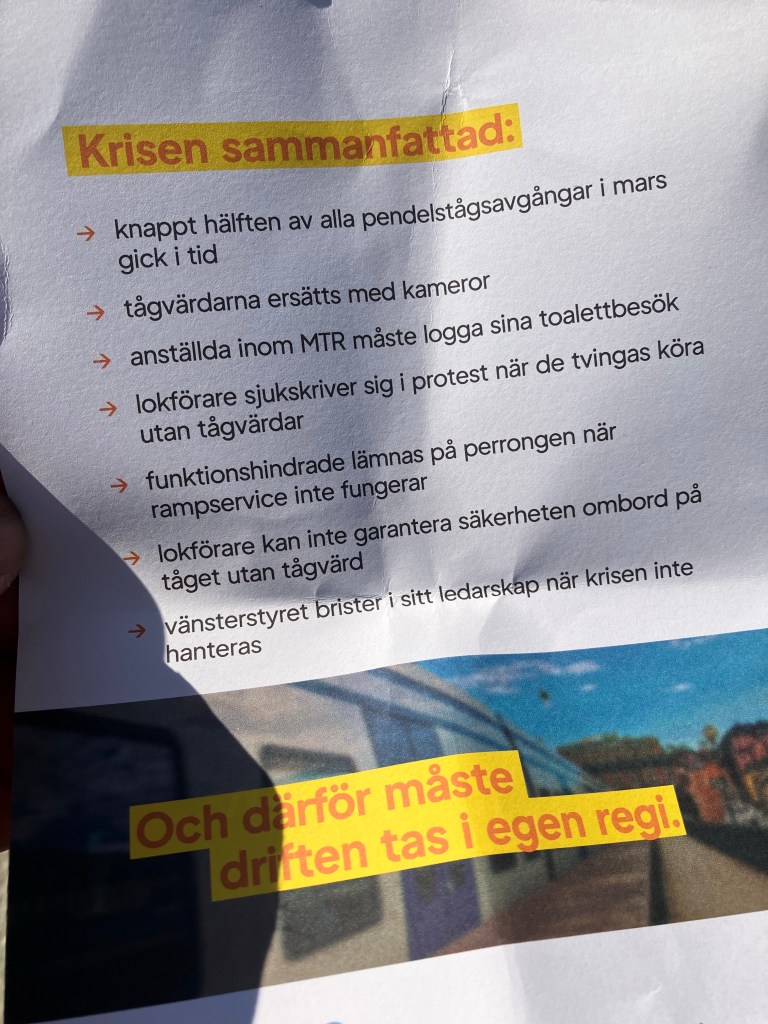
There are strikes on the commuter trains — the otherwise fabulous pendeltågs — here in Sweden: even the occasional wildcat ones. The frustration is patent: more so, because the strikers are right.


This is why:


An aside:

As a brief by the by before I continue, I think the train companies are able to claim the numbers of security and safety staff would remain the same, and yet still want to go ahead with it all, because they’re changing the type of workforce: you still need to go through with rightful and rigorous measures to vet and upskill non-train guards of all sorts it’s true, but with a train guard it’s less easy to change and chop their working locations, conditions and so forth. Or outsource the workforce, even. Change overnight who employs them and how.

No?

So …

How a data-driven world can deceive:

The thing is, here we have a perfect example of when a “data-driven world” actually needs academia more than it needs an automated data analytics and data science as we usually understand them.

The train companies in Liverpool and Sweden both I am sure will have had long-term strategies to re-engineer the structures of their employees and related re in-house and outsourcing options, and whilst taking guards off the trains in the circumstances described wouldn’t deliver immediate economic advantage, as indeed they underlined in Liverpool for sure, long-term if I’m right it definitely would.

The real nub of the issue is this: in the absence of data, we can only use data that is present. Here, it’s clear when someone commits a crime and we catch them after the event with a certain number of mobile train security personnel on our payroll. That’s measurable: the ratio of events to arrests, for example. What’s not measurable by automated data science and analytics half so easily is when something doesn’t happen because a permanent guard is present to act as deterrent.

And this is the challenge here. It really is a challenge around what we do when the evidence base is incomplete: that is, how it leads us to take quite the wrong decisions.

To the solution:

There is a solution too; I alluded to it above. Straightforward academia gives us tools to codify absences, in for example qualitative data such as an interview transcript or video, so that what isn’t said is as significant as what is.

If we could create an equal set of tools for strategic decision-making when deciding if to take train guards off trains or no, perhaps we would avoid the strikes we’re having everywhere: and at the very least, we could validate, in a less conflictive way, the common sense most users of public services have that a “bobby on the beat” engenders an incomparable feeling of safety even where a car in the neighbourhood can be evidenced to deliver on objective data relating to quantitative crime events.

Summarising:

In crime and public safety, what doesn’t happen is as important as what does: and the “why” of both these matters, too.

So.

Let’s do something after the evidence bases for both aspects of the truth: that which has a visible side and the invisible events as well.

And then let’s achieve delivery of these aspirations sooner rather than later.


Further reading:

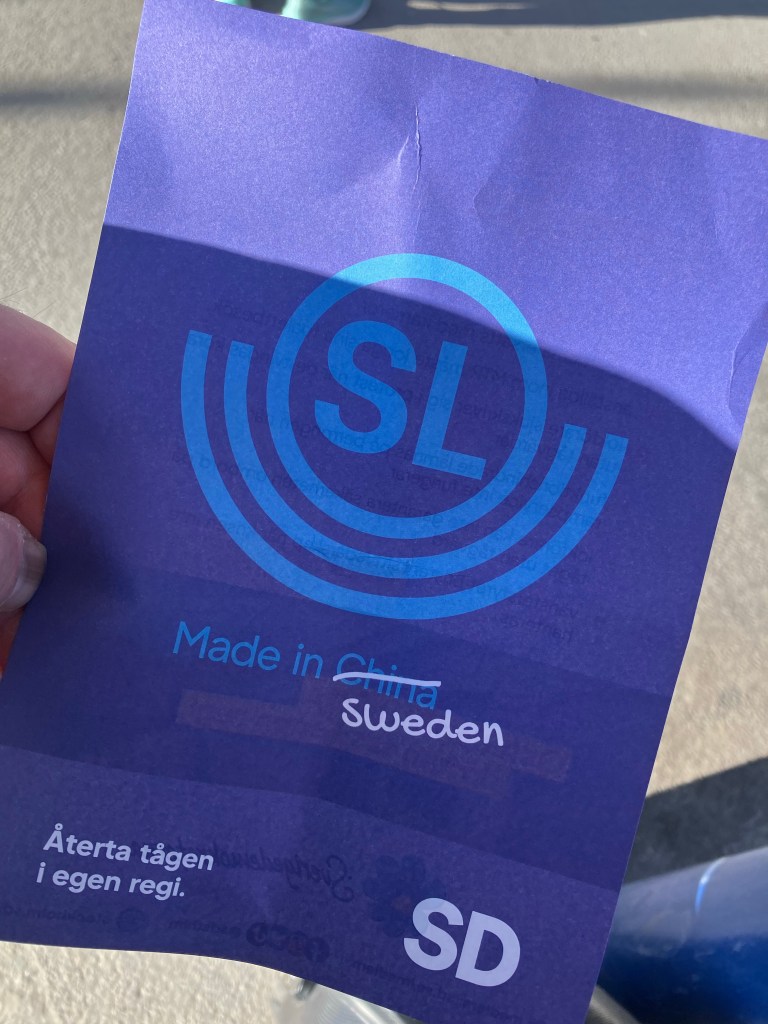
https://en.wikipedia.org/wiki/Sweden_Democrats

Another by the by: the promoters of today’s information are a further example of why we should act on the basis of what is not visible, as well as what is.

The Sweden Democrats started out as fascist and redolent of nazism of the very worst sort — at least according to the English version of Wikipedia. They themselves claim to have re-engineered their political DNA, which is not impossible but highly unlikely. Even so, medical professionals claim bespoke DNA of the human kind is very close to becoming a reality now; so we could argue that in politics it’s not unthinkable any more.

Let’s just say, however, for the moment unlikely and hard to do.

So. The risk from relying on present datasets instead of datasets relating to both what’s present and absent too? We allow people to hijack in bad faith what needs to be promoted in good faith.

The train personnel are right. Guards on trains deliver safety and security. This Swedish political party — in the current security conditions which China and Russia together have been stealthily laying out for decades together — are also correct to highlight the dangers of such, separate, narratives.

But they are wrong to a) conflate two issues like this; and b) lever the abuse and violence of both nation-states and their outliers in the fields of geopolitics to then promote an immigration narrative of their own re Sweden which delivers total obfuscation of our all too human reality and a zero confusion around their racist truths. Unless you choose to remain confused.

Sometimes it’s right to be firm: China — not all Chinese people — is a toxic regime. Putin’s Russia, too, has absolutely no redeeming qualities. But firm doesn’t mean we have to give fascism a place at the table of a wider collective progress.

Don’t besmirch the truth of the train staff by taking political shortcuts. And if this is what changing your political DNA leads to, change is what clearly you are NOT delivering.

Just occurs to me, too: even more reason to proceed with #intuitionvalidation.

how a characteristically swedish approach could deliver a different take on #complexproblems

so #it-#tech must come afterwards: it must come when the rest of us have designed the problem as robustly as we can without knowing if what we design is practical or not. only then will we not censor our ideas whilst we still have the capability to be ambitious and aspirational: only then will we only think of the real world.

mil williams, stockholm sweden, 16th april 2023

from my iphone’s notes app just now:

i’m open to being hired as employee or consultant or business. any of; any combination of. all too.

absolutely.

if it means i can stay in #sweden but not have to do it with the traditional kind of simplifying and incremental #tech ecosystem … well, then yes. even more so.

because i’m defo NOT looking for that if i stayed here. i’m not looking for it anywhere. wherever we took the #hq.

the #hq is a starting point but not an envelope of participation, anyway. we do live in a hybrid-working and effervescently connected world.

but i get the concerns, too.

now.

i still think best process would involve, first, an empathetic #consulting organisation; only after this, a single #tech corp (once the problem was scoped by us, i mean); and finally, an intimately connected #security complex and infrastructure, too … but always, in this field, independently managed by the country’s own existent domain experts. me only ever going so far as delivering a participation that consisted of being a consultant, ever.

if a #tech ecosystem of local and regional is preferred here, or anywhere else, it must be absolutely and heavily vetted to filter out those people and companies who won’t see/can’t see the virtues of the different architectures i am proposing. this we could do on the basis of historical behaviours and pronouncements; products and digital service rollouts over the years; and other data which could help us drill into company and individual cultural dna.

because i’m not prepared to accept intellectual and technological trojans into the projects and workstreams. and i recognise them easily enough these days, when i meet them. so no pulling any wool over my eyes on this. on other matters, maybe still. this, no longer.

i need to be firm in this. i really do. you will probably never understand why: but here i don’t budge. not any more.

and so this is why i’d prefer to scope with a #nontech ecosystem before going to #tech partners, in order to only then finally begin to implement.

so this is what i propose (though i am always open to evidenced counter-proposals):

1. a chosen #tech partner — a single organisation or a vetted ecosystem — can start by implementing already drawn-up specs, created outwith their thinking-spaces; just as liverpool did for me back in 2019, with almost fabulous effect.

2. only once they understand and embrace emotionally and intellectually the new #secrecypositive ideas, and the consequent #it implications, do they then start to have the right and duty to input at deeper and more conceptual scoping stages.

if you want to do a #consulting corp in #sweden for example, that’s obviously good and in line with my existing ideas.

or any #swedish entity in any endeavour which is not #it, of course …

yup. this as well. (engineering and most manufacturing and retail are now #tech too, but not #it-#tech for example).

so #it-#tech must come afterwards: it must come when the rest of us have designed the problem as robustly as we can without knowing if what we design is practical or not. only then will we not censor our ideas whilst we still have the capability to be ambitious and aspirational: only then will we only think of the real world.

• first we design the problem. always. the real problem

• it’s NOT NOT NOT going to slide into being “how to get paid soonest”

• it’s going to be how to reverse climate change. that’s the first #nontrad #security #complexproblem i want to deal with. that’s what will be my day-to-day. and i want citizens who don’t know what’s impossible to achieve to be scoping the envelope of the necessary over the possible

and that’s then when #tech comes in and starts to implement. and once it sees our new #neurodiverse #software and #hardware architectures work in practice is when it will also get freely enthusiastic about a totally different panorama from the #neurotypical #it they so firmly and universally believe in atm.

and so that’s when — but only then! — they’ll also be able to deliver #neurodiverse principles in their praxis. equally deeply as we will show ourselves capable of delivering in problem design. and so then, equally convincingly.

without reluctance any more.

without back-pedalling at all.

without thinking the problem needs to be reduced stealthily to how to get paid above and beyond how to save the species.

mil williams, stockholm sweden, 16th april 2023

#ai: a #neurotypical #it to the max?

if i work with a big corp, it must be a free-thinking big corp capable of having its own, totally independent, criteria in respect of innovation

mil williams, stockholm sweden, 15th april 2023

introduction:

i’ve begun to re-strategise how projects like #complexifyme might reach direct clients:

  • first, identify convinced #neurodiverse company cultures where such thinking processes are already considered potential — or actual — skillsets
  • second, filter in those organisations that already evidence, publicly and proudly, innovation criteria clearly independent of those big tech partners might offer
  • i’m talking here of following what we might term the “ronald reagan approach”: go over the heads of an establishment and speak directly with an interested set of parties
  • finally, address such potential clients’ existent concerns in relation to whether the implementation of current #it-#tech serves their #neurodiverse business cultures, philosophies, beliefs and evidence-base

why this proposed approach:

this is the conclusion i arrived at yesterday: “if i work with a big corp, it must be a free-thinking big corp capable of having its own, totally independent, criteria in respect of innovation.” that is, be its own jury passing an informed and independently sophisticated judgment on what the tech barristers are laying out as the truth.

and then, via a final judge also independent of such process, deliver a final, robust and game-changing sentence.


meantime, is the above — as i assert — really true, do you think?

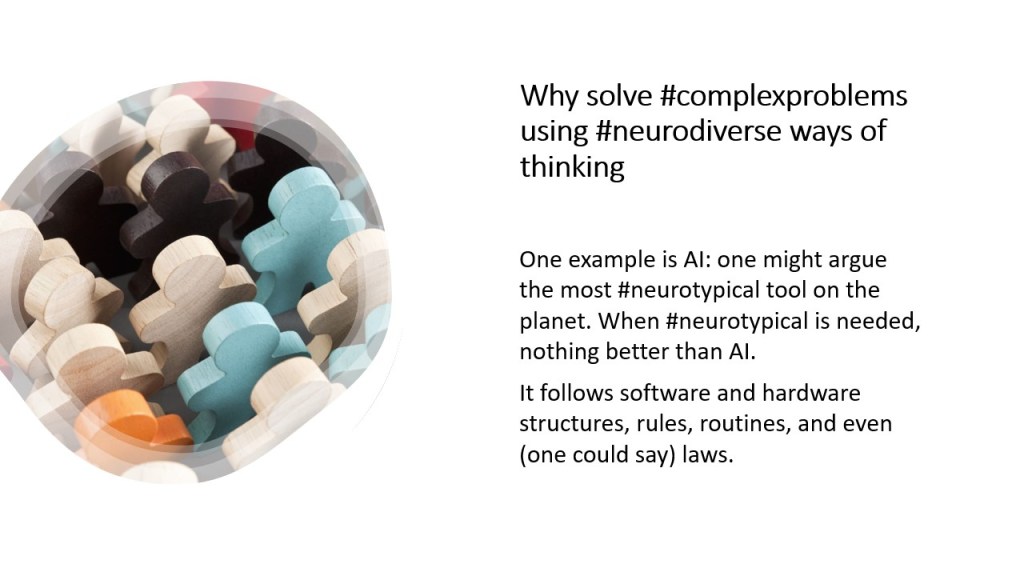
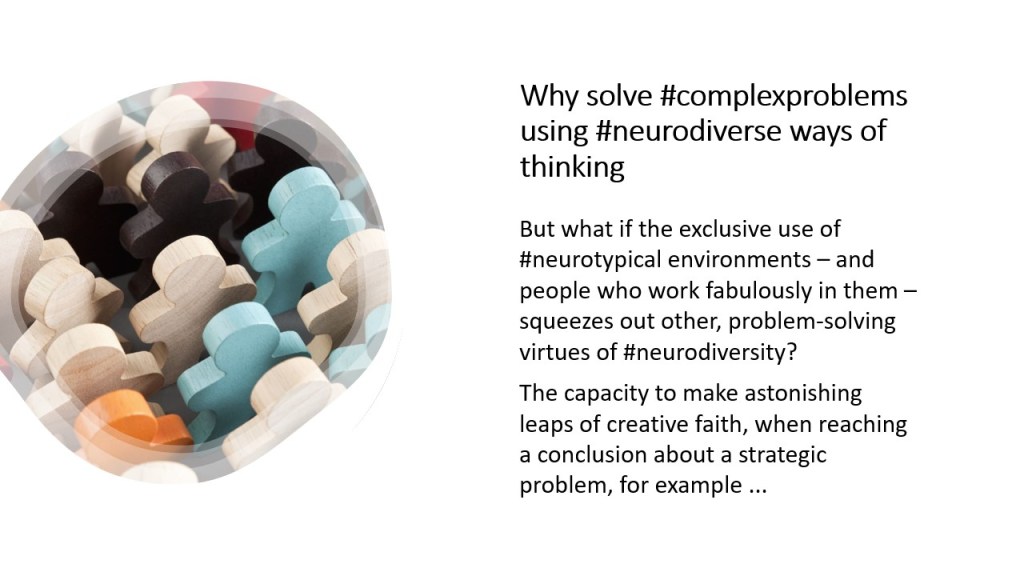
is #ai probably the most #neurotypical construct in the digital world? and given its widespread use, what does this mean for the problem-solutioning space we offer #neurodiverse thinking and their thinkers?

before you answer the questions posed, look at the example roadmap and its rationales below:


full presentation here:


summarising:

so. what do we think?

is #ai actually — in its broadly accepted automation implementations, at least — the most #neurotypicalising modern tool currently being used by humanity … and maybe misused at that?

complexify.me: an example roadmap

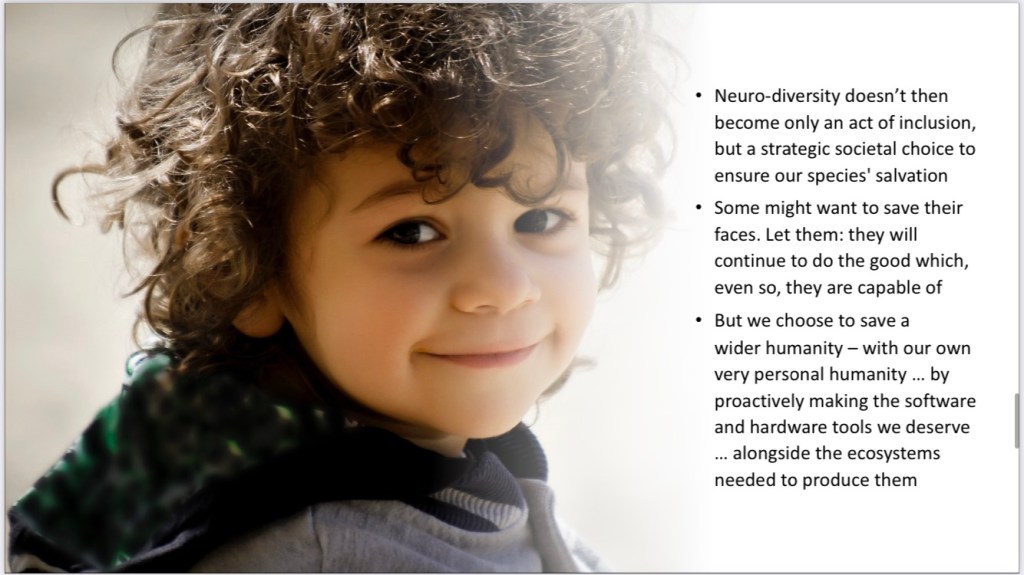
how #neurodiversity can save our humanity

yep!

just that … as i move from considering #lawenforcement and #security to the wider challenge of #complexproblems which may already be affecting our very survival.

which is not to say the first two don’t, but my thinking now assumes that if we can crack #complexproblem-solutioning first, we’ll then be in a position to give those in #security and #lawenforcement the opportunity to access such tools in a freer and more “pick & mix” way, which then may be far more suitable for their specific domains and wider ways of thinking than all my thought-experimenting has been to date.

the presentation itself in image and pdf formats

the presentation itself can be viewed below as a gallery, and can be found in downloadable pdf format here: